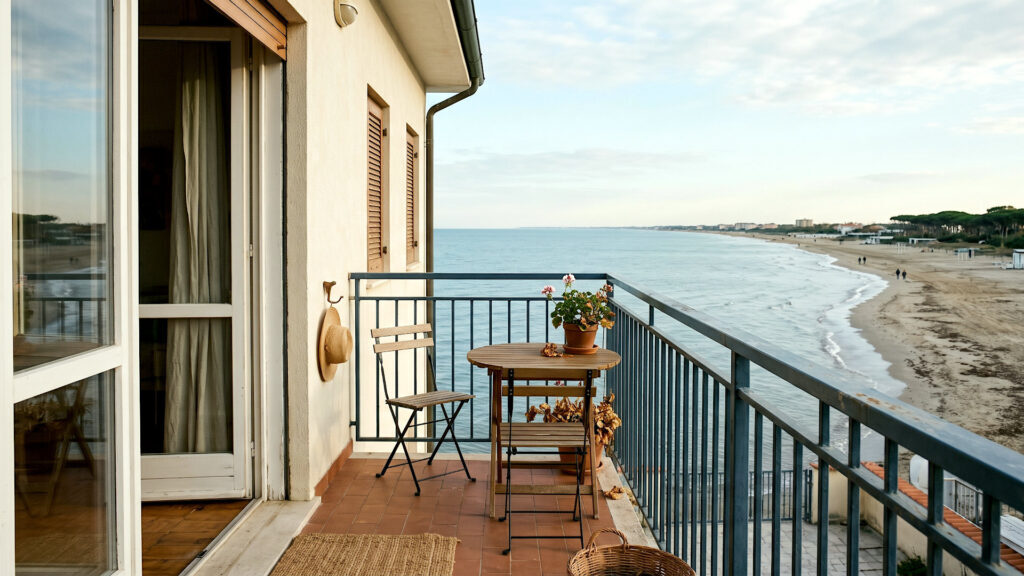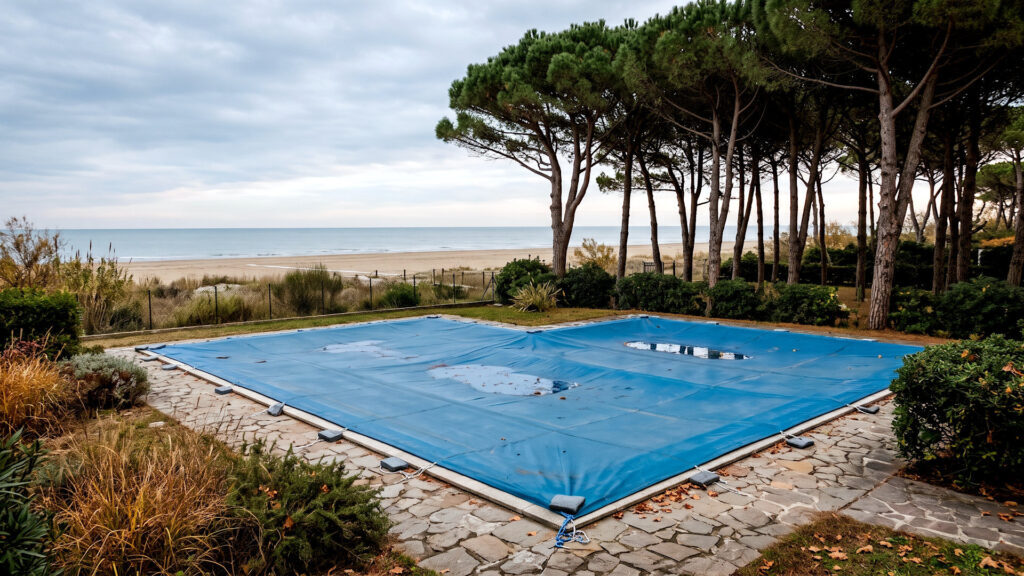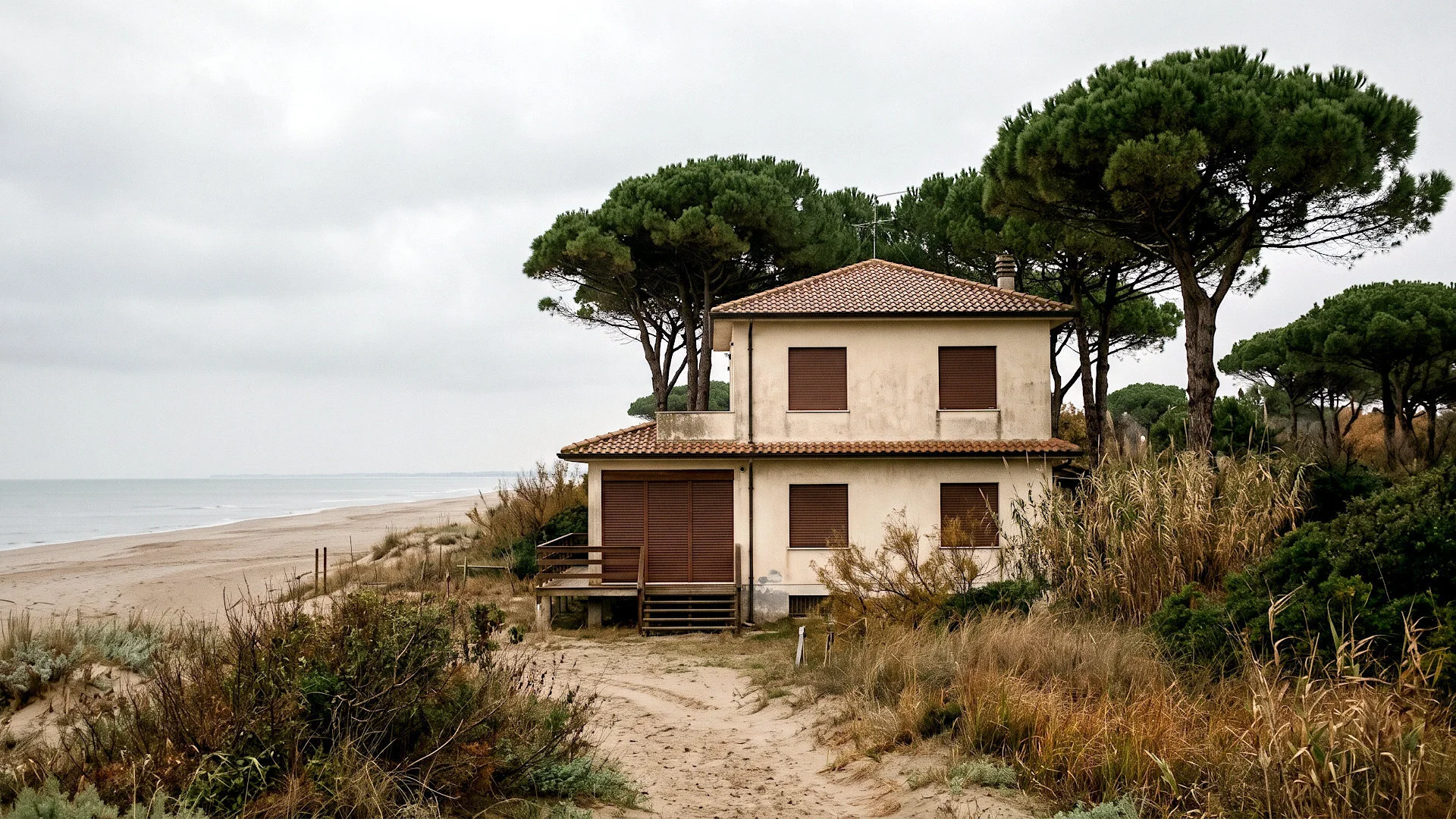
At the end of October, Eraclea Mare changes face. The roller shutters come down one after another, the car parks in the pine forest empty out and the houses stay shut until spring. For a good five months the home is left on its own: a window that comes open, a dripping tap or a roof tile shifted by the bora, the cold north-easterly wind of the upper Adriatic, all wait for spring.
In April, when you reopen, the first thing you do is turn the water valve. If the October closing was done properly, nothing happens. If it was done in a hurry, the water finds the path the frost prepared for it over the winter, and you discover it on the floor or, worse, on the ceiling of the neighbour below.
In this guide I explain how to close up a seaside home for the winter, item by item: water, boiler, electricity, damp, insurance, deadlines. For every action you will find the reason behind it, because a step you understand is a step you don't skip the following year. At the end there is the complete checklist, to print out and keep next to the fuse box.
Why a home closed for the winter is at greater risk than a lived-in one
A lived-in home defends itself, because someone notices. A closed home has no witnesses: a small leak works away for weeks, damp rises with nobody airing the rooms, a pane broken by the wind stays open to the rain until March.
The coast adds two opponents that weigh less in town. The first is the damp cold of winter nights, which on the coast can bring frost into pipes that have been left full. The second is the salt air, which even in winter works on railings, hinges, locks and the outdoor units of air conditioners.
Then there is an aspect that many owners only discover when it matters. Article 2051 of the Italian Civil Code states that everyone is liable for the damage caused by the things in their custody, except in the case of an unforeseeable event. If the home is yours and nobody else uses it, the custody is yours. A pipe that gives way in February and floods the flat below becomes your problem, even if you were two hundred kilometres away.
That is why the end-of-season closing is the cheapest way to avoid the damage, the argument with the neighbour and the claim with the insurer.
How to drain the water system before the frost
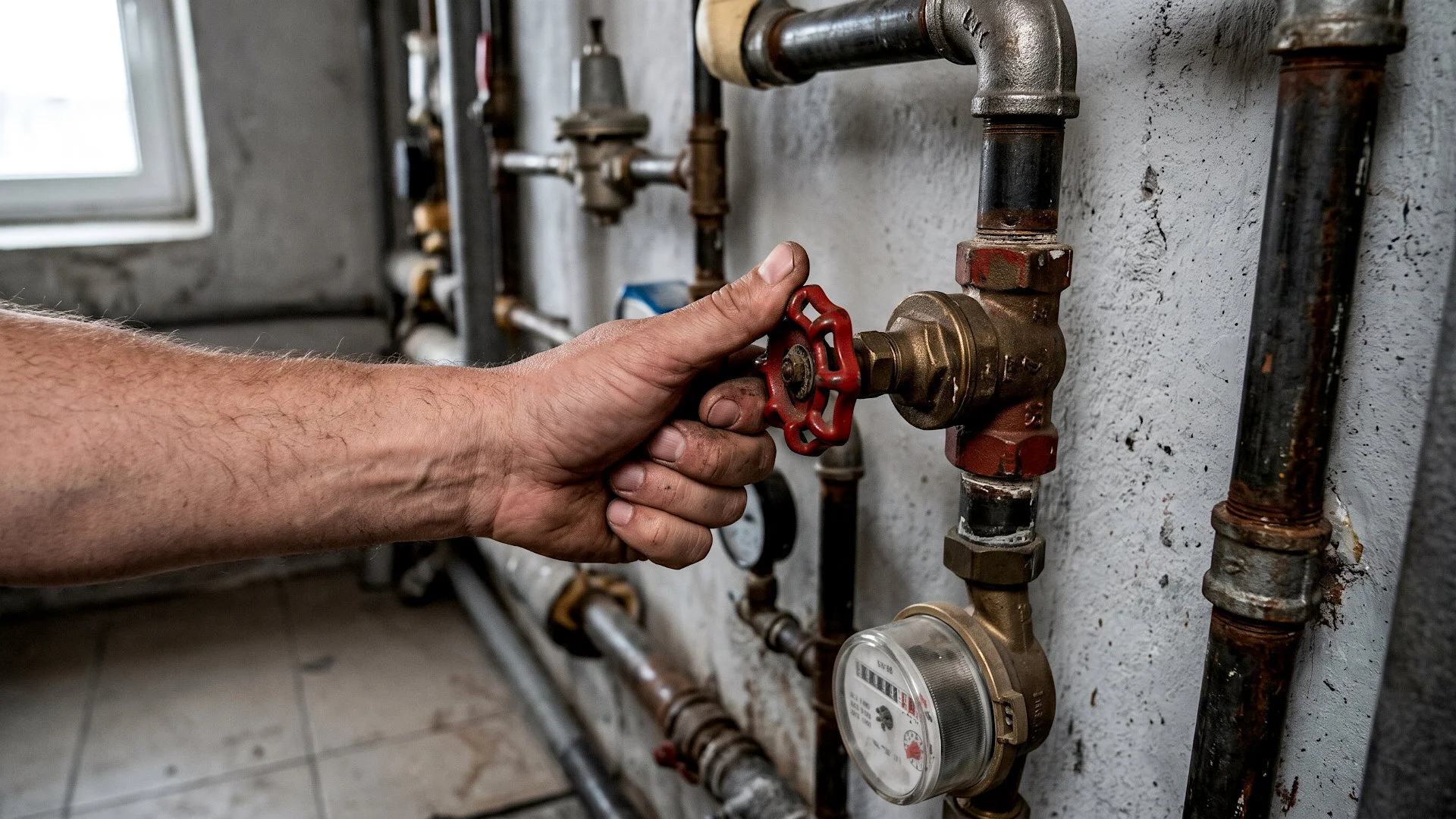
Water comes first, for a simple physical reason: water expands when it freezes. If it stays trapped in a pipe, a fitting or a flexible hose, the ice pushes against the walls and can crack them. The trouble is that in winter you don't notice, because the water is still and frozen: the crack only shows itself when the pressure returns, on the day you reopen.
Closing the main valve, then, is not enough. If the pipes stay full after you close it, you have only stopped the water where it can do the most damage. The right sequence is a different one, and it doesn't take long.
Draining the water system in six steps
Close the main valve
the one downstream of the meter, or the flat's inlet tap if you live in a block of flats.
Open all the taps, hot and cold Key step
basins, shower, bath, bidet. Leave them open until nothing more comes out: the pressure drops and much of the pipework empties. If there is a drain cock at the lowest point of the system, open it.
Empty the toilet cisterns
flush with the valve closed, so the cistern stays empty.
Disconnect and empty the washing machine and dishwasher hoses
a little water always stays inside, and their flexible hoses are among the most vulnerable points.
Close and drain the outdoor taps
garden shower, hose connection, irrigation. They are the most exposed to the cold.
Leave a note on the valve
write down what you closed and in what order to reopen. In April you will need it, or whoever reopens in your place will.
The electric water heater deserves a word of its own. If you have one, disconnect it from the power; whether to drain it or leave it full is decided by the manufacturer's manual, and on this it pays to ask the plumber who installed it. Think about the water meter too, if it is outside, in a manhole or in a recess in the wall. Protecting it from the cold with insulating material costs little and saves you discovering in spring that it needs replacing.
One detail I often see overlooked is the flexible hoses under the basins, the braided metal ones that connect the tap to the wall. They are inexpensive, can be changed without any building work and age faster than the pipes. If they are a few years old or show rust on the nuts, replace them before you close up.
Boiler and gas: what the law says if the home stays closed
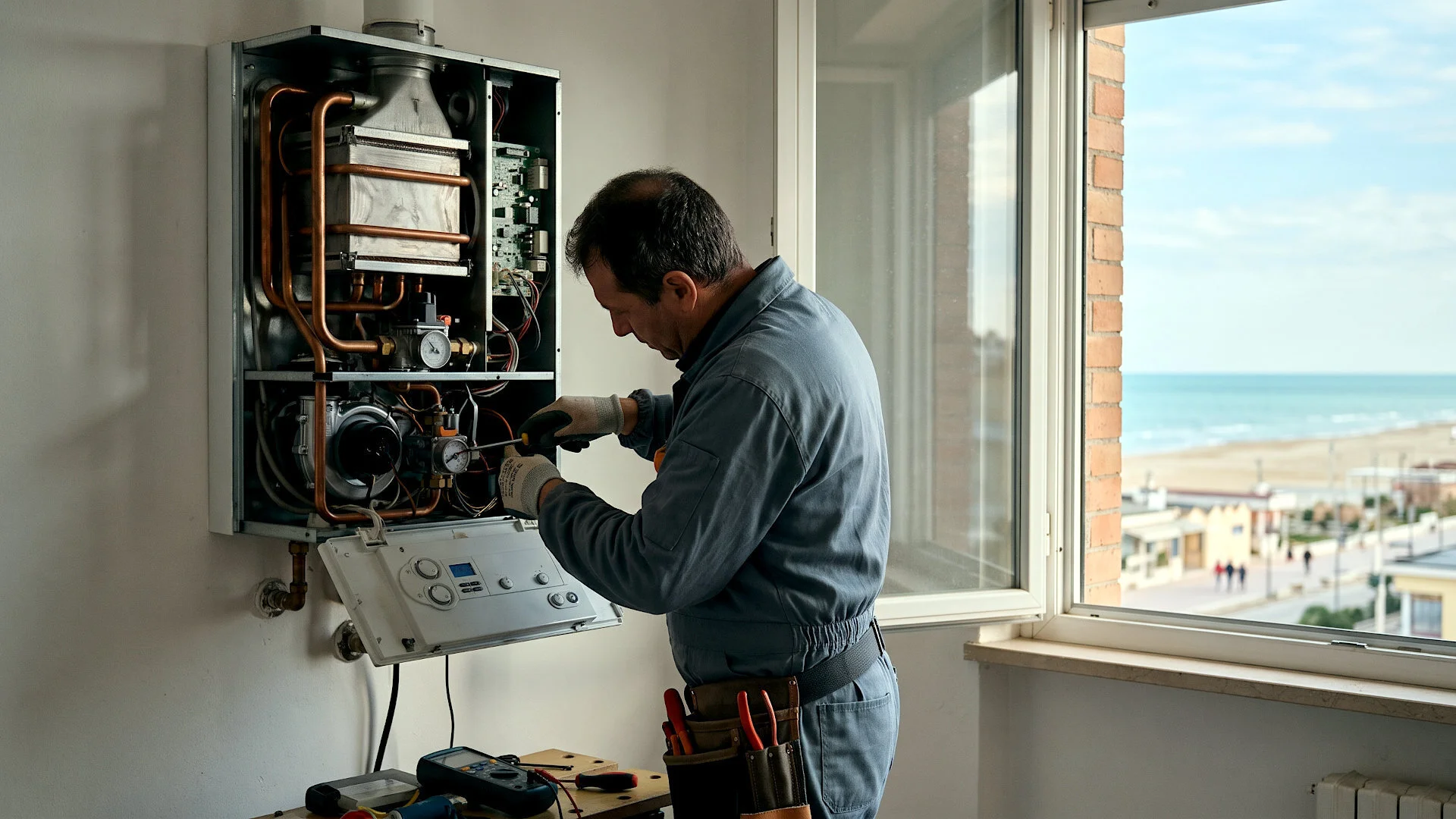
The boiler is where closing up for the winter meets a legal obligation. Article 7 of Presidential Decree (D.P.R.) 74/2013 says that inspection and maintenance of the heating system must be carried out by qualified firms, at the intervals set out in the instructions of the company that installed it. If those instructions are missing, the ones from the manufacturer of that specific model apply.
The rule, in other words, ties maintenance to the technical instructions of the appliance, not to the months in which the home is lived in. The maintenance engineer has to tell you in writing which operations are needed and how often, and everything goes into the libretto di impianto, the system logbook that every boiler must have.
Alongside maintenance there is the energy efficiency check, which many people in Italy still call the “bollino” (the sticker). For a gas, methane or LPG boiler between 10 and 100 kW, Annex A of the same decree sets it every 4 years. They are two different things on two different calendars: anyone who confuses them risks skipping the maintenance while believing they are compliant.
In a seaside home, the most convenient time for maintenance is often the end of the season. The home is still open, the engineer finds someone to let them in, and any spare part arrives before you close. Putting it off until spring means squeezing everything into the weeks when maintenance engineers on the coast are in most demand.
That leaves the question of what to do with the heating system over the winter. There are two routes, and the choice should be made with your maintenance engineer, on your system.
Boiler left on in frost-protection mode
Gas and electricity stay connected and the boiler, if it has a frost-protection function, switches itself on when the temperature drops below the manufacturer's threshold. The gas stays on, and someone needs to check that the boiler does not lock out.
What you get
- system full and ready for reopening
- a minimum of protection for the heating pipes
System shut down and drained by the engineer
The gas is turned off at the meter and the maintenance engineer drains the heating circuit, or protects it as the manufacturer specifies. In spring the circuit has to be refilled and brought back up to pressure by an engineer.
What you get
- no gas appliance running in the empty home
- no gas consumption over the winter
A warning about the first route: the frost-protection function only works if the boiler has gas and electricity. If in November you switch off the main switch just to be safe, you have also switched off the protection you were counting on. If instead you choose the second route, turn off the gas tap at the meter and add to the note on the water valve that the heating has been drained.
Electricity, fridge and appliances: what to unplug
The simple rule would be to flip the main switch and leave. It only works if nothing in the home needs to keep working over the winter. Before you do it, then, ask yourself what needs power: the boiler in frost-protection mode, an alarm system, a flood sensor, a camera, a dehumidifier.
If something has to stay on, the solution is to leave only the circuit you need switched on and turn off the rest at the fuse box, or unplug the appliances one by one. The TV, router, small appliances and chargers have no reason to stay plugged in all winter. A thunderstorm with lightning on a November night does damage even to an empty home. The guide published by ANIA, the Italian association of insurance companies, lists electrical damage among the risks covered by an optional cover, added to the basic fire policy.
The fridge has its own procedure, and skipping it costs you in smell. It has to be emptied completely, defrosted, cleaned and dried, then left with the door ajar: closed and switched off for months, in the dark and damp, it becomes a breeding ground for mould. The same goes for the washing machine, which is best left with the door and the detergent drawer open.
Damp and salt air: how to protect a closed seaside home
Damp is the slow damage of a seaside home. It breaks nothing overnight, but in spring you find it in the wardrobes, in the mattresses, behind furniture pushed up against outside walls. Fresh air is the first defence, and in winter that is exactly what is missing.
A few steps before you close up reduce the problem a great deal:
- leave wardrobe doors and drawers ajar, so the air circulates;
- raise the mattresses or stand them on end, and take away cushions and textiles you can wash at home;
- move furniture that stands against outside walls a few centimetres away from them;
- put moisture absorbers (the salt-crystal kind) in the most closed-in rooms, such as a windowless bathroom and the storeroom;
- if there are gas appliances in the home, do not block the air vents in the rooms where they are.
Salt air, on the other hand, works on the outside and on anything made of metal. A rinse with fresh water on railings, gates and garden locks, followed by a thin film of oil or grease on hinges and bolts, helps you reopen without forcing anything. The outdoor unit of the air conditioner should be checked: if it already has rust on the casing or the brackets, it is worth having the engineer look at it now, when nobody is in a hurry to switch the air conditioning on.
If your home is in the pine forest, you have an extra job. In autumn pine needles pile up in the gutters and downpipes, and a gutter blocked in November means water running down the façade in January. Cleaning them before you close up is the kind of detail that makes the difference between a calm reopening and a stain on the render.
Finally, the garden furniture. Bring it indoors, into the garage or a storeroom: on top of the wind and the salt, there is an insurance reason. The ANIA guide explains that garden furniture left outside and not stored in a protected space may be excluded from cover for weather damage.
Insurance: the lines of your policy to reread before you close up
Many owners only find out what their policy covers on the day of the claim. A home closed for the winter is the case where it is worth reading it beforehand. The questions to ask are few, and the answers are in the policy terms.
Actual value or new-for-old? With an actual-value policy (valore d'uso), ANIA explains, the payout takes into account depreciation from use: for a ten-year-old kitchen or a sofa worn by many summers, the sum will be low. With a new-for-old policy (valore a nuovo) the payout equals the cost of buying again, with no depreciation. In a home furnished with pieces that are no longer new, the difference is noticeable.
What does the basic cover exclude? The ANIA guide lists damage from vandalism among the exclusions of basic fire cover. If your home is in an area that empties out in winter, ask yourself whether you are comfortable with this exclusion or whether you need additional cover.
How does theft cover work? Theft cover has specific exclusions, including frequent, small-scale damage that effective, active surveillance can prevent. In the event of a theft, the ANIA guide also states that the policyholder notifies the insurer within 24 hours of discovering it and reports it to the police: check the deadline written in your own contract. If nobody visits the home for months, the moment of “discovering it” can come very late.
What does the policy say about an empty house? Some contracts treat a home left empty for a long time differently. There is no rule that applies to everyone. Look through the definitions and exclusions of your policy for anything about an uninhabited or unoccupied home; if in doubt, ask your insurance agent to clarify it in writing.
If the flat is in a block of flats (condominio), remember that damage to the common parts falls under the building's own policy, if the building has one. There are also so-called connected policies, which ANIA describes as cover with devices installed in the home that can report the onset of a risk in real time. For a home that stays empty in winter, a flood sensor linked to your phone is an idea worth considering.
The deadlines that fall while the home is closed
Even with the home closed, a few dates remain. The first to mark is 16 December, the deadline for the balance of IMU, the Italian municipal property tax, as set by the Comune (municipality) of Eraclea. For second homes the 2026 rate is 0.97% for “other buildings”, calculated on the cadastral income (rendita catastale) revalued by 5% and multiplied by 160. If you want to redo the sum on your own cadastral income, you will find a complete example in the guide to how much it costs to buy and run a second home by the sea.
If you let the home for short stays in summer, the obligations that come with letting remain too. In Eraclea the tourist tax (imposta di soggiorno) applies all year round: whoever manages the let pays it to the Comune by the 15th of the following month and files the annual return by 30 June of the following year. If you let until September or October, the last payment falls when the home is already closed. The full picture of the rules is in the guide to how to earn an income from a holiday home in 2026, while for the tax side you will find the taxation of short-term lets, updated to 2026.
Then there is a practical question to settle before you leave: who has the keys. Before you leave, decide who can go in if there is an emergency, give that person the note about the valves and the number of the maintenance engineer, and tell the building manager (amministratore di condominio) who to contact.
Who checks on the home during the winter
Here there is an objection I hear often, and it deserves an honest answer. “If I close up properly, why does anyone need to drop by?” In part it is true. A closing done the way it should be removes most of the risks, and that is the reason this guide exists.
A good closing, however, cannot see what happens afterwards. It cannot see the window forced in January, the pane broken by a gust of wind, the shifted roof tile letting in the rain, the boiler in frost-protection mode that locks out. In each of these cases the damage grows with every day that passes before someone notices. And the policies themselves, as you have seen, tie some cover to surveillance and to how quickly the claim is reported.
That is why, if you live far from Eraclea, you have two realistic options. The first is a trusted neighbour or relative who drops by regularly, opens the windows for an hour and sends you a couple of photos. The second is to entrust the home to someone who does it for a living, knows where to look and already has the number of a local plumber.
Massimo Ongaro, estate agent, ma.re.blu“Every spring I see homes that were closed with method and kept an eye on over the winter reopen without surprises, even when they are old. A note on the valve and a regular check do more than an expensive system.”
The end-of-season closing checklist
Here are all the actions in this guide in a single list. Print it, tick off one item at a time and leave a copy in the home, next to the fuse box: in spring it will tell you in what order to reopen.
Seaside home closing checklist
Main water valve closed
then taps open until nothing more comes out.
Toilet cisterns emptied
flushed with the valve closed.
Washing machine and dishwasher
hoses disconnected and emptied, doors left open.
Outdoor taps and garden shower drained
and the meter protected if it is outside.
Flexible hoses under the basins checked
replaced if old or rusty.
Boiler
maintenance done and recorded in the logbook, efficiency check up to date.
Heating
frost protection on or circuit drained by the engineer, choice written down.
Gas turned off at the meter
if the boiler is not left in frost-protection mode.
Fuse box
only the circuit you need left on, appliances unplugged.
Fridge empty, clean and with the door ajar
Wardrobes and drawers ajar, mattresses raised, textiles taken away
Moisture absorbers in the most closed-in rooms
Gutters cleared of pine needles
Garden furniture stored under cover
Outdoor metalwork rinsed with fresh water and hinges greased
Policy reread
actual value or new-for-old, vandalism, theft, empty home.
IMU balance of 16 December in the diary
Tourist tax for the last month of letting paid by the 15th of the following month
Keys and the valve note left with someone you trust
Close up well, reopen with peace of mind
Closing up a seaside home for the winter takes an afternoon of work and a few phone calls. In return it spares you the most common problems at reopening: water where it shouldn't be, mould in the wardrobes and an insurance claim that doesn't cover what you thought it did.
If, however, you live far away, or you simply want someone to keep an eye on the home over the winter, request ma.re.blu's winter inspection and caretaking service. We can talk about it at the agency or by phone: you tell me what the home is like and how you usually close it up, and together we decide what to check during the winter.
What happens in winter also depends on the building: for a closer look at one there is the page of Residence Hermitage 1, and if you are looking for a home, the homes for sale.
Is closing the water valve enough to protect a seaside home from frost?
No. After closing the main valve, open all the taps until no more water comes out, empty the toilet cisterns, and drain the washing machine and dishwasher hoses and the outdoor taps. Water expands when it freezes: if it stays trapped in a pipe or a flexible hose, the ice can crack it, and the leak only shows when you reopen.
Do I have to service the boiler if my holiday home in Italy stays closed all winter?
Yes. D.P.R. 74/2013 ties maintenance to the intervals set by the installer or, failing that, by the manufacturer, and makes no exception for homes used only in summer. D.Lgs. 192/2005 punishes the owner or occupant who fails to do it, or the third party who has taken on the responsibility, with a fine of 500 to 3,000 euros.
How often is the energy efficiency check on a gas boiler done in Italy?
For a gas, methane or LPG boiler between 10 and 100 kW, Annex A of D.P.R. 74/2013 sets it every 4 years. It is a different check from maintenance, which follows the installer's instructions and is recorded in the system logbook (libretto di impianto).
Is it better to leave the boiler in frost-protection mode or to drain the system?
It depends on the system and should be decided with your maintenance engineer. Frost protection keeps the system ready, but it needs gas and electricity connected and someone to check that the boiler does not lock out. Draining the circuit avoids gas appliances running in the empty home, but in spring an engineer is needed to refill it.
Does home insurance cover an empty house by the sea in winter?
It depends on the policy. The ANIA guide points out that basic fire cover excludes vandalism and that theft cover excludes damage that effective surveillance could have prevented. With an actual-value policy, the payout also takes depreciation into account. Reread the terms and look for what they say about an unoccupied home.
Which deadlines fall in winter for a second home in Eraclea Mare?
The IMU balance by 16 December, at the rate of 0.97% for other buildings. If you let the home for short stays in summer, the tourist tax for the last month of letting must be paid to the Comune by the 15th of the following month. The annual return is then filed by 30 June of the following year.