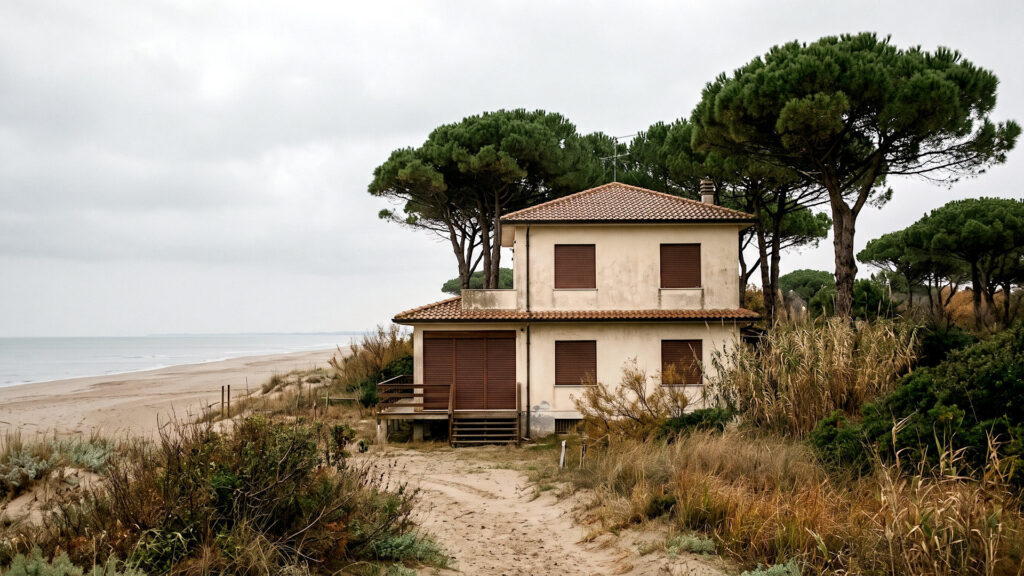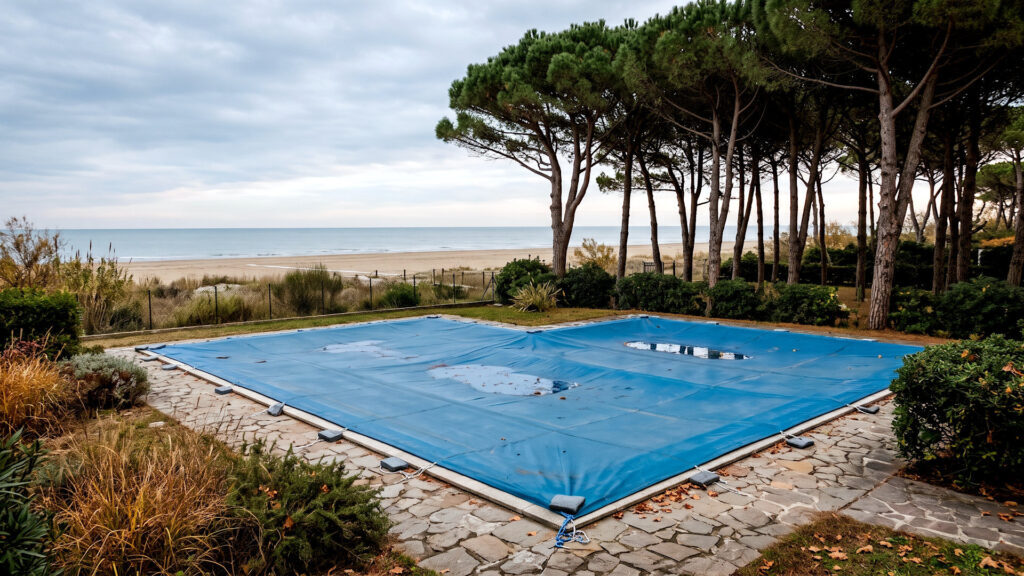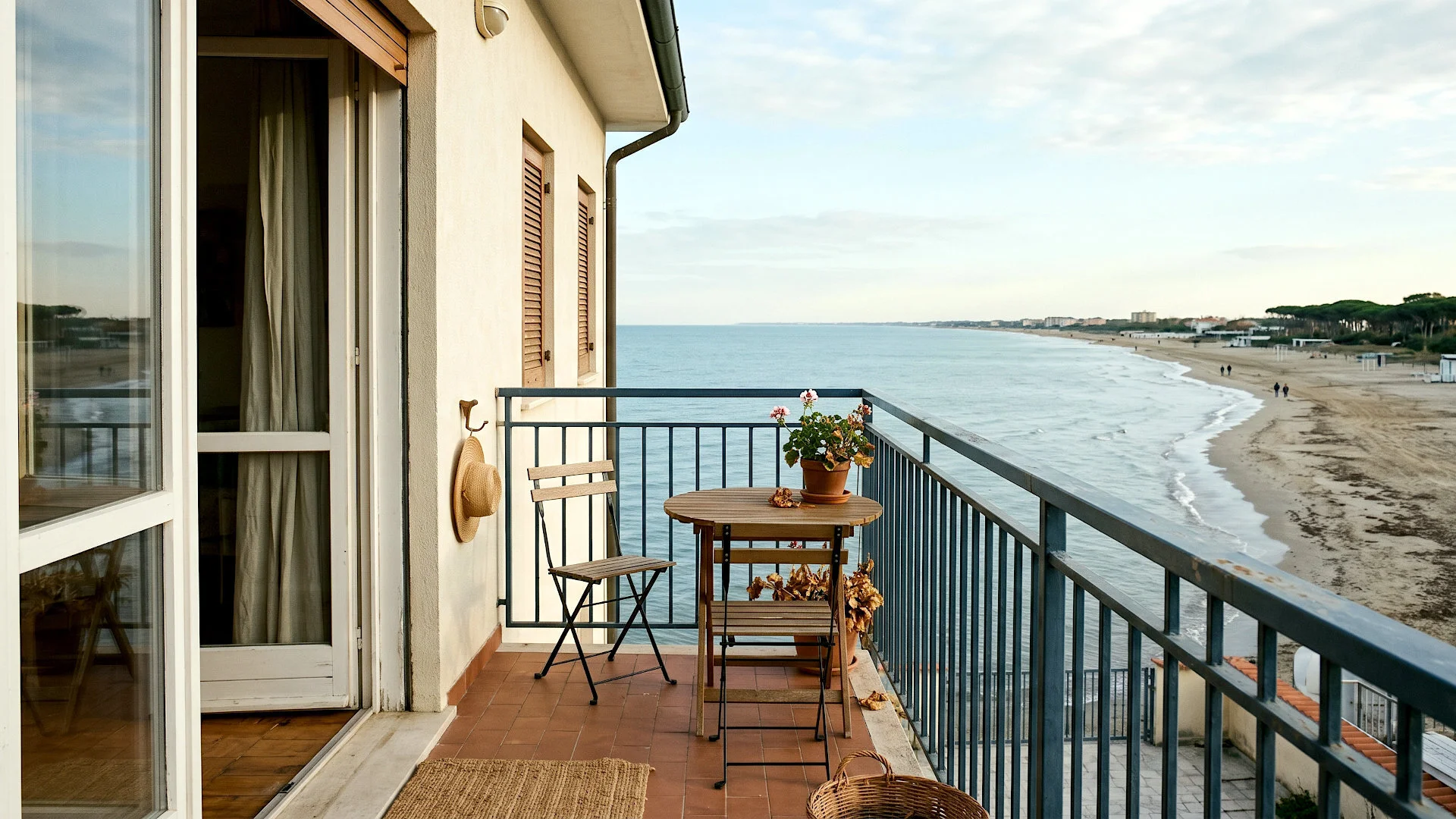
In November a holiday home by the sea seems to be resting. The shutters are closed, the air conditioning is silent, the balcony railing is dry. The salt from the summer, though, is still there: a thin film on the metal, in the tracks of the French windows, on the fins of the outdoor unit. In winter it works without anyone seeing it, and in spring it sends the bill.
The good news is that against salt, routine maintenance done to a calendar is enough: a few tasks in autumn, a second check in spring, a few minutes on every visit. In this guide you will find what to do now, in autumn, what to check again in April and what falls to the building's management rather than to you.
Closing the home for the winter proper (water, gas, fridge, insurance policy) has a guide of its own: the end-of-season closing checklist. Here we talk about what comes round every year: windows and doors, metalwork, air conditioning, the electrical system, façades and balconies.
Why salt air damages a holiday home even when you are not there
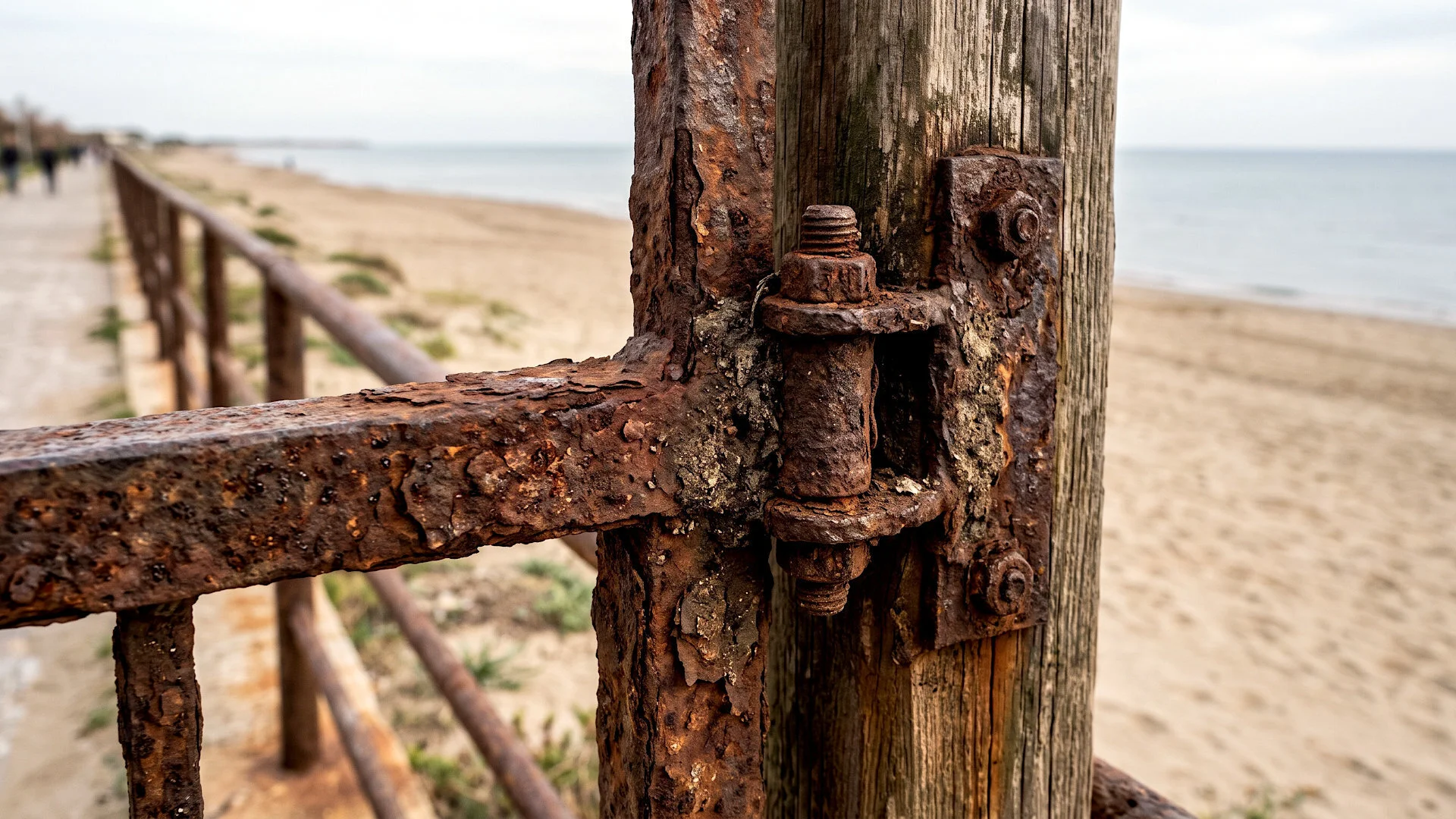
Salt air is sea salt carried by the wind: it settles on surfaces and, with humidity, attacks above all metal and moving parts. The damage comes from the salt that stays, not from the salt that arrives once: a surface nobody washes builds up layer after layer, season after season.
There is one detail that changes the way you do maintenance, and it is explained by the International Molybdenum Association (IMOA) in a technical sheet on the corrosiveness of coastal environments. Heavy rain washes exposed surfaces and reduces the build-up of corrosive substances. Sheltered surfaces, which the rain does not reach, are the ones most at risk. Salt fog, on the other hand, wets surfaces without washing them.
In a home in Eraclea Mare, that means looking where the rain does not reach:
- the inner side of the railing, under the balcony of the floor above;
- the ceiling and brackets of the porch;
- the tracks of the French windows and the rails of sliding doors;
- the lower part of the air conditioner's outdoor unit, especially if it sits in a recess;
- hinges, locks and padlocks on gates and storerooms.
That is where it pays to look first. And it is why the most useful rule of maintenance by the sea is also the simplest: wash with fresh water whatever the rain does not wash.
The routine maintenance calendar: autumn, winter, spring
Maintenance of a holiday home by the sea is organised around three moments. In autumn you remove the salt that built up over the summer; in winter you make a few quick checks each time you call in; in spring you check everything again before reopening. In summer a few tasks on each visit are enough.
| When | What you do | Why |
|---|---|---|
| Autumn, at the end of the season | Wash metalwork and sheltered parts with fresh water; clean windows and doors on the outside; treat seals and hardware; clean the air conditioner's filters and outdoor unit; photograph the façade and balconies | The summer's salt does not stay on the surfaces all winter |
| During the winter | Each time you call in, test the RCD, look at the outdoor unit and its drain, check that doors and windows close properly | A fault spotted in January costs less than one discovered in April |
| In spring, before reopening | Second clean of windows and doors; recheck the metalwork and touch up the paint; a technician for the air conditioner before it is first switched on | The home reaches the summer already in order, with no last-minute jobs |
| In summer, on every visit | Air conditioner filters cleaned as often as the manual says; a rinse of fresh water on railings and gates after windy days | The less salt builds up in summer, the less work is left for the autumn |
Autumn is when it pays to do the most. The home is still open or has only just been closed, and if a spare part is needed there is plenty of time to order it before the season. If you need an excuse to come back to Eraclea in these months, the guide to Eraclea Mare out of season tells you what to do between the lagoon, cycling and the markets.
Railings, gates and outdoor metalwork: how to stop rust in time
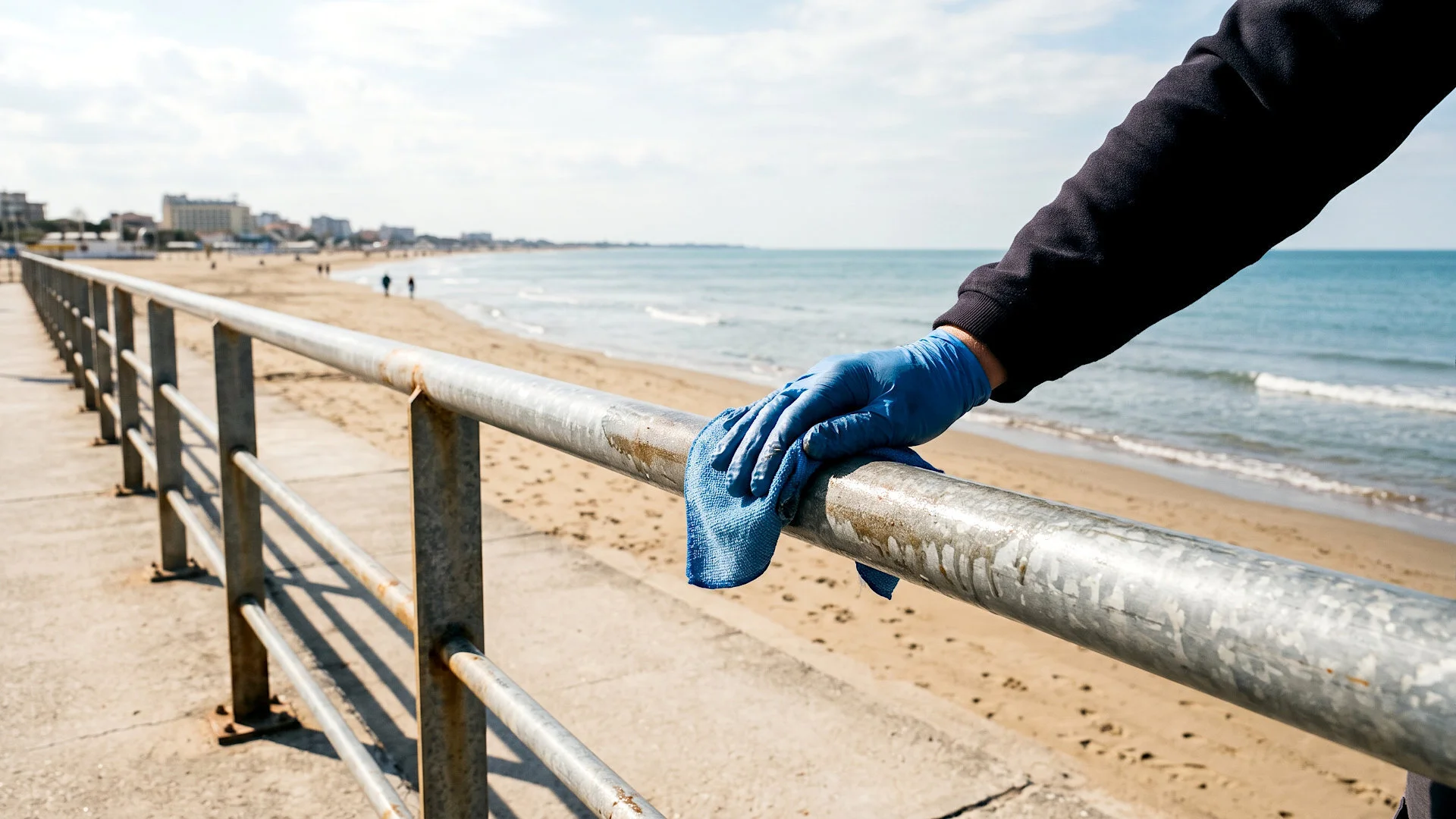
Outdoor metalwork is protected by two repeated tasks: washing it with fresh water to remove the salt, and looking at it closely to find rust while it is still a speck. A rust spot caught early can be dealt with by a touch-up; left alone, it tends to spread under the paint and calls for a bigger job.
The sequence is the same for railings, gates, window grilles and metal garden furniture.
Washing outdoor metalwork in five steps
Start with the sheltered parts
the inner side of the railing, the corners, the spots under the balcony above.
Use fresh water and a soft cloth
remove the salt and sand, without abrasive sponges that scratch the paint.
Dry the spots where water collects
joints, welds, the feet of uprights fixed to the floor.
Look for signs of rust and photograph them Key step
an orange speck, a blister in the paint, a crust that is flaking off. This is when the repair costs least.
Protect hinges and latches
a thin film of the lubricant the manufacturer recommends, then open and close them a couple of times.
The photos are more useful than they seem. If you take them every autumn from the same spot, in spring you can see at once whether a patch has spread. You can also send them to the metalworker or painter for a quote, without having them come out twice.
A word of warning if your flat is in a condominio, the Italian form of a jointly owned building, with common parts run by an administrator (amministratore). If your balcony railing is part of the design of the façade, changing its colour or model affects the architectural appearance of the building (decoro architettonico). Article 1122 of the Italian Civil Code (codice civile) forbids owners to carry out works that harm it, and requires them to notify the administrator in advance. A touch-up in the same colour does not change how the façade looks; a railing of a different model does, and has to be agreed first.
Windows, doors and locks: cleaning, seals and hardware
Windows and doors by the sea suffer in three places. The seals dry out and let air and water through, the hardware stiffens, and in the tracks of sliding doors sand and salt act like sandpaper. Maintenance is simple, and manufacturers state how often to do it in their booklets.
I will take as an example the instructions of a PVC window manufacturer, Oknoplast, in its 2025 “Warranty and maintenance” guide (Garanzia e manutenzione). They give three tasks with a precise frequency:
- for white windows, wash the outer parts at least twice a year, with products free of solvents and abrasives;
- treat the seals with silicone lubricant or petroleum jelly;
- lubricate the hardware at least once a year, at the points shown in the booklet.
Twice a year, by the sea, means once in autumn and once in spring: the calendar of this guide. If your windows and doors are aluminium or wood, the tasks are similar but the products and frequencies are set by your manufacturer. Look for the maintenance booklet in the folder of the home's documents, or ask the installer who fitted them.
The same guide contains two lines every owner by the sea should read. The warranty on the colour of the profiles does not apply if the windows are installed where there are corrosive agents or atmospheres. And changes in colour caused by cleaning with unsuitable products are not covered. Not every warranty says this, but it is worth rereading your own before you call for service.
Locks deserve a thought of their own. The cylinder of the front door and the one on the gate work outdoors, or nearly so, and salt makes them stiff to turn. Use the lubricant recommended by the lock manufacturer, or ask the locksmith who fitted it which product to use. A cylinder that is stiff in October can jam completely in winter, and a locksmith called out to open the door costs more than a bottle of lubricant.
Finally, at the bottom of the frame of the French windows there are the small slots that let water out. If sand and pine needles block them, the water stays inside the profile. A pass with a dry brush, in autumn and in spring, is enough to keep them clear.
Air conditioning near the sea: how to look after the outdoor unit
The outdoor unit of the air conditioner stays outside all year round, and it is among the most exposed appliances in the home. The installation manual of a Daikin split system says so among its precautions: in coastal areas, corrosion may shorten the life of the air conditioner. Maintenance is there to slow that process down.
The most precise instructions I found are in the installation manual of a Samsung air conditioner, which has a chapter called “Installation guide near the sea”. In short, it says five things:
- the outdoor unit should not be directly exposed to the sea breeze, and is better sheltered by a building or a wall;
- the salt that settles on the panels should be removed by periodic washing with water;
- water standing under the unit encourages corrosion, so the drain hole must be kept clear;
- the installation site should be checked every 3 months, with anti-corrosion treatment according to the product's conditions;
- within 500 metres of the shore a special anti-corrosion treatment is required.
These are one manufacturer's instructions for its own models, and the reasoning is useful for the others too. If your outdoor unit is close to the beach, ask the technician whether the installed model has a treatment for coastal areas and what its manual provides.
Indoors, the work is yours. The user manual of a Daikin model recommends cleaning the air filters every 2 weeks with normal use, washing them with water or using a vacuum cleaner. When the air conditioner is left unused for a long time, as in winter, it says to unplug it or switch off its dedicated circuit. The batteries come out of the remote control. The details vary from one model to another: the manual for your own unit is the source to follow.
So in autumn, clean it, wash the outside with fresh water and look at the brackets that hold it up. If you see rust on the casing or the supports, call the technician now rather than waiting for the first hot day.
Fuse box and RCD: the test that takes one minute
The RCD (residual current device), which Italians call the salvavita, is the switch that cuts the power when current is leaking to earth. It has a test button that is there to check that it really trips. How often to press it is up to the manufacturer: the product standard, as Schneider Electric explains, refers to the manufacturer's instructions.
For difficult environments Schneider is explicit. Unless other rules apply, it recommends testing the RCD every month when it works in corrosive or severe environmental conditions. For a holiday home by the sea, with the salty air and the damp of the closed months, it is sensible to go by that.
In practice: press the test button on every visit, and at least once a month if someone calls in at the home during the winter. The switch must trip; then you reset it. If it does not trip, call an electrician: the protection you are relying on is not working.
One precaution. If in winter you leave the boiler on frost protection or a flood sensor switched on, the test also cuts the power to them. After resetting, check that they have started again. For the boiler's obligations, which follow a legal calendar, you will find everything in the winter closing guide.
Façades, balconies and common parts: what falls to you and what to the building
In a residence, maintenance is split in two. Inside your flat you decide, within the limits of Article 1122; the façades are common parts, as Article 1117 of the Civil Code states, together with roofs, stairs, main doors and courtyards. Their condition concerns all the owners, and it is the condominio, through its administrator, that takes care of them.
That does not mean you should not look at them. You are the one who walks out onto the balcony. You are the first to see a crack in the render, a rust stain under the balcony edge, a piece of concrete coming away from the rim. Photograph it and report it in writing to the administrator, with the date. A documented report helps get the work scheduled before it becomes urgent.
On costs there is a little-known tax point. According to the Italian Revenue Agency (Agenzia delle Entrate), routine maintenance does not qualify for the renovation tax deduction (detrazione, a reduction of Italian income tax) when it concerns a single property unit. On the common parts of residential buildings, however, the deduction also applies to routine maintenance.
For expenses in 2026 the deduction is 36% in cases other than the main home, with a ceiling of €96,000, spread over 10 annual instalments. From 2027 it falls to 30% under current law; the 2027 Budget Bill, presented to the Italian Parliament on 30 October 2026, proposes 36% for second homes instead: the figure is confirmed when the law is passed, expected at the end of December. How it is divided among the owners and what is due to you is something to check with the administrator and with your accountant (commercialista).
Massimo Ongaro, estate agent at ma.re.blu“The homes that reopen in spring without surprises nearly always have one thing in common: someone who, in autumn, removed the salt, took a close look and reported problems in time. Routine maintenance costs little precisely because it is done early.”
The autumn maintenance checklist
Here are the tasks from this guide to do now, between November and closing up. Many take a few minutes; for some you need a tradesperson, and it is better to call them now.
Autumn checklist against salt air
Outdoor metalwork washed with fresh water
railings, gates, window grilles, starting with the sheltered parts.
Rust photographed
specks, blisters and crusts, with the date, to compare in spring.
Hinges and latches lubricated
with the product the manufacturer recommends.
Windows and doors washed on the outside
without solvents or abrasives.
Seals treated
with the product named in the windows' booklet.
Window and French window hardware lubricated
at the points the manufacturer shows.
Tracks and drainage slots of sliding doors cleaned
no sand or pine needles.
Lock cylinders checked
they turn without effort, lubricated if needed.
Air conditioner filters cleaned
as the model's manual says.
Outdoor unit washed with fresh water
drain clear, brackets free of rust.
Technician called if the outdoor unit shows rust
now, not in June.
RCD tested with the test button
and reset.
Cracks and rust on the façade and balconies reported to the administrator
in writing, with photos.
In spring, before reopening, repeat the cleaning of windows and doors, compare the rust photos with the autumn ones and have the air conditioner checked before it is first switched on. If you have a garden among the pines, go over the gutters and downpipes again: that is where the needles that fell in winter end up.
Who does the maintenance if you live far from Eraclea
There is an objection I often hear, and it is a fair one. “These are simple jobs, I'll do them when I come.” True: almost everything you have read can be done with water, a cloth, a bottle of lubricant and an hour of your time. The problem is how often, not how hard.
The RCD every month, the outdoor unit every three months according to one manufacturer, the rust before it spreads: these are rhythms designed for people who see the home often. If you live in Milan, Munich or Vienna and come to Eraclea only in summer, months go by between one visit and the next.
There are three realistic options. A neighbour or relative you trust who calls in regularly and sends you photos. A small group of local tradespeople, each with their own part: metalworker, window installer, air conditioning technician. Or someone who knows the home and coordinates everything. If you let it out for short stays, maintenance can also go into the holiday rental management mandate, with the items written down in black and white.
A well-kept holiday home shows in spring
In Eraclea Mare there is salt in the air all year round, and it is managed with a simple calendar. Autumn and spring, plus a few tasks on every visit, keep windows, metalwork and systems in order and put off major repairs. Your job is to look where the rain does not reach, read the manuals and report in good time what falls to the building.
If you would like help setting it up, request an inspection of your home by ma.re.blu. We will look at the windows, railings, air conditioner and common parts together, and decide what to check during the year and who can do it, even while you are far away.
Salt air also works on the shared parts: for a closer look at a building there is the page of Residence Hermitage 1, and if you are looking for a home, the homes for sale.
How often should a holiday home by the sea be maintained?
It is best organised around two fixed moments, autumn and spring, plus a few tasks on every visit. In autumn you remove the summer's salt from metalwork, windows, doors and the air conditioner; in spring you check everything again before reopening. Some frequencies come from the manufacturers: for example, a PVC window manufacturer says to wash the outer parts of white windows at least twice a year.
How do you protect the air conditioner's outdoor unit from salt air?
The installation manual of a Samsung air conditioner says not to expose it directly to the sea breeze, to wash it periodically with water, to keep the drain clear and to check the installation site every 3 months, with anti-corrosion treatment according to the product's conditions. Within 500 metres of the shore it requires a special anti-corrosion treatment. For your own model, its manual applies.
How often should windows and doors by the sea be cleaned and lubricated?
The instructions of a PVC window manufacturer, Oknoplast, say to wash the outer parts of white windows at least twice a year without solvents or abrasives, to treat the seals with silicone lubricant or petroleum jelly and to lubricate the hardware at least once a year. By the sea it makes sense to do this in autumn and in spring. For aluminium and wood, your own manufacturer's instructions apply.
How often should you test the RCD in a holiday home by the sea?
The frequency is set by the manufacturer. Schneider Electric recommends a monthly test for RCDs working in corrosive or severe environmental conditions. In a home by the sea it is best to press the test button on every visit, and at least once a month if someone calls in during the winter. If the switch does not trip, you need an electrician.
In an Italian apartment building, is maintaining the façade my job?
Under Article 1117 of the Italian Civil Code the façades are common parts of the building, and the condominio takes care of them through its administrator. As an individual owner, it is worth photographing cracks and rust and reporting them in writing. For works on your own unit, such as changing the railing, Article 1122 requires you not to harm the appearance of the building and to notify the administrator first.
Can routine maintenance of a second home be deducted from tax in Italy?
According to the Italian Revenue Agency, routine maintenance on a single property unit does not qualify for the renovation tax deduction. On the common parts of residential buildings it does. For expenses in 2026 the deduction is 36% in cases other than the main home, with a ceiling of €96,000 and 10 annual instalments; from 2027 it falls to 30%.