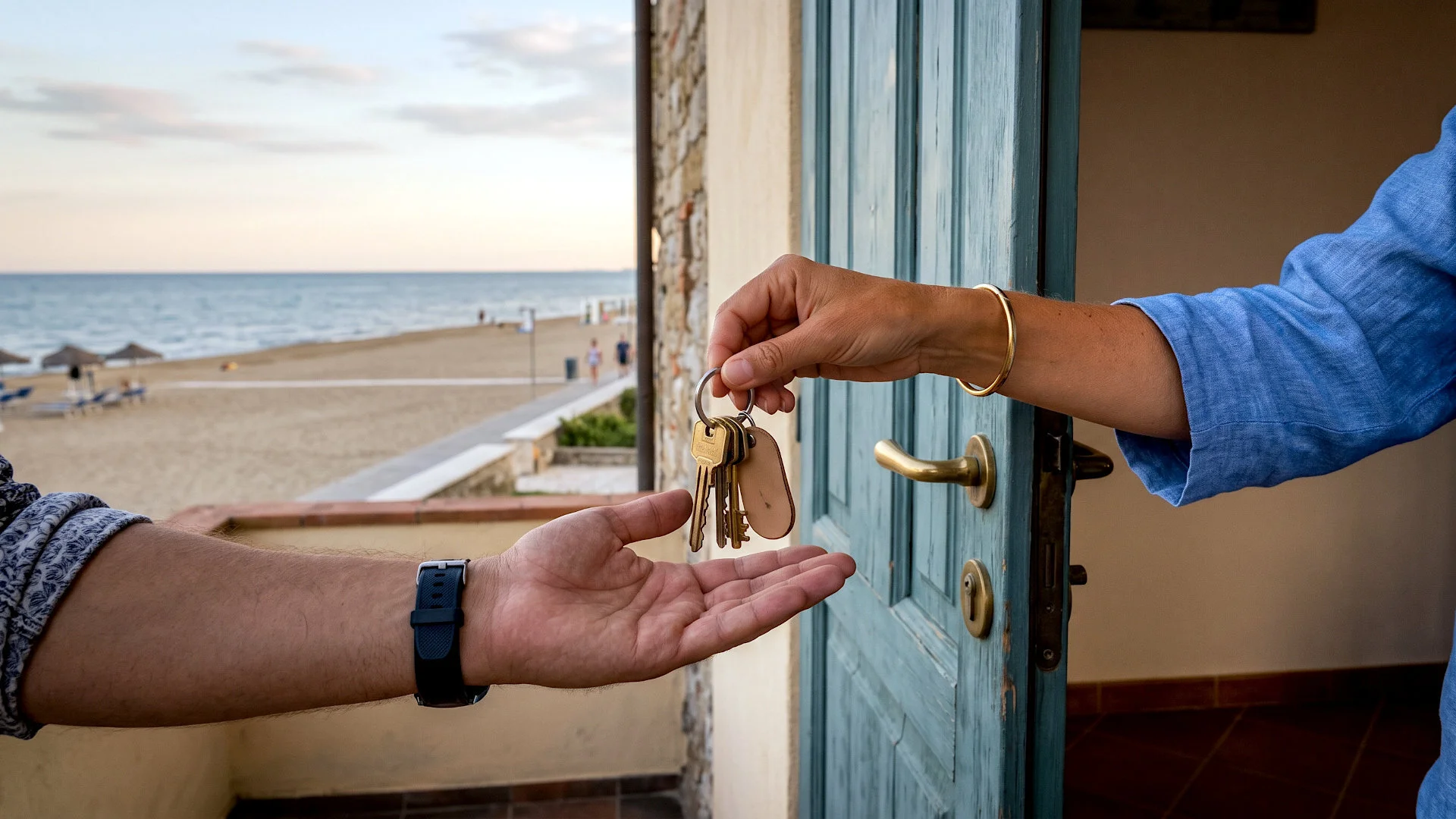
A Saturday in July, ten o'clock at night. The guests have just arrived in Eraclea Mare, and you are at home, an hour and a half's drive away. Someone has to hand over the keys, check their identity documents, report their details to the police within twenty-four hours and collect the tourist tax. On Sunday morning another family leaves the flat next door, and someone has to clean it.
Anyone who lets a home for short stays knows this scene well. Sooner or later the question comes: do I carry on alone, or do I sign a management agreement with an agency? The answer depends on how much time you have, how far away you live and how many homes you let. It also depends on something few people look at before signing: what really passes to the agency and what stays with you.
In this article you will find a map of the obligations of anyone who lets for short stays, with who fulfils each one in the two cases. Then come the Italian Civil Code's rules on the mandate, the clauses to read and a method for deciding about your own home. What you will not find are the prices of our service: those belong in a written quote, item by item.
What a holiday let management agreement is
A management agreement, in Italian mandato di gestione, is the contract by which you entrust an agency with the acts needed to let your home on your behalf. Under the Italian Civil Code (codice civile) it is a mandate (mandato): one party undertakes to carry out one or more legal acts on behalf of the other (article 1703). The words "management agreement" come from common practice: the law does not make it a separate type of contract.
The difference from a sale instruction is clear-cut. When you sell, the agent usually works as a broker: they bring the parties together without being bound to either of them by a relationship of representation. When you hand over the management, the agency acts on your behalf: it advertises the home, accepts bookings, hands over the keys, and sometimes signs and collects payment.
The mandate can come with representation, if the agency also acts in your name (article 1704). Without representation, the agency acts in its own name and takes on the obligations towards the guests itself (article 1705). The Veneto Region expressly provides for this role: in its FAQs for holiday landlords it calls the party appointed to let the property, an estate agency for example, the "mandated landlord" (locatore mandatario).
The mandate is presumed to be paid (article 1709): the fee is agreed between the parties; failing that, it is set by tariffs or custom and, failing those, by a judge. That is why the contract must state the fee and the items it covers.
The obligations of short-term landlords, and who fulfils them

Anyone who lets a home for short stays answers to four different authorities: the Questura (the provincial police headquarters), the Region, the Municipality and the Italian Revenue Agency (Agenzia delle Entrate). Some obligations pass to the agency by law, as soon as it collects the rent; others pass only if the mandate says so; others stay with the owner regardless.
| Obligation | Legal basis | If you manage it yourself | With a mandate and the agency collecting payment |
|---|---|---|---|
| Applying for the CIN (national identification code for rental properties) and declaring cadastral and safety data | Decree-Law 145/2023, art. 13-ter | You | The landlord: you, or the agency if it acts as mandated landlord; you answer for the property's data |
| CIN displayed outside the building and in every listing | Decree-Law 145/2023, art. 13-ter | You | Display is up to you; the agency also shows it in its listings, by law |
| Gas and carbon monoxide detectors, fire extinguishers | Decree-Law 145/2023, art. 13-ter | You | They stay with you: they are fittings of the home |
| Guest details to the Questura (Alloggiati Web portal) | TULPS (consolidated public security law), art. 109 | You, within 24 hours of arrival | The agency, if it handles check-in and the mandate assigns it the task |
| Arrivals and overnight stays on ROSS1000 (the Veneto Region's tourism statistics platform) | Veneto Region FAQs for holiday landlords | You, by the 10th of the following month | The agency, if it acts as mandated landlord |
| Eraclea tourist tax (imposta di soggiorno) | Decree-Law 50/2017, art. 4(5-ter) | You, if you collect the rent | The agency, because it collects the rent |
| Contract data to the Revenue Agency | Decree-Law 50/2017, art. 4(4) | Nobody, if there is no intermediary | The agency, which brought the parties together, even if it does not collect payment |
| 21% withholding and certification | Decree-Law 50/2017, art. 4(5) | Nobody, if you collect payment directly | The agency, as withholding agent |
| Tax return, choice of the cedolare secca, final payment | Law 213/2023 and Revenue Agency guide | You | You |
Three rows of this table depend on the law, not on the contract: the tourist tax, the contract data and the withholding. The others depend on what you write in the mandate. That is why a vague mandate leaves grey areas precisely on the tasks that fall due every week.
What changes if the agency collects the rent
The rules are in Decree-Law 50/2017, article 4, which from 1 January 2027 moves, with the same content, into articles 207 and 208 of the consolidated income tax act (Legislative Decree 117/2026). A first obligation does not depend on who collects payment. The agency that put you in touch with the guests reports to the Revenue Agency the data of the contracts concluded through it, by 30 June of the following year.
The second is triggered by collecting payment. When the agency collects the rent, or is involved in the payment, the law makes it a withholding agent (sostituto d'imposta): it withholds 21% of the rent, pays it to the tax authorities and gives you a certificate.
The 21% withholding is always a payment on account, whatever tax regime you choose: the Revenue Agency's guide, updated in April 2026, says so again. You settle the final figure yourself in your Italian tax return. If you have two flats let for short stays, one pays the cedolare secca (the flat-rate tax on rental income) at 21% and the other at 26%: you pay the difference on the second one as a balance. The mechanism is explained in the guide to short-term rental tax in 2026.
The same guide clarifies a common case. If the agent you have instructed also advertises the home on a portal, the withholding and the reporting of the data remain the agent's responsibility. It is up to the agent to tell the portal in what capacity it is acting, so that the portal does not withhold a second time.
Then there is a point that concerns your own responsibility. The intermediary's obligations rest on the information you give it, and according to the Revenue Agency liability falls on the landlord if that information is not truthful. If the home is jointly owned and only one of the owners signs the contract, only that owner can offset the withholding; the others declare their share.
The tourist tax passes to whoever collects payment
The law makes the party that collects the rent, or is involved in the payment, responsible for the tourist tax, with the right to recover it from the guest (Decree-Law 50/2017, article 4, paragraph 5-ter). If the agency collects payment, it is the agency that collects the tax, pays it to the Municipality of Eraclea and files the returns and the annual declaration with the Revenue Agency. If you collect payment yourself, even with an agency that only looks after keys and cleaning, those obligations stay with you.
What stays with the owner even with a mandate
Signing a mandate does not transfer the home or the income to the agency. The rental income remains yours, and with it the tax return, the choice of which property the 21% rate applies to and the payment of the balance. IMU (the municipal property tax) and the running costs of the home also remain yours.
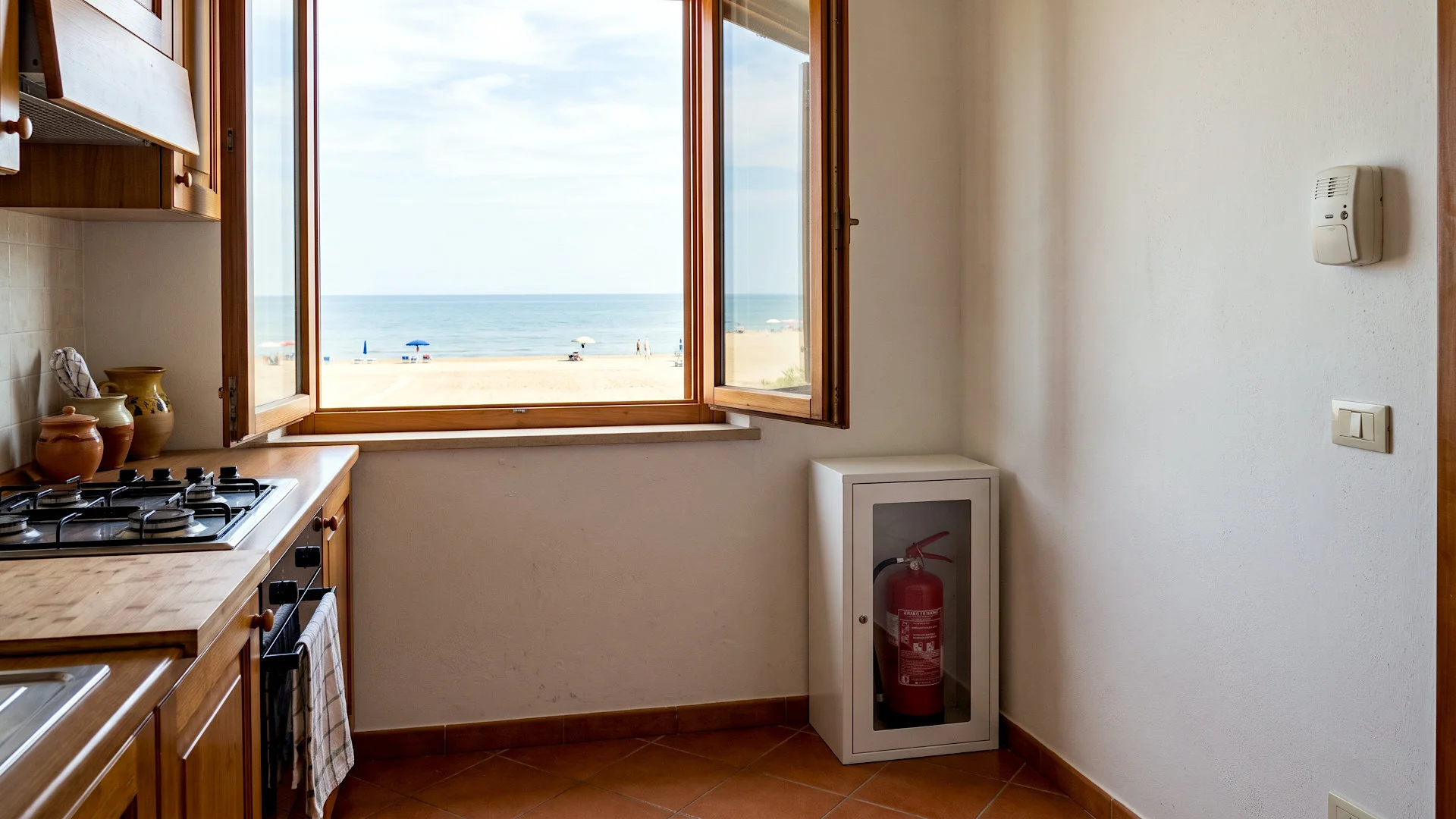
For the CIN, what matters is who the landlord is. Decree-Law 145/2023 assigns the code at the landlord's request, with a sworn declaration on the cadastral data and safety requirements. You submit the request, or the agency does if it acts as mandated landlord; you remain answerable for the accuracy of the property data in any case. And gas and carbon monoxide detectors and fire extinguishers are fittings of your home.
Finally, counting your homes remains your job. Since 2026, Law 199/2025 presumes a business activity once more than two flats are let for short stays in the year, and the count covers all your homes, even if different agencies manage them.
For a missing code, or one not shown in listings, the law provides for fines and removal of the listing, and the checks are carried out by the Municipality. A well-written mandate states who checks that the code is displayed and appears in every listing, every season.
Managing it yourself: how much work a season takes
Managing a holiday home yourself is possible, and many owners do it well. Before deciding, though, it pays to count the tasks, because they repeat with every arrival and every month, even when the home is empty. Split them by frequency and you will see the real workload.
With every arrival there is the key handover and the identification of the guests with a valid document. Then their personal details go to the Questura within twenty-four hours, or within six hours if the stay is no longer than one day. For breaches of the consolidated public security law that carry no specific penalty of their own, article 17 provides for arrest of up to three months or a fine. With every departure there is cleaning, linen and a check of the home before the next guest.
Every month there are also two deadlines: ROSS1000 by the 10th, even in months with no guests, and the tourist tax by the 15th. The penalties are in the tax guide I mentioned above.
Winter is when things are most easily forgotten. The home is shut, nobody thinks about the regional platform, and the zero months are not submitted. According to the Region's FAQs, after twelve consecutive months without submissions the registration is closed automatically and the CIR (the regional identification code) and the CIN are cancelled. To start letting again you need to file a new holiday let notification with the Region.
To work out what it costs you in time, take last summer's calendar and count the changeovers. Multiply by the time a handover takes, a clean, and a journey if you live far away. The result is the number to set against the agency's fee, together with the monthly deadlines. The cost items of a season, management included, are in the figures for a three-room flat let for the season in Eraclea Mare.
Three ways to organise it, compared
Between doing everything yourself and handing everything over there is a middle way: an agency that looks after keys and cleaning, while the owner keeps collecting the rent. It changes a lot, because the obligations tied to collecting payment follow whoever collects it.
You manage everything yourself
You keep the whole income and decide on every booking, but every obligation is yours.
What you do
- check-in, identification and Alloggiati Web within 24 hours
- ROSS1000 by the 10th, even with zero guests, and the tourist tax by the 15th
- cleaning, linen, maintenance and replies to guests
You hand over the keys, you collect the rent
The agency handles the operational side you assign to it; the money goes through you.
What changes
- no withholding by the agency, because it does not collect payment; if a portal collects payment, the portal withholds
- the tourist tax stays with whoever collects payment: you, or the portal if the payment goes through it
- the mandate must state who does Alloggiati Web and ROSS1000; the contract data are reported by the agency in any case
Mandate with collection
The agency collects the rent, withholds 21% as a payment on account and pays you the rest with a statement.
What changes
- the tourist tax and its annual declaration pass to the agency
- you receive the withholding certificate for your tax return
- the CIN data, the safety of the home and the balance of your taxes stay with you
None of the three arrangements is right for everyone. What counts is how far away you manage the home from, how many weeks you let it and how present you want to be with your guests.
The clauses to read in a management agreement
The Civil Code protects the owner, but only if the mandate is well written. The agency must carry it out with the diligence of a prudent person (diligenza del buon padre di famiglia) and inform you of any new circumstances that might make you change your mind (article 1710). It cannot go beyond the limits set in the mandate (article 1711).
It must also tell you without delay what it has done: if you take too long to reply, your silence counts as approval (article 1712). And it must account to you for what it has done and hand over everything it has received under the mandate (article 1713). For your part, you reimburse the expenses it has advanced and pay the fee (article 1720).
On duration the rules are precise. You can revoke the mandate, but if it is paid and for a fixed term, revoking it before it expires obliges you to compensate for damages, unless there is just cause. If it has no fixed term, you must give reasonable notice (article 1725). An agency that withdraws must also do so in time for you to make other arrangements (article 1727).
What the management agreement must state
Scope and limits
which acts the agency carries out, which periods you keep for yourself, which decisions stay with you.
Representation
whether the agency signs with guests in your name or in its own.
Collection
who collects the rent, by when the agency pays the money over to you, how the withholding works.
Statement
how often you receive it and what it contains, booking by booking.
Fee
how it is calculated, which items it covers and whether VAT is added.
Expenses
which ones the agency advances and how it recharges them to you.
Obligations
who does Alloggiati Web, ROSS1000 and the tourist tax, and who checks the CIN and the listings.
Duration and exit
expiry, renewal, notice for revocation and for withdrawal.
Ask for these points to be written down, not explained verbally. A mandate with a monthly statement lets you keep an eye on the season while it is under way, not just in September.
When managing it yourself really pays
The strongest objection to handing over management is financial: the agency's fee is paid every season, while your own time seems to cost nothing. On time I disagree; on the fee I agree: it is a real cost and belongs in the sums like the others.
Managing directly works well if the home is a few minutes away and you have no other properties to coordinate. It helps to have free summer weekends and to enjoy contact with guests. It also works if you let for only a few weeks a year and use the home yourself the rest of the time. In these cases the obligations are manageable, as long as you do not forget the zero months on ROSS1000.
Handing over management makes sense when you live far away, when you have two homes or when you do not want an income to become a second job. The next step is always the same: compare the time you have counted with a written quote. If you are still deciding whether to let at all, the ground rules are in the guide on how to earn an income from a holiday home in 2026.
How to decide about your home
Count last season's arrivals
each arrival means a handover, an identity check and a report to the Questura.
Mark the monthly deadlines
ROSS1000 by the 10th, tourist tax by the 15th, in winter too.
Decide who collects payment Key step
the withholding, the tourist tax and the statement depend on it.
Ask for a written quote, item by item
fee, expenses, obligations included.
Compare the fee with the hours and journeys
you save, and with the risk of a missed deadline.
The next step for your home in Eraclea Mare
Handing the management of a holiday let in Eraclea Mare to an agency transfers a great deal of work and some specific obligations, starting with the tourist tax and the withholding. The income, the CIN data, the safety of the home and your tax return stay with you. With this map in hand, the choice between doing it yourself and handing it over can be made with the figures from your own season.
Request a detailed quote for managing your home in Eraclea Mare. We set out for you, item by item, what we would do, what would stay with you, how collection and statements would work and what it costs. With the quote in hand you decide whether to entrust your home to us or carry on alone, knowing exactly what you are choosing.
To see how a managed home is presented, look at the rentals in Eraclea Mare and the residences in the area.
What is a holiday let management agreement in Italy?
It is the contract by which you entrust an agency with the acts needed to let your home on your behalf. Under the Italian Civil Code it is a mandate (article 1703), with or without representation, and it is presumed to be paid. In the Veneto, the agency appointed is called the mandated landlord (locatore mandatario).
If an agency manages my holiday let, who pays the tourist tax?
The guest pays it, but the party that collects the rent is responsible for it (Decree-Law 50/2017, article 4, paragraph 5-ter). If the agency collects payment, it collects the tax, pays it to the Municipality of Eraclea by the 15th of the following month and files the annual declaration by 30 June. If you collect payment, it stays with you.
Does a holiday let management company withhold tax in Italy?
If it collects the rent, it withholds 21%, pays it over and gives you a certificate. It is always a payment on account: in your tax return you calculate the tax due, offset the withholding and pay any balance, for example on a second flat taxed at 26%.
With a management agreement, who does Alloggiati Web and ROSS1000?
Whoever provides the accommodation reports the guests' details to the Questura within 24 hours, and whoever is registered as landlord submits arrivals and overnight stays on ROSS1000 by the 10th of the following month. These tasks can pass to the agency if it handles check-in or acts as mandated landlord: write it into the agreement.
What stays with the owner when an agency manages the holiday let?
The owner keeps the income, the tax return, the choice of the property taxed at 21% and the IMU. The safety fittings of the home also stay with the owner. If the agency submits the CIN request as mandated landlord, the owner still answers for the property data and for the information given to the agency.
Can a management agreement be revoked before it expires?
Yes, the owner can revoke it. If the agreement is paid and for a fixed term, early revocation obliges the owner to compensate for damages unless there is just cause; if it has no fixed term, reasonable notice is required (article 1725 of the Italian Civil Code). Duration, renewal and notice should be written into the contract.