Every spring, in my office in Eraclea Mare, the same scene plays out. An owner comes in with two flats let out to holidaymakers, smiles and tells me: “Well, I pay the 21% flat tax on both of them anyway.” Then I explain that the 26% rate on the second property has existed since 2024, and the smile stiffens.
The situation is not dramatic. The rules really have changed, though, in two stages, and anyone still working with the 2023 rules risks leaving money on the table or facing an unexpected balance on their tax return.
In this guide I explain, item by item, how short-term rental tax in Italy works today. We look at the two rates of the cedolare secca (the flat-rate tax on rental income), the threshold that makes a VAT number compulsory, the national identification code and the extra obligations on the Venetian coast. By the end you will know where you stand and what makes sense for you to do.
An honest premise: this is an up-to-date overview for information only, and it does not replace the advice of your commercialista, the accountant who prepares your Italian tax return. Its purpose is to help you reach their office with a clear picture and the right questions.
What changes in 2026 for anyone letting a home by the sea
Since 1 January 2024 the cedolare secca on short-term rentals has been 21% on one property of your choice and 26% on the others. What changes from 2026 is the number of homes you can manage as a private individual before the tax authorities treat you as a business: the threshold has fallen from four to two apartments.
The two changes come from two different laws, and it helps to keep them apart. The rates were set by the 2024 Budget Law (Law 213/2023, art. 1, para. 63). The 2026 Budget Law (Law 199/2025, art. 1, para. 17) lowered the threshold and left the rates as they were.
To get your bearings, start from this snapshot. It is the first thing I show anyone who comes into the agency with a home to let.
| Properties let to tourists | Tax status | Taxation | VAT number and SCIA | INPS contributions |
|---|---|---|---|---|
| 1 property | Private individual | Cedolare at 21% | No | No |
| 2 properties | Private individual | 21% on one (your choice), 26% on the other | No | No |
| 3 or more properties | Business activity (presumed by law) | Cedolare not available: flat-rate scheme (5/15%) or ordinary IRPEF | Yes, mandatory | Possible INPS registration: to be checked with your accountant |
Keep this table to hand. Each section below goes into the detail of one of its rows, and explains the Italian terms along the way.
Two-tier cedolare secca: how the 21% and 26% rates work

The cedolare secca is an optional regime that replaces IRPEF (Italian personal income tax), the regional and municipal surcharges, and registration and stamp duties. Since 2024 it has two rates: one apartment stays at 21%, and on the others you pay 26%. You choose which property goes at 21% every year, in your tax return.
This is where many owners slip up through inattention. The reduced rate does not fall automatically on the “oldest” property or on the first one you bought. You decide every year, in the Modello 730 or the Modello Redditi Persone Fisiche (the two Italian personal tax return forms), which unit to apply it to.
The logic is simple: you put it on the apartment that earns the most. The higher that property's rental income, the more the five-point gap between 21% and 26% weighs on you. Over a full season in Eraclea, this choice can be worth several hundred euros.
One more thing to know: the cedolare does not exempt you from IMU, the municipal property tax. It replaces IRPEF, not local property taxes, and IMU on a second home remains payable in full. If you want to see how it affects the real return, I cover it in the piece on how much a two-bedroom flat in a holiday complex in Eraclea really earns.
How to choose which property gets the 21% rate
Put the 21% on the property that generates the highest revenue in the year. The gap with 26% is calculated on the rent you collect, so five points weigh far more on an apartment that takes in €14,000 a season than on one that takes in €6,000.
Let's take a concrete example. You have a one-bedroom flat in the pine forest that earns €8,000 a season and a two-bedroom seafront flat that earns €15,000. If you put the 21% on the two-bedroom flat and the 26% on the one-bedroom flat, compared with the opposite choice you save €350: 5% of the €7,000 difference between the two incomes.
Watch out for one detail. The option does not stay attached to the contract for ever: you have to make it every year in your tax return. If the rents change, reassess where the 21% is best placed.
Airbnb, Booking and property managers: how the 21% withholding tax works
Platforms and managers that collect the rent, or that are involved in the payment (Airbnb, for example), withhold 21% before passing the money on to you. This is laid down by article 4 of Decree-Law 50/2017, which from 1 January 2027 moves, with the same content, into articles 207 and 208 of the consolidated income tax act (Legislative Decree 117/2026). The European DAC7 directive concerns something else: it requires portals to report payment data to the Agenzia delle Entrate, the Italian Revenue Agency.
That withholding does not settle your account with the tax authorities, and the misunderstanding on this point is very widespread. Since 2024 the intermediaries' withholding is always an advance payment, whichever regime you choose.
- Property at 21%: the withholding usually covers the tax, but the rent must still be declared and the withholding is credited in your tax return.
- Property at 26% or under ordinary IRPEF: the 21% withholding covers only part of the tax, and you pay the difference as a balance in your tax return.
In plain terms: if you have a second property at 26% and think Airbnb has already paid everything, in June of the following year you will find a balance to pay. That is why it pays to keep each platform's certificates in good order: in the event of an inspection they are your defence.
How many properties can I let without a VAT number?
From 1 January 2026 you can manage a maximum of two apartments as short-term lets as a private individual. From the third onwards the law presumes a business activity: you need a partita IVA (VAT number) and a SCIA filed with the municipality (the certified notice that a business activity is starting), and registration with INPS, the state social security institute, should be checked with your accountant. Until 2025 the threshold was four apartments.
This is the real watershed of 2026, and the question I am asked most often. What counts is the number of apartments let short-term during the year, not turnover. Beyond two, in the eyes of the tax authorities you stop being a private individual topping up your income and become an accommodation business.
The heaviest consequence is losing the cedolare secca on your entire portfolio, and social security contributions may come on top.
What happens from the third property: the presumption of business
Letting three or more apartments short-term triggers the presumption of business activity laid down by Law 178/2020, art. 1, para. 595. The rule says that in these cases the activity is presumed to be carried on as a business. Whether and how the contrary can be proven is a matter of interpretation: talk to your accountant before relying on it.
The consequences are immediate. You lose access to the cedolare secca for the entire portfolio let short-term, not just for the third property. You have to open a VAT number, normally under ATECO code 55.20.42 (holiday homes and apartments; ATECO is the Italian classification of economic activities), and file the SCIA with the municipality's one-stop business desk. The income changes nature: from property income it becomes business income.
Then there is an issue that affects many Italian public-sector employees, who are subject to restrictions on opening a VAT number. For them the most sensible route is often to convert the properties beyond the second into long-term lets. Here are the three routes, side by side.
Stay at two apartments
You keep only two homes as short-term lets and remain a private individual.
What it involves
- cedolare at 21% on one apartment and at 26% on the other
- no VAT number and no SCIA
- the choice of the 21% property, renewed every year in your tax return
Open a business
From the third apartment, the law presumes a business.
What it involves
- a VAT number, normally under ATECO code 55.20.42, and a SCIA filed with the municipality
- the flat-rate scheme at 15% (5% for new businesses that qualify) or ordinary IRPEF
- possible registration with INPS, to be checked with your accountant
Let the third one long-term
An open-market lease (4+4 years) or an agreed-rent lease (canone concordato, 3+2 years): the two-apartment threshold does not apply.
What it involves
- cedolare at 21%, or 10% for agreed-rent leases in municipalities with high housing pressure
- no presumption of business for that property
- a stable tenant instead of guests who stay a week
INPS contributions and the flat-rate scheme: the figures to know
Once you become a business, the question to ask your accountant is whether you need to register with INPS, and under which scheme. It depends on how you actually run the activity. For 2026, in the Gestione Commercianti (the INPS scheme for traders), the minimum income threshold is €18,808 and the minimum contribution is €4,611.64.
INPS circular 14/2026 adds an important clarification: anyone operating as an affittacamere (a licensed room-letting business) is not subject to the annual minimum income. The social security cost therefore varies greatly depending on how you are classified, and it has to be calculated case by case before you cross the threshold.
On the tax side you can consider the regime forfettario, a flat-rate scheme with a substitute tax of 15%, which falls to 5% for the first five years for new businesses that meet the legal requirements. The limits are tight: annual revenue under €85,000 and no employment income above €35,000. If you do not qualify, you fall under ordinary IRPEF, with rates from 23% to 43%.
That is why the jump to three properties should be worked out on a spreadsheet, not by gut feeling. On a highly seasonal portfolio, contributions and the loss of the cedolare can eat up much of the margin; on a well-built portfolio the numbers can hold up. If you are unsure where you stand, let's go through it together with your real figures in front of us.
Whole apartment or single rooms: how the portfolio is counted
The threshold is counted in apartments, not in contracts or guests. The law uses exactly this word: “no more than two apartments for each tax period”. Three separate apartments, even small ones, trigger the business rules.
The case of someone letting a single large apartment room by room, with several separate contracts, is different. The most common reading is that it remains one apartment for the purposes of the threshold. On this point, however, I have not found a written clarification from the Agenzia delle Entrate: before you organise your letting by rooms, have your accountant confirm it.
The count starts from a simple question: how many separate homes do you let short-term during the year? A small detached house counts as one, a two-bedroom flat counts as one, a one-bedroom flat counts as one. Above two, you are in business territory.
The national identification code (CIN): obligations, safety and penalties
Since 1 January 2025 the national identification code (CIN, codice identificativo nazionale) has been mandatory for letting legally. Without a CIN you face fines from €800 to €8,000 per property, and for a non-compliant listing the law provides for immediate removal. The CIN is governed by article 13-ter of Decree-Law 145/2023 and is requested from the Ministry of Tourism's national database.
The CIN brings precise obligations on display and safety. This is where I see the most owners caught out, because they treat it as a formality, when it is the key that keeps your listings online.
How to apply for the CIN on the national database
You obtain the CIN by logging in with SPID or CIE (the Italian digital identity system and the Italian electronic identity card) to the Ministry of Tourism's national database of accommodation facilities. Once you have it, you must display the code outside the building and include it in every listing: international portals, your own website, social media profiles.
The code must also be stated in your tax return: in section B of the 730 (line B12) or in section RB of the Modello Redditi (lines RB24-RB25). If you let in the Veneto region there is an extra step, which I explain further on: before the national CIN you need the regional code.
Fire extinguishers and gas detectors: the safety requirements
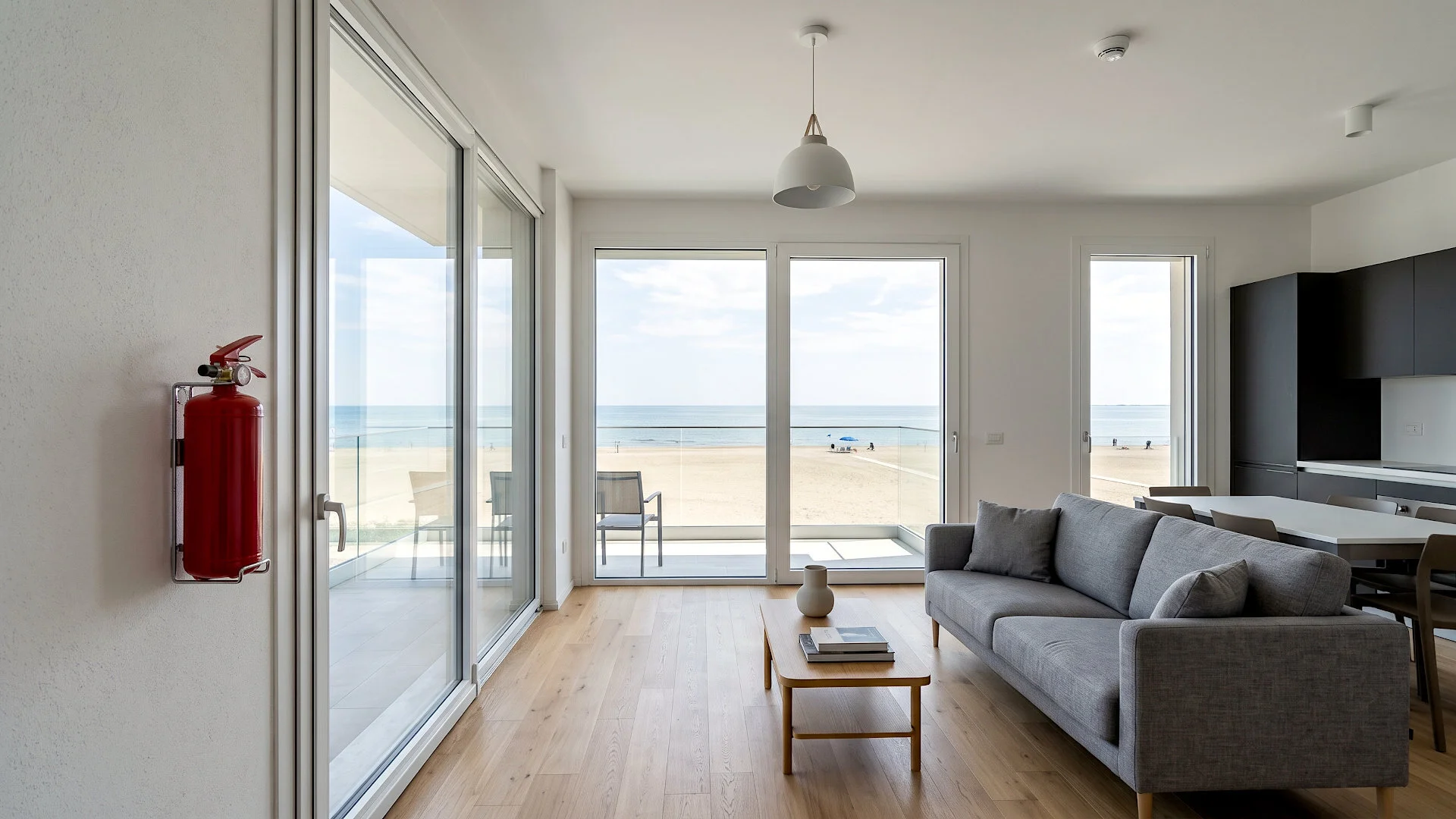
To obtain the CIN you need a self-certification (dichiarazione sostitutiva) confirming the property's cadastral data and the safety requirements set by the Decreto Anticipi (Decree-Law 145/2023). In practice the property must have working devices and minimum fire-fighting equipment.
What the property must have for the CIN
Flammable gas detector
working and installed in the property.
Carbon monoxide detector
also active.
Compliant portable fire extinguishers
one for every 200 square metres or part thereof, and in any case at least one per floor, clearly visible and accessible.
Self-certification
confirms the property's cadastral data and the safety requirements.
Regional code (CIR)
in Veneto it must be obtained before you apply for the CIN.
CIN displayed and stated
outside the building, in every listing and in your tax return.
Beyond the fines there is a second risk. In the event of a claim, the absence of these devices can also cause problems with your insurer: it is a point to check in your policy wording. Bringing an apartment up to standard costs little and protects you a great deal, and it is one of the first checks we make on the properties we look after in Eraclea.
Penalties for non-compliance
Penalties in this sector are designed as a deterrent against undeclared letting, and they apply per property. They start at €800 for letting without a CIN and reach significant amounts for missing life-saving devices. Here is the picture as of 2026.
| Violation | Penalty | Who checks |
|---|---|---|
| Letting without a CIN | €800 to €8,000 per property | Municipality (local police) |
| CIN not displayed or not included in the listing | €500 to €5,000, with immediate removal of the listing | Municipality (local police) |
| Missing safety devices | €600 to €6,000 for each missing item | Municipality (local police) |
| Business activity beyond 2 apartments without a SCIA | €2,000 to €10,000 | Municipality (one-stop desk and local police) |
| Failure to send statistical data (ROSS1000) | €1,000 to €2,000 (Veneto Regional Law 11/2013, art. 27-bis) | Municipality |
| Failure to pay over the tourist tax | Administrative penalty on the unpaid amount, plus interest | Municipal tax office |
A note for anyone letting in Veneto: when regional law penalises the same offence, regional penalties apply instead of national ones. This is laid down by the same article 13-ter, in paragraph 10.
The extra obligations in Veneto: CIR, ROSS1000 and the Alloggiati portal
In Veneto the national CIN has not done away with the regional identification code (CIR). The two codes coexist: before applying for the CIN you must register the property in the regional system and obtain the CIR. On top of this come two mandatory reporting channels: the Alloggiati Web portal of the Questura (the provincial police headquarters) and the Region's ROSS1000 platform.
Owners from outside the region often discover this layer late. The two channels have different purposes and deadlines, and neither replaces the other.
The Alloggiati Web portal is used to report guests' personal details to the Questura, for public order and safety. The ROSS1000 platform, on the other hand, collects statistical data for the Region and for ISTAT, the Italian national statistics institute: arrivals, length of stay, where guests come from. Put in order, the obligations for anyone letting in Veneto are these.
The obligations for letting in Veneto, in order
Regional code (CIR)
you register the property in the regional system and obtain the CIR.
National code (CIN)
you log in with SPID or CIE to the national database and obtain the CIN.
Displaying the CIN
you display it outside the building and include it in every listing.
Alloggiati Web
you report guests' details within 24 hours of arrival, or 6 hours for one-night stays.
ROSS1000 The step people forget
you send the statistical data by the 10th of the following month, including months with no guests (a nil return, movimentazione a zero).
Tourist tax
you collect it from the guest and, in Eraclea, pay it over and report it by the 15th of the following month.
The trap lies in the nil return: you must also report the months in which you had no guests. If the data are missing, the municipality imposes a penalty of €1,000 to €2,000.
In practice, anyone letting in Veneto keeps two channels open in parallel, with different deadlines. Keeping on top of these obligations takes up a great deal of an owner's time, and it is the first service people look for when they decide to entrust their home to us.
Tourist tax in Eraclea Mare, Caorle and Jesolo
The tourist tax (imposta di soggiorno) is paid by the guest, but you are the one who collects it and pays it over. The law makes you the person responsible for paying the tax: you collect it from the guest, issue a receipt and pay it to the municipality by the set deadlines. In Eraclea it is paid and reported by the 15th of the following month, and the annual return must be filed online by 30 June of the following year.
Rates vary from one municipality to another, and on the Venetian coast the difference is noticeable. Here are the rates for tourist lets in the three main resorts: for Eraclea and Jesolo they are the 2026 rates, for Caorle the most recent ones published by the municipality, those for 2025.
| Municipality | Rate per person per night | Period, cap and exemptions |
|---|---|---|
| Eraclea Mare | €1.00 | All year, no cap on nights (over 30 days with a registered contract, €25 per person), children under 6 exempt |
| Caorle | €1.70 | Maximum 10 consecutive nights, children under 6 exempt |
| Jesolo | €1.80 | April to October, maximum 10 consecutive nights, children under 10 exempt |
Eraclea Mare has the lowest rate of the three: one euro a night. It applies it all year round, though, with no cap on nights, while in Jesolo children are exempt up to the age of 10. For two adults staying fourteen nights, the tax comes to €28 in Eraclea and €36 in Jesolo: a difference of €8. With two children aged between 6 and 9, on the other hand, Eraclea costs more.
The tourist tax, then, is not a reason to choose one resort over another. It is, however, an item to explain clearly to your guests before they arrive, because nobody likes surprises at check-out.
Eraclea Mare and the new tax rules: why where you buy matters
When the rules get tighter, where you bought starts to matter. The OMI quotations of the Agenzia delle Entrate (the Revenue Agency's property market observatory) show it clearly: in the first half of 2026, for standard residential homes in normal condition, Eraclea Mare (zone E6) ranges from €1,700 to €2,000/m².
In the same half-year, Lido di Jesolo ranges from €2,400 to €3,000/m² in the Lido Ovest zone and from €2,100 to €2,600 in Lido Est. In Caorle, in the Levante and Ponente beach area, prices go from €2,400 to €2,800/m². In Eraclea Mare, then, you get in with less capital.
Be careful, though, not to take the next step too quickly. The return on a short-term let is a fraction: revenue on top, what you spent to buy underneath. OMI measures the bottom figure but not the top one, because for these areas OMI does not publish rental values.
A lower entry price gives a higher return only if the home earns as much as a similar home elsewhere. That has to be checked case by case, against the actual income of that property and not against portal listings.
Demand, for its part, is there. According to the Veneto Region, the eastern coast recorded 22.74 million tourist overnight stays in 2024 and 22.69 million in 2025. In 2025 arrivals in the Jesolo-Eraclea tourist system grew by 2.5%.
In our experience, the owners who let well in Eraclea work mainly with families looking for the pine forest and a quiet beach. Eraclea Mare has held the Blue Flag since 2007, confirmed again in 2026, and its bathing waters are rated “excellent” by ARPAV, the Veneto regional environmental agency. These are things a guest with children looks at, and they help to fill the calendar.
In my experience, the 2026 dividing line runs between those who treat their home as a way to top up their income and those who treat it as an investment, with the paperwork in order and the figures under control. Owners who buy with the sums done on real income also hold up better when the rules change. If you want to bring figures and areas into focus, the comparison of what a home in Eraclea is really worth compared with Jesolo will help.
5 tax mistakes to avoid with short-term rentals in 2026
Avoiding these slip-ups costs nothing; ignoring them can cost thousands of euros. They are the first five checks I make when an owner entrusts me with their home.
Conclusion: put your investments in order and protect their value
The 2026 rules weigh most heavily on those who improvise. The cedolare at 21% and 26%, the two-apartment threshold, the CIN and the regional obligations are manageable rules. You just need to know them in advance, not after an inspection or an unexpected tax bill.
A single thread runs through this whole guide. Owners who keep the paperwork in order and choose carefully where to buy protect their margins; the rest, from choosing the rate to bringing the property up to safety standards, is execution.
If you have a home in Eraclea Mare to let, or are thinking of buying to let on the Venetian coast, we can look at your figures together. Contact ma.re.blu for a no-obligation consultation. We will work out where you stand, what makes sense for you and how to keep every obligation under control.
Tax is worked out on a real rent: for a reference look at the rentals in Eraclea Mare and, if you have yet to buy, the homes for sale.
How many properties can I let short-term in Italy without a VAT number in 2026?
From 1 January 2026 you can manage at most two apartments as a private individual. From the third, the law presumes a business activity: you need a VAT number (partita IVA) and a SCIA, you lose the cedolare secca on your whole portfolio, and any registration with INPS should be checked with your accountant. Until 2025 the threshold was four apartments.
How does the 21% and 26% cedolare secca work on short-term rentals?
Since 2024 you pay 21% on one property of your choice and 26% on the others. Every year, in your tax return, you choose which property gets the 21% rate: it pays to put it on the one that earns the most, so the five-point gap weighs less. In 2026 only the threshold changed: beyond two apartments the cedolare no longer applies.
If Airbnb and Booking already withhold 21%, have I finished paying tax?
No. The 21% the platforms withhold when they collect the rent is always an advance payment and is credited in your tax return. On the property at 21% it usually covers the tax, but the rent must still be declared. If the property is at 26% or under ordinary IRPEF, you pay the difference as a balance: keep the platforms' certificates.
Does the cedolare secca also cover IMU on a second home?
No. The cedolare secca replaces IRPEF, the regional and municipal surcharges, and registration and stamp duties, but not local property taxes. IMU on a second home remains payable in full to the municipality: in Eraclea it is calculated at the 0.97% rate for “other buildings”.
In Veneto, is reporting on ROSS1000 enough, or do I also have to report to the Questura?
You need both, because they serve different purposes. The Questura's Alloggiati Web portal collects guests' personal details for public safety, within 24 hours of arrival (6 hours for one-night stays). The ROSS1000 platform collects statistical data for the Region and ISTAT, by the 10th of the following month, nil returns included.
Which safety devices do you need to get the CIN?
You need flammable gas and carbon monoxide detectors and compliant portable fire extinguishers: one for every 200 square metres or part thereof, and in any case at least one per floor. The requirements are confirmed with a self-certification when you apply. If a device is missing, the fine ranges from €600 to €6,000 for each missing item, and the checks are carried out by the municipality.