Sooner or later two people ask me the same question, from opposite sides of the table. The first has owned a seaside home for many years and would like some cash, but does not want to give up their summers. The second has capital to invest and is looking for a way into the coastal market while spending less than the full value.
The answer they are both looking for has a precise name: selling the bare ownership while keeping the usufruct. In Italian it is called vendita della nuda proprietà con riserva di usufrutto. The seller is paid straight away and goes on enjoying the home for life. The buyer pays less than for full ownership and becomes the full owner when the usufruct ends.
Put like that it sounds simple, and plenty of promises of extraordinary deals circulate on this subject. I prefer figures. In this article you will find the public calculation of the value under the rules in force in 2026. Then what the Italian Civil Code says about costs and building work, who pays IMU, the municipal property tax, and what to check before you sign.
What usufruct and bare ownership are, in plain words
Usufruct (usufrutto) is the right to enjoy a home as if it were yours, without being its full owner. The Italian Civil Code (art. 981) says that the usufructuary has the right to enjoy the property and to draw every benefit from it, while respecting its economic purpose. In practice the usufructuary can live in it, lend it, let it and keep the rent.
Bare ownership (nuda proprietà) is what is left to the owner while the usufruct lasts: title to the home, without being able to use it or collect its income. Today it is worth less than full ownership precisely because someone else has the enjoyment of it.
The point the whole arrangement rests on is duration. A usufruct cannot last longer than the life of the usufructuary (art. 979). When the usufructuary dies, the right ends and the bare owner finds themselves with full ownership of the home, to use or to sell.
The Civil Code also provides other ways in which a usufruct ends (art. 1014): if it is not exercised for twenty years, if usufruct and ownership end up with the same person, or if the home is completely destroyed. For a seaside home lived in every summer, the case that matters is the first, the one tied to the usufructuary's life.
There is also a detail many people discover late. The usufructuary can transfer the right to someone else, for a period or for its whole duration, unless the deed that created it forbids this (art. 980). The duration, however, remains tied to the life of the original usufructuary.
How the value of bare ownership is calculated in 2026
The tax value of the bare ownership is obtained by subtracting the value of the usufruct from the value of full ownership. The usufruct is calculated with a public formula, set by the Italian Consolidated Law on Registration Tax (Testo unico dell'imposta di registro, Presidential Decree 131/1986, arts. 46 and 48), which anyone can work through with a calculator.
The formula has three steps:
- Annual value = value of full ownership × interest rate.
- Value of the usufruct = annual value × coefficient linked to the usufructuary's age.
- Value of the bare ownership = value of full ownership − value of the usufruct.
Why 2.5% is used in 2026 and not 1.60%
Since 1 January 2026 the Italian legal interest rate has been 1.60% (decree of the Ministry of Economy and Finance of 10 December 2025). For usufruct, however, the rate cannot go below 2.5%. This is laid down in article 46 of the Consolidated Law, paragraph 5-ter, introduced by the 2024 reform (Legislative Decree 139/2024) and in force for deeds from 1 January 2025.
The decree of 24 December 2025, published in the Gazzetta Ufficiale (Italy's official journal) on 31 December, confirms it for the whole of 2026: the table of coefficients is calculated at 2.5%. For anyone buying or selling in 2026, then, the same coefficients apply as in 2024 and 2025.
The practical result is simple. The legal rate of 1.60% concerns interest under civil law, for example on a late payment. To put a value on a usufruct before the notary, 2.5% is used, and the usufruct percentage equals the coefficient multiplied by 2.5.
The coefficients by age
Here is the table for a life usufruct from age 51 upwards, the ages I see almost every time in these transactions. The younger the usufructuary, the more the usufruct is worth, and the less the bare ownership is worth.
| Age of the usufructuary (completed years) | Coefficient | Usufruct | Bare ownership |
|---|---|---|---|
| 51 to 53 | 28 | 70% | 30% |
| 54 to 56 | 26 | 65% | 35% |
| 57 to 60 | 24 | 60% | 40% |
| 61 to 63 | 22 | 55% | 45% |
| 64 to 66 | 20 | 50% | 50% |
| 67 to 69 | 18 | 45% | 55% |
| 70 to 72 | 16 | 40% | 60% |
| 73 to 75 | 14 | 35% | 65% |
| 76 to 78 | 12 | 30% | 70% |
| 79 to 82 | 10 | 25% | 75% |
| 83 to 86 | 8 | 20% | 80% |
| 87 to 92 | 6 | 15% | 85% |
| 93 to 99 | 4 | 10% | 90% |
Source: table of coefficients at the 2.5% rate (Ministerial Decree of 21 December 2023, Gazzetta Ufficiale no. 302/2023), confirmed for 2026 by the Ministerial Decree of 24 December 2025 (Gazzetta Ufficiale no. 302/2025). Below age 51 the coefficients rise up to 38, meaning a usufruct worth 95%, from age 0 to 20.
A worked example: a home worth €240,000
Value of full ownership
a home in Eraclea Mare is worth €240,000.
Annual value
240,000 × 2.5% comes to €6,000.
Coefficient by age The step that decides
with a usufructuary aged 74 the coefficient is 14. The usufruct is worth 6,000 × 14, that is €84,000, or 35%.
Bare ownership
240,000 − 84,000 comes to €156,000, 65% of the full value.
Same home, usufructuary aged 62
the coefficient is 22, the usufruct is worth €132,000 and the bare ownership €108,000, or 45%.
So the same home, with a usufructuary aged 62, is worth €48,000 less in bare ownership than with one aged 74. Age makes the difference, because the usufructuary's life determines how long the bare owner will wait.
If the usufruct stays with a couple
It is common for the bare ownership to be sold by a married couple who keep the usufruct for both of them. If the usufruct is set up in favour of several people with a right of accrual (diritto di accrescimento, the survivor's share grows when the other dies), the value is calculated on the age of the younger one (art. 46, paragraph 3, referred to by art. 48). The two ages are not averaged.
The reason is logical: the usufruct lasts as long as the last of the two is alive. With spouses aged 78 and 70, then, the coefficient for age 70 is used, which is 16, not the one for 78.
Who pays IMU, running costs and building work when there is a usufruct
The usufructuary pays almost everything that has to do with using the home. The bare owner pays for the work that keeps its structure standing. The Italian Civil Code says so, article by article.
| Item | Who pays | Where it is written |
|---|---|---|
| IMU | the usufructuary | Law 160/2019, art. 1 para. 743; Civil Code art. 1008 |
| Custody, management, ordinary maintenance | the usufructuary | Civil Code art. 1004 |
| Extraordinary repairs (load-bearing walls, beams, roofs, floors, stairs) | the bare owner | Civil Code art. 1005 |
| Interest on the sums spent on extraordinary repairs | the usufructuary, to the bare owner | Civil Code art. 1005 |
| Extraordinary repairs caused by neglected ordinary maintenance | the usufructuary | Civil Code art. 1004 |
| Charges imposed on the property | the bare owner, with the interest paid by the usufructuary | Civil Code art. 1009 |
The usufructuary pays IMU
The IMU law names as the taxpayer, alongside the owner, the holder of the right of usufruct. The Civil Code places taxes and other annual charges on the usufructuary for as long as the right lasts (art. 1008). While the usufruct lasts, the bare owner does not pay IMU on that home.
In Eraclea the rate for "other buildings" (altri fabbricati), which covers seaside homes not lived in as a main residence, is 0.97% in 2025 and 2026. The tax base is calculated on the cadastral income (rendita catastale, the notional income the Italian land registry assigns to every property): cadastral income × 1.05 × 160. With a cadastral income of €600 that comes to 600 × 1.05 × 160 × 0.97%, or about €978 a year, which stays with the usufructuary.
Ordinary maintenance and extraordinary work
Ordinary maintenance falls to the usufructuary: repainting, small repairs, custody and management of the home (art. 1004). If the usufructuary neglects it and extraordinary work becomes necessary as a result, they pay for that too.
Extraordinary repairs fall to the bare owner (art. 1005). The Civil Code lists them: the stability of load-bearing walls and vaults, the replacement of beams, and the renewal of all or a substantial part of roofs, floors and stairs. In return, while the usufruct lasts, the usufructuary pays the bare owner interest on the sums spent.
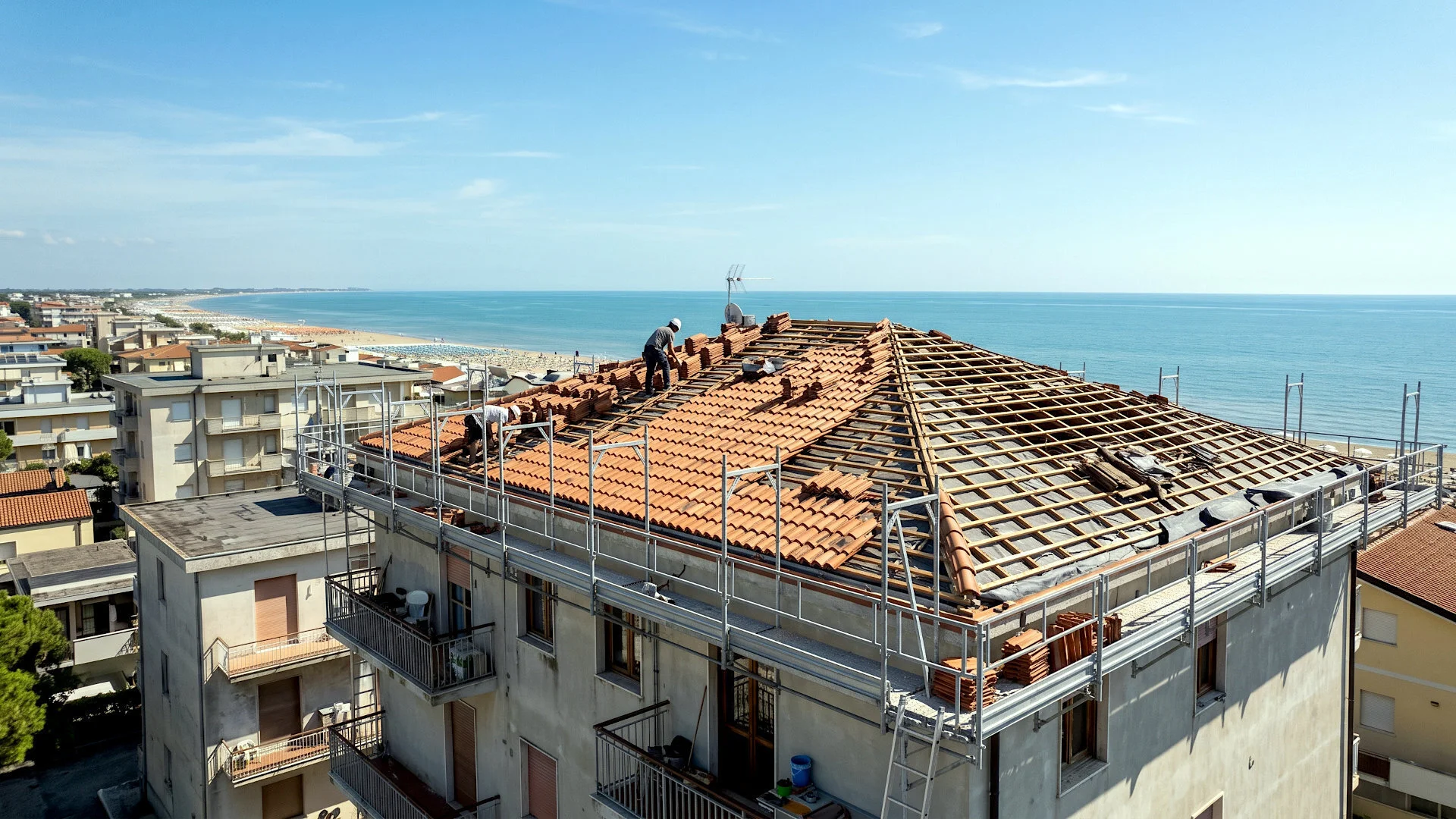
For a seaside home this carries real weight. Between salt air, damp and apartment buildings that are no longer young, a facade or a roof to redo is a real cost. Anyone buying the bare ownership should look at the condition of the building as if they were moving in tomorrow, because the major work is theirs.
The advantages for those who sell and keep the usufruct
The first advantage for the seller is the most obvious: you receive the value of the bare ownership today and go on living in the home as before. In the €240,000 example, at age 74 the tax value of the bare ownership is €156,000.
The second is that the home stays at your disposal for the rest of your life. You can spend the summer there, lend it to your children, let it and keep the rent, because the usufructuary has the right to draw every benefit from the home. If you let it, the same tax rules apply as for any owner who lets a property: you will find them in the guide to the taxation of short-term lets in Italy in 2026.
The third is that extraordinary work is no longer your responsibility. The roof, the floors and the stairs are paid for by the bare owner, and you are left with the interest on the sums spent.
Some costs remain. IMU, ordinary maintenance, custody and management costs are yours for as long as you hold the usufruct. And it is a choice there is no going back on: bare ownership, once sold, cannot be taken back. If instead you want to sell the whole home, the path is a different one, and I have described it in the guide on how to sell a seaside home without underselling it.
Advantages and limits for those who buy the bare ownership
For an investor the main advantage is an entry price lower than full ownership, in proportion to the usufructuary's age. While the usufruct lasts you pay no IMU, no ordinary maintenance, and you have no home to manage.
The limits need to be set out just as clearly. You do not use the home and you do not collect rent from it until the usufruct ends. You do not know when it will end, because it depends on a person's life. Your capital is tied up for all that time, and extraordinary work is yours.
There is also an effect few people know about. If the usufructuary has let the home with a lease made by public deed or bearing a data certa (a date that can be proven in law), that lease can continue for up to five years after the usufruct ends (art. 999). On the day the usufruct ends, then, the home might not be vacant.
You sell the bare ownership and keep the usufruct
For those who already own a seaside home and want cash without leaving it.
What stays with you: IMU, ordinary maintenance and custody; interest on the sums spent on extraordinary repairs.
What you get
- The value of the bare ownership straight away
- Use of the home and any rental income for life
- Extraordinary work paid for by the bare owner
You buy the bare ownership
For those investing with a long horizon who do not need the home now.
What stays with you: extraordinary repairs; A wait of uncertain length, with no use and no rent.
What you get
- A price linked to the usufructuary's age, lower than the full value
- No IMU and no ordinary maintenance while the usufruct lasts
- Full ownership when the usufruct ends
In this transaction, buyer and seller are not opponents: they share a length of time that neither of them knows. That is another reason why the right price starts from a serious valuation of full ownership, even before the table of coefficients.
What to check before signing
A bare ownership transaction is completed before a notary, like any property sale in Italy; the notary is a public official who draws up the deed. Purchase taxes are calculated on the value of the bare ownership, that is full ownership minus the usufruct (art. 48 of the Consolidated Law). The exact figure, including the cadastral base, is worked out by the notary on the deed.
Before you get there, though, there are checks I always have buyers and sellers make. They help you understand what you are really buying or giving up.
The checks before a bare ownership deal
Age and ID document of the usufructuary
the coefficient comes from there, and with it the whole calculation.
Usufruct for one person or several
with a right of accrual, the age of the younger one counts.
Leases in progress
those with a data certa can last up to five years after the usufruct ends.
Condition of the building and approved work
roof, facades, floors and stairs belong to the bare owner.
Cadastral income in the land registry extract
(visura catastale): it is needed to calculate the usufructuary's IMU and the tax base.
Deed creating the usufruct
it says whether the usufruct can be transferred and on what terms.
For the rest of the purchase taxes, whether you buy from a private seller or from a company, you will find the figures in the guide on what it costs to buy a second home by the sea. Personal tax choices, as always, should be checked with the notary and with an accountant (commercialista).
In short: a public formula and two interests to reconcile
The bare ownership of a seaside home is valued with a formula that in 2026 uses a rate of 2.5%, even though the legal interest rate is 1.60%. The value of the usufruct depends on age: at 74 it is 35% of the full value, at 62 it is 55%. The usufructuary pays IMU and ordinary maintenance, the bare owner pays for extraordinary work. The usufruct ends with the usufructuary's life, and nobody knows when.
It is a transaction that can serve both sides well, if the figures are clear from the start and the home is valued on site. Tables and articles give you the frame; the starting value has to be measured on the property.
Book a meeting with Massimo Ongaro at our agency in Eraclea Mare: we start from the value of the home, the age of the usufructuary and the condition of the building, and we look together at whether bare ownership is right for you, with no obligation on your part.
To reason on a real value, look at the homes for sale in Eraclea Mare and the residences in the area: the calculation always starts from the price of full ownership.
How is the value of bare ownership calculated in Italy in 2026?
You multiply the value of full ownership by 2.5% and the result by the coefficient linked to the usufructuary's age: this gives the value of the usufruct. The bare ownership is the difference between full ownership and usufruct. For a home worth €240,000 and a usufructuary aged 74, the usufruct is worth €84,000 and the bare ownership €156,000.
Why is usufruct valued at 2.5% if the legal interest rate is 1.60%?
Because article 46, paragraph 5-ter, of Presidential Decree 131/1986 prohibits using a rate below 2.5% to put a value on a usufruct. The decree of the Ministry of Economy and Finance of 24 December 2025 confirms this for 2026: the table of coefficients is still calculated at 2.5%. The 1.60% rate applies to interest under civil law.
Who pays IMU when a home in Italy is held in usufruct?
The usufructuary. Law 160/2019 names the usufructuary as the person liable for IMU, and the Civil Code (art. 1008) places taxes and annual charges on them. In Eraclea, for a seaside home that is not a main residence, the rate is 0.97% of the cadastral income increased by 5% and multiplied by 160.
Who pays for extraordinary repairs, such as a new roof?
The bare owner. Article 1005 of the Italian Civil Code places extraordinary repairs on the bare owner, such as load-bearing walls, beams, roofs, floors and stairs. While the usufruct lasts, the usufructuary pays the bare owner interest on the sums spent and takes care of ordinary maintenance.
How long does a usufruct last?
At most for the usufructuary's lifetime, as article 979 of the Italian Civil Code provides. It ends earlier if it is not exercised for twenty years, if usufruct and ownership end up with the same person, or if the home is completely destroyed. When it ends, the bare owner has full ownership.
Can the usufructuary let the seaside home?
Yes. The usufructuary has the right to enjoy the home and draw every benefit from it (art. 981), so they can let it and keep the rent. If a lease with a data certa is still running when the usufruct ends, it can continue for up to five years afterwards (art. 999): anyone buying the bare ownership needs to know this beforehand.