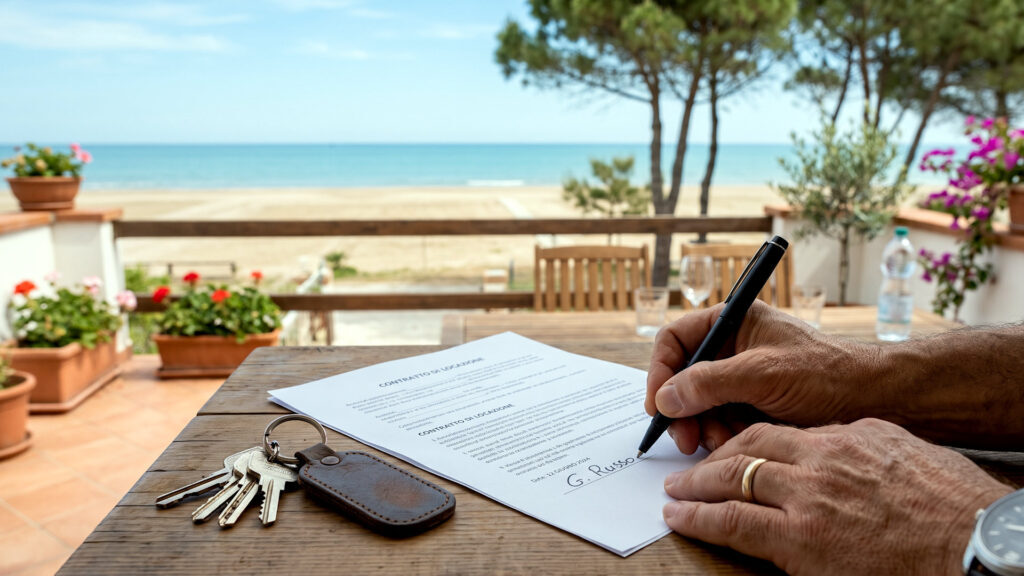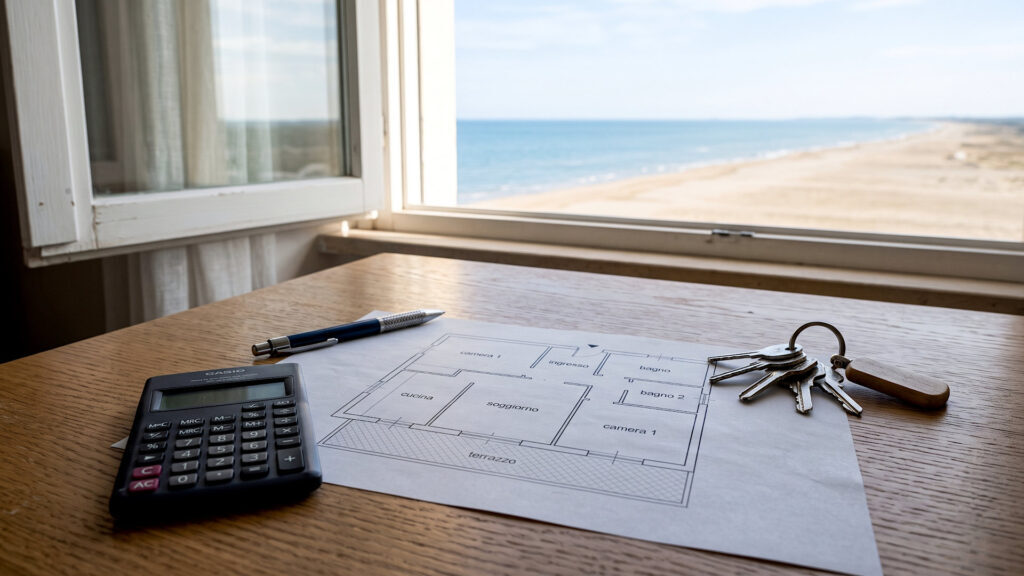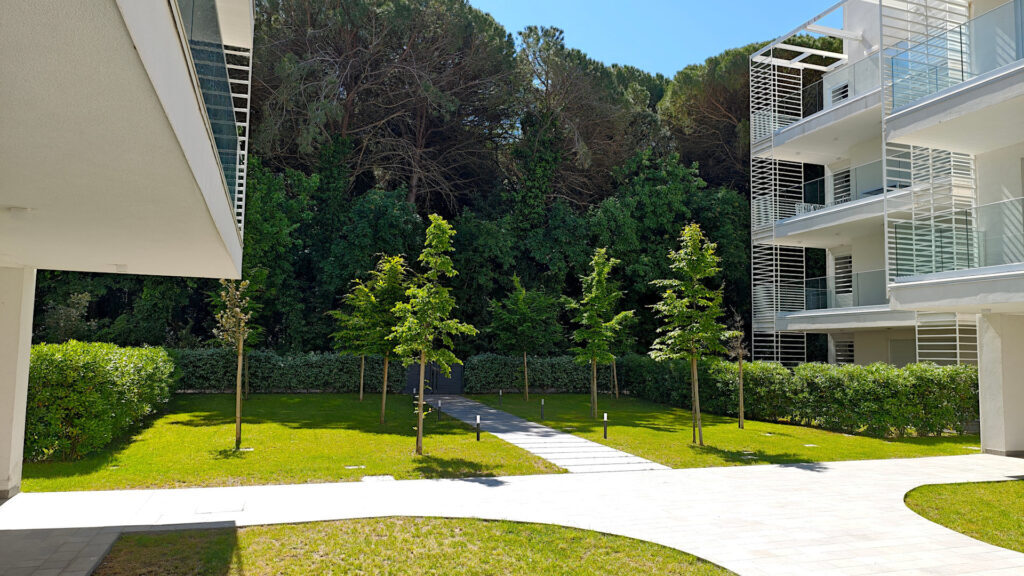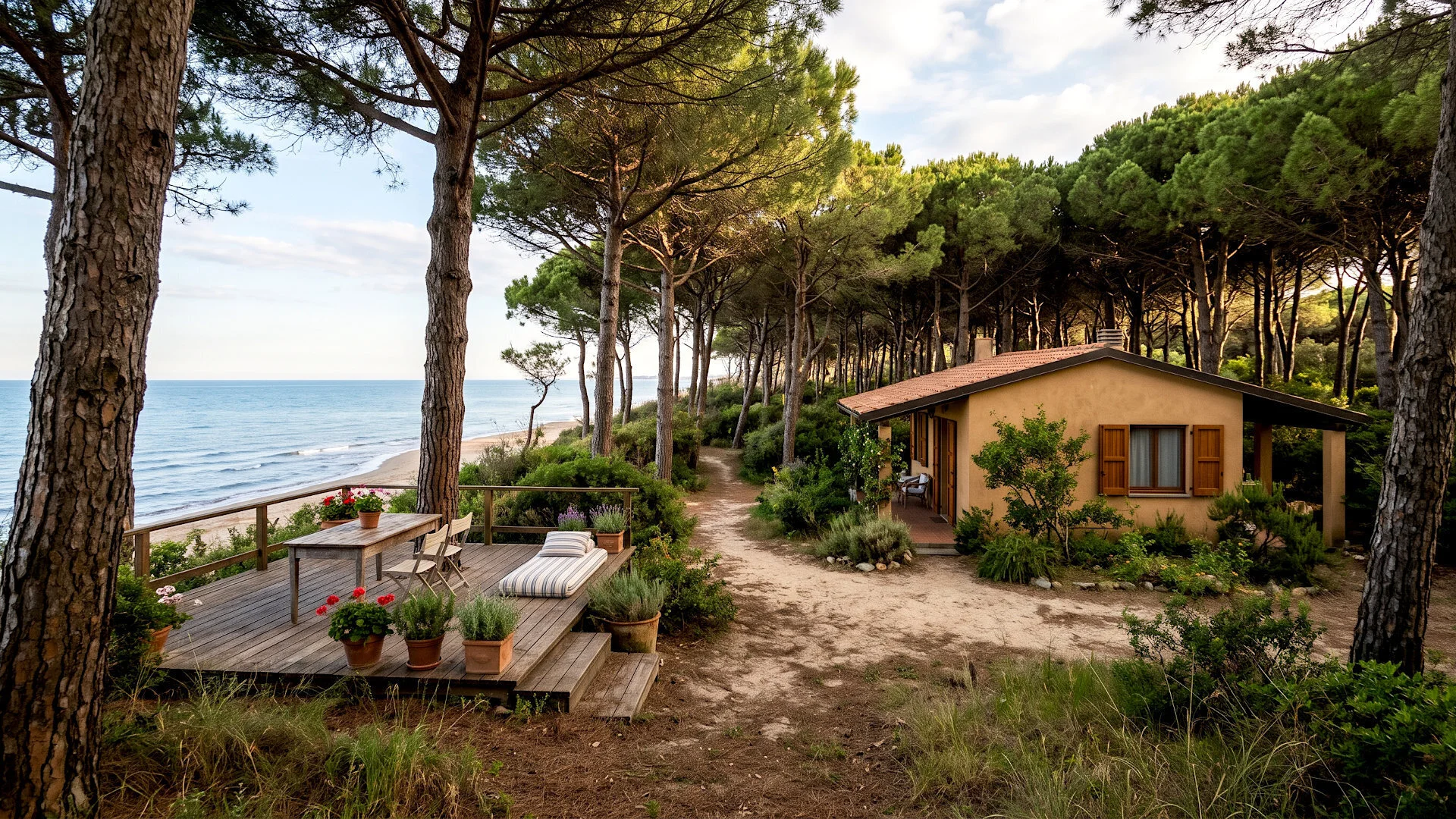
There is a precise moment when a family decides to buy a home by the sea. It is almost always the last evening of the holiday, with the suitcases already in the car and the children asking when they can come back. In my many years running ma.re.blu I have seen that scene hundreds of times, and I have learned to respect it: the wish is the right place to start. Left to itself, though, it leads to the most expensive mistakes.
Social psychologists know the mechanism well: whatever is about to end seems more precious to us. On the last evening of August a flat seen by chance becomes “the one”, and people sign an offer without having read the accounts of the building or worked out the property tax. The rules for renting it out usually come to light afterwards.
This guide lines up the answers to the questions I am asked every spring, when people start searching again. What a holiday home by the sea really costs, which taxes you can expect, where it makes sense to buy on the Venetian coast, and what changed in 2026 for anyone who rents out. I use official figures from the Agenzia delle Entrate, the Italian Revenue Agency, and from the Municipality of Eraclea, plus what you only understand by working here every day.
Why the seaside home is back at the heart of Italian families’ plans
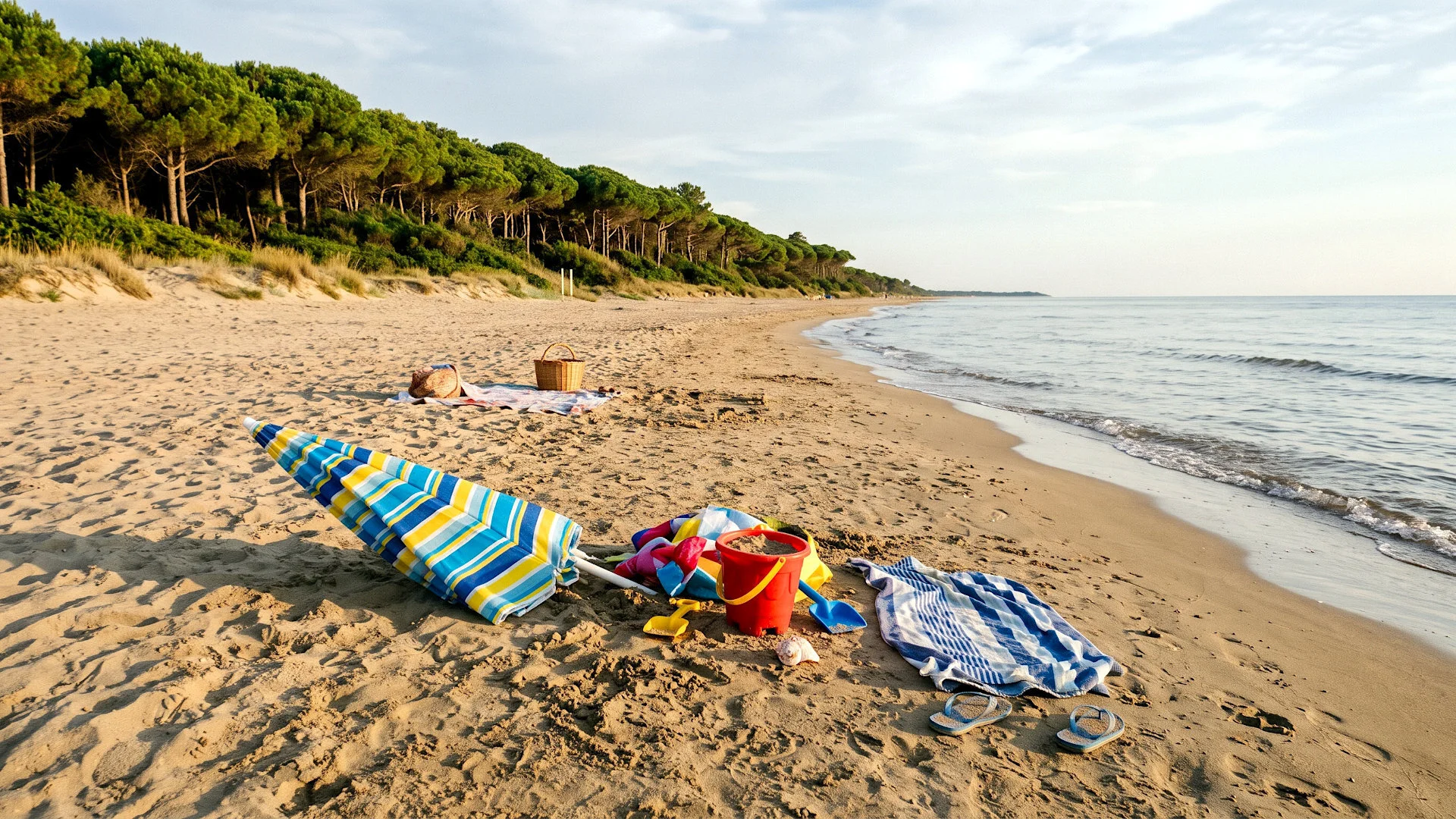
A second home by the sea is once again a concrete goal for many families, and the market figures confirm it. According to the 2026 Property Report of the Revenue Agency's property market observatory, the OMI (Osservatorio del Mercato Immobiliare), home sales in Italy came close to 767,000 in 2025, 6.4% more than in 2024. The north-east, where the Venetian coast lies, grew at the same pace.
Behind these figures is a change of mindset. After years of rising rates, monetary policy has stabilised, and bricks and mortar are once again seen as a safe haven: something solid that protects savings while inflation eats into them.
I see it in the agency too. People looking for a holiday home by the sea today rarely chase a bargain to sell on quickly. They are looking for a stable place for the family, the house to come back to every summer. It is an old idea returning, with a few new habits.
A safe haven against inflation
A second home is first of all a place to put your savings. Money sitting in the bank loses value to inflation, while a property in a well-chosen location remains a tangible asset. In Eraclea Mare, according to the OMI (first half of 2026), a home in normal condition is worth €1,700 to €2,000 per m², unchanged on the year. Homes in excellent condition have moved from €2,300-2,900 to €2,400-3,100 per m².
Read honestly, these figures do not promise quick gains. They say that the capital stays in a solid asset and that, in the meantime, your family uses it every summer.
It is the first change of perspective I ask of anyone who sits down across the desk from me. Look less at the initial outlay and more at what that money becomes: a real place, where the family builds memories and protects its wealth at the same time.
Beyond the holidays: remote work and the grandparents’ summer
Today a seaside home is used well beyond the three weeks in August. Remote work has lengthened stays: people who can log on from anywhere often choose the pine forest over the flat in town. And then there is what I call the grandparents' summer.
A house you can reach in a few hours becomes the meeting point for the extended family. The grandparents bring the grandchildren for two or three months, the parents arrive at weekends, and the initial cost is spread over many more days actually lived. It is one of the reasons why distance matters as much as price.
Does buying make more sense than a hotel holiday every year?
Many people ask me this, and it is a fair question. With the capital tied up in a second home, the argument goes, you could pay for dozens of holidays, each in a different place. On paper the sums add up; in the life of a family things work differently.
A seaside home gives you three things a hotel does not:
- stability: you leave your things there, arrive when you like, and do not chase bookings that become expensive and hard to find in July and August;
- an asset: a hotel is an expense that vanishes, the house remains yours, and in Eraclea Mare official quotations have held steady over the last year;
- family: with the grandparents available, the house becomes the fixed point where the children spend whole months of the summer.
Before going further, try a small exercise. Think back over the past year and count the times you would really have used a home by the sea: free weekends, spring bank holidays, escapes from the heat of the city. If the number is low, the hotel remains the more sensible choice, and I will tell you so plainly.
If the number is high, the rule of thumb I always repeat applies: buy within two or three hours' travel from home. Only at that distance does a property really get used. Eraclea Mare falls within this radius for most of north-east Italy (the Triveneto), Lombardy and Emilia-Romagna. A house far away, however beautiful, ends up being opened for one week in August.
Choosing the location: Jesolo, Caorle or Eraclea Mare compared
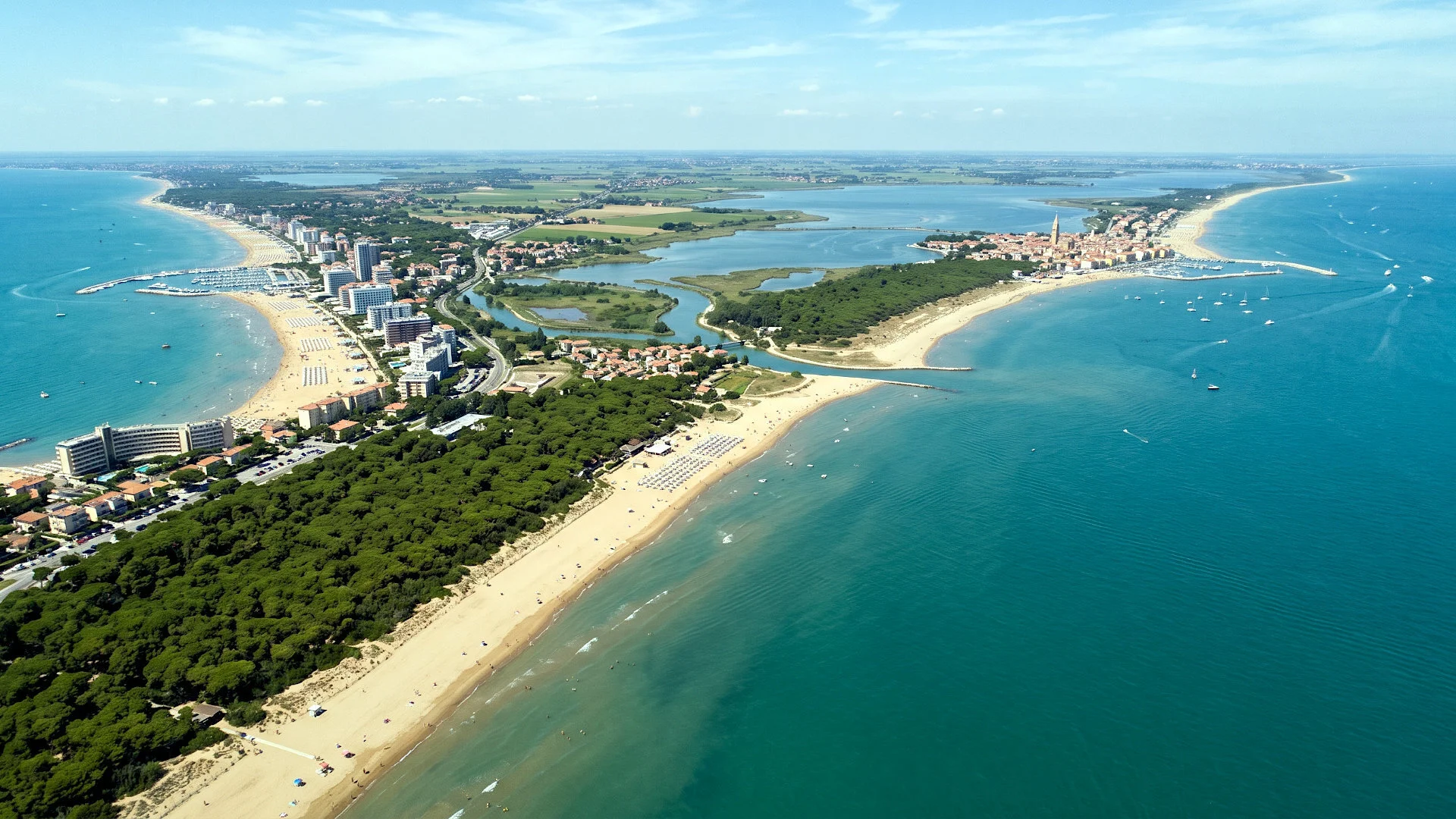
On the eastern Venetian coast, three names compete for families: Jesolo, Caorle and Eraclea Mare. They have different prices, rhythms and characters, and the same sum buys opposite experiences. To compare them I use a single yardstick: the official OMI quotations for the first half of 2026, zone by zone.
| Town (province of Venice) | OMI zone | Normal condition (€/m²) | Excellent condition (€/m²) |
|---|---|---|---|
| Jesolo | E3 Lido Ovest | 2,400-3,000 | 3,500-4,400 |
| Jesolo | E4 Lido Est | 2,100-2,600 | 3,300-4,400 |
| Jesolo | E6 Pineta | 2,000-2,500 | 2,350-3,400 |
| Caorle | Historic centre | 2,400-3,500 | 3,000-4,500 |
| Caorle | Levante and Ponente beach area | 2,400-2,800 | 3,100-4,300 |
| Eraclea | E6 Eraclea Mare | 1,700-2,000 | 2,400-3,100 |
Source: Italian Revenue Agency, Osservatorio del Mercato Immobiliare (OMI), quotations for the first half of 2026. Standard residential homes, euros per square metre of gross floor area.
The figures describe three worlds. Jesolo is the most expensive market: large complexes, services, nightlife. In the best zones of the Lido, the OMI reaches €4,400 per m² for homes in excellent condition. In high season the pace is intense, and for a family with small children it can become chaotic.
Caorle sits in the upper-middle range, supported by the charm of its historic centre and its fishing tradition. In the historic centre the OMI gives €2,400 to €3,500 per m² in normal condition, and in the Levante and Ponente beach area €2,400 to €2,800 per m².
Eraclea Mare is the most interesting market for anyone weighing price against quality of life. In normal condition a home is worth €1,700 to €2,000 per m²: the lowest range among the seaside zones in the table, and unchanged on the year. In excellent condition it rises to €2,400-3,100 per m².
For villas and detached houses the OMI does not publish a quotation in this zone. The value of a detached house is therefore estimated case by case, by looking at the property rather than at an average.
I know what you are thinking: if it costs less, there must be a reason. There is one, and it is worth looking at closely before drawing conclusions.
Eraclea Mare: the value of the pine forest and the Laguna del Mort
Eraclea Mare has chosen a different model from its neighbours: slow tourism, a protected environment, families. Its defining feature is an old forest of stone pines (Pinus pinea) between the built-up area and the beach, protected as the Special Area of Conservation “Laguna del Mort e Pinete di Eraclea”.
That pine forest weighs on the choice of home. It gives shade in the hottest hours and separates the houses from the road. Many of the villas and flats we handle look onto the greenery or sit right in it, and that is why people looking for peace rather than crowds find it in Eraclea.
At the western end, towards the mouth of the river Piave, lies the Laguna del Mort. It is a wild haven, one of the few free and unspoilt beaches in the region, well suited to walks, birdwatching and cycling trips.
The Blue Flag, which Eraclea Mare has held since 2007 and which was confirmed in 2026, rewards the quality of the water and the environmental management of the beach. ARPAV, the Veneto regional environmental agency, rates Eraclea's waters as excellent. For a family, it means a place where the children get around by bike away from the traffic of the big resort, a short walk from protected natural areas.
The villages of the municipality and a boundary worth knowing
Around Eraclea Mare are the other villages of the municipality (frazioni), which widen the choice according to budget. Inland, Torre di Fine and Ponte Crepaldo have much lower quotations. In normal condition the OMI gives €850 to €1,050 per m² for Torre di Fine and €750 to €950 per m² for Ponte Crepaldo. These are areas for people looking for space, rural houses or land.
Then there is a misunderstanding I come across often. Duna Verde, which many people associate with Eraclea, lies in the Municipality of Caorle and falls under Caorle's OMI quotations. Knowing these boundaries is already half the work: the same sum, moved a few kilometres, buys a completely different kind of property.
Have you already chosen Eraclea and are wondering whether to go for a flat or a detached house? You will find the comparison between a two-room flat in a holiday complex and a small villa in the pine forest in a dedicated article.
What buying really costs: purchase taxes and duties
The taxes on buying a second home in Italy depend on who is selling. If you buy from a private seller you pay registration tax on the cadastral value, which is almost always much lower than the price; if you buy from a building company you pay VAT on the agreed price. Understanding this difference before you make an offer is the most practical way to avoid paying more than you need to.
The tax mistake is the most expensive one, and it almost never comes from hidden rules. It comes from the fact that nobody worked them out before signing. Let us go through them with the figures.
Buying from a private seller: the advantage of the prezzo-valore rule
Buying from a private seller is the most common case for resale homes, and also the cheapest. If you buy as a private individual, the taxes are calculated on the cadastral value, thanks to the mechanism known as prezzo-valore. You have to ask the notary to apply it in the deed, because it does not happen automatically.
Buying from a private seller, you pay:
- registration tax (imposta di registro): 9% of the cadastral value, with a minimum of €1,000;
- mortgage tax (imposta ipotecaria): a fixed €50;
- cadastral tax (imposta catastale): a fixed €50.
The cadastral value of a second home is obtained by increasing the cadastral income (rendita catastale, the notional income recorded in the land registry, the catasto) by 5% and multiplying it by 120; for a main home the multiplier is 110. Take a flat in Eraclea Mare with a cadastral income of €600:
€600 × 1.05 × 120 = €75,600 of cadastral value.
Registration tax at 9% on €75,600 comes to €6,804, far less than 9% calculated on a purchase price of €200,000. That is the gap between those who calculate first and those who find out afterwards.
Buying from a company: when VAT applies
If you buy a new or renovated property from the company that built it, within five years of the end of the work, the rule changes. Instead of proportional registration tax you pay VAT on the actual price: 10%, rising to 22% for the luxury categories A/1, A/8 and A/9. Registration, mortgage and cadastral taxes become fixed at €200 each, €600 in total.
You buy from a private seller
Taxes are calculated on the cadastral value, if you ask the notary for the prezzo-valore rule.
What you pay
- registration tax at 9% of the cadastral value, minimum €1,000
- fixed mortgage tax of €50
- fixed cadastral tax of €50
You buy from a company within five years of the work
Taxes are calculated on the price agreed in the deed.
What you pay
- VAT at 10%, or 22% for categories A/1, A/8 and A/9
- fixed registration tax of €200
- fixed mortgage tax of €200
- fixed cadastral tax of €200
Neither route always wins: it depends on the property and on the seller. The cadastral data are all you need to turn an estimate into a precise figure, and it pays to have that figure in hand before making an offer. The items one by one, notary included, are in the guide to taxes on buying a second home.
What it costs to run a holiday home by the sea
In our experience, running a 60 m² flat in Eraclea Mare costs between €1,500 and €2,000 a year. The main item is IMU, then come TARI, building service charges and the minimum utility bills. It is a predictable figure, provided you know it before you sign.
The fear I hear most often is that taxes and costs will eat away the value of the house. The answer depends on how well you know the numbers in advance, and you will find them all here.
IMU is the municipal property tax on second homes. The standard national rate is 0.86% and municipalities can raise it to 1.06%. In the Municipality of Eraclea, for 2025 and 2026, the rate for “other buildings”, which include holiday homes, is 0.97%. The taxable base is obtained by increasing the cadastral income by 5% and multiplying it by 160.
On top of IMU there are:
- TARI, the waste tax, due even if the property stays empty for most of the year;
- service charges (spese condominiali), if the property is in a holiday complex with services and shared areas;
- minimum bills for the utilities that stay connected.
Let us do the sums for the flat in the example, with a cadastral income of €600. IMU in Eraclea comes to 600 × 1.05 × 160 × 0.97%, around €978 a year. With service charges, TARI and minimum utilities you reach the range we usually see, from €1,500 to €2,000. If you rent it out for a few weeks, the rent covers part of it: how much depends on the property and on the calendar.
IRPEF: when the second home enters the tax return
There is a lot of confusion about IRPEF, the Italian personal income tax. If the second home is not rented out and is in the same municipality as your main home, half of its income is added to your IRPEF base, on top of IMU.
In all other cases IMU replaces IRPEF on buildings that are not let. If you live in another municipality and buy in Eraclea, the half rule does not concern you.
Renting out the home: what changed in 2026
Renting out the second home when the family is not using it is the most common way to cover the fixed costs. From 2026, however, the rules have changed. The 2026 Budget Law (Law 199/2025) lowered to two flats the threshold above which short-term letting is presumed to be a business activity.
Until 2025 you could manage up to four flats as short lets and remain a private individual. From 1 January 2026 the threshold dropped to two, and knowing it before you buy avoids costly mistakes.
Up to two flats you can operate as a private individual, without a VAT number (partita IVA). For tax purposes you choose between ordinary IRPEF taxation and the cedolare secca, a flat-rate tax on rental income: 21% on one unit of your choice, 26% on the other. These rates have applied since 1 January 2024, so the 2026 change is the threshold.
From the third flat onwards the presumption of business activity applies. You need a VAT number (ATECO code 55.20.42 for tourist lets) and must meet the obligations of a business, to be checked with an accountant (commercialista). The law counts the units let short term, not the number of contracts.
For a family buying a single home in Eraclea, partly for themselves and partly to let, the route stays simple: with the cedolare secca, 21% applies to the rent. There are, however, three obligations to know before the first guest arrives.
CIN checks are carried out by the municipality, and from 20 May 2026 EU Regulation 2024/1028 on short-term rental data also applies. For the tourist tax, the 2026 rates are set by municipal executive resolution no. 44/2025: as well as the monthly payments and returns, an annual declaration is due by 30 June.
In 2026 doing it yourself has become risky, because every wrong step carries a fine. The tax details, with worked examples, are in the guide to the taxation of short-term rentals in 2026.
The three mistakes I see most often in the field
Purchases people regret almost always stem from the same three mistakes, and they concern details that slip by when you fall in love with a house. I describe them as I see them during viewings, each with its own way of protecting yourself.
First mistake: falling in love with the living room and ignoring the building. You walk in, the light is right, you like the furniture, and the decision is made. Nobody has asked about the state of the service charges, the extraordinary works on the way, the condition of the shared areas and the pool. A façade that needs redoing can cost thousands of euros in the year after the rogito, the final deed signed before the notary.
The defence is simple: before any offer, ask for the building accounts for the last two years (rendiconto condominiale) and the minutes of the last owners' meeting. They show the real running costs and the extraordinary works already approved or on the way.
Second mistake: not checking planning compliance. A veranda enclosed without a permit, an undeclared mezzanine, a discrepancy with the land registry look like harmless details. They can invalidate the deed or block a future mortgage. It is the most technical check and the most neglected, and it has to be done before you are brought to sign, while there is still time to put things right.
Third mistake: believing that being a step from the water is the only value. A crowded seafront is not always the right choice. A house in the quiet of the pine forest, with a garden and natural shade, is often worth more to live in. Eraclea's value comes from exactly this, from the peace the seafront rarely offers.
The checks to make before the offer
Building accounts for the last two years
they show the real running costs.
Minutes of the last owners' meeting
they tell you which extraordinary works are approved or on the way.
Planning compliance
verandas, mezzanines and enclosures must have a permit.
Cadastral compliance
the floor plan must match the actual state of the home.
Shared areas and pool
look at them during the viewing, not just at the flat.
Purchase taxes
calculate them with the cadastral data, whether you buy from a private seller or a company.
This is the check that separates a predictable annual cost from a surprise worth several thousand euros. I want to be direct about this, because it is where an agent really makes the difference.
Massimo Ongaro, estate agent, ma.re.blu“In my many years running ma.re.blu I have seen many families fall in love with the furniture and overlook what really matters: planning compliance and the building's ownership tables (tabelle millesimali). The secret is to look for a safe refuge, like the homes set in our pine forest, that protects the family's wealth with clear costs from day one.”
A decision best not made alone
Buying a holiday home by the sea in 2026 is a good decision if you take it with the figures in front of you and an expert at your side. Here is the path, in the order I follow with the families I work with.
From idea to deed in six steps
Set the radius
within two or three hours' travel, the house really gets used.
Choose the town and the zone
compare the OMI quotations, not the asking prices in listings.
Calculate the purchase taxes
buying from a private seller or a company changes the bill by thousands of euros.
Estimate the annual costs
IMU, TARI, service charges and utilities, before you sign.
Check the building and compliance before the offer Key step
it is the most neglected check.
If you rent out, get CIN, safety and tourist tax in order
before the first guest.
The highlighted step is the one that makes the difference between a calm purchase and a regret, because once the offer is signed the room for manoeuvre narrows. You can set up the other five today with the figures in this guide.
For anyone looking for quality of life and well-protected capital, Eraclea Mare remains one of the soundest choices on the Venetian coast. It has stable quotations, the lowest entry range among the seaside zones compared, the pine forest and the lagoon as a backdrop, and quiet spaces for children.
The next step is to sit down with someone who knows every holiday complex, every zone and every constraint of this area. Request a personal consultation at our agency: together we look at your budget, your needs and the solutions that suit you best, with no obligation. Your summer in Eraclea can start here.
To move from theory to real homes, look at the homes for sale in Eraclea Mare and, to work out where to buy, at the residences in the area.
How much does it cost to buy a holiday home in Eraclea Mare?
According to the Italian Revenue Agency's property market observatory, the OMI (first half of 2026), a home in Eraclea Mare in normal condition is worth €1,700 to €2,000 per m² of gross floor area, and €2,400 to €3,100 per m² in excellent condition. The OMI does not publish a quotation for villas and detached houses in this zone. Purchase taxes come on top of the price; when you buy from a private seller they are calculated on the cadastral value.
What taxes do you pay when buying a second home in Italy in 2026?
From a private seller you pay 9% registration tax on the cadastral value, with a minimum of €1,000, plus €50 mortgage tax and €50 cadastral tax. From a company, within five years of the end of the work, you pay VAT at 10% on the price (22% for categories A/1, A/8 and A/9) plus €600 of fixed taxes. With a cadastral income of €600, registration tax from a private seller comes to €6,804.
How much IMU do you pay on a second home in Eraclea?
In Eraclea the IMU rate for “other buildings” is 0.97% in 2025 and 2026. The base is calculated as cadastral income × 1.05 × 160: with a cadastral income of €600, IMU is around €978 a year. With TARI, service charges and minimum utilities, we estimate €1,500 to €2,000 a year for a 60 m² flat.
What are the 2026 rules for renting out a holiday home in Italy?
From 2026 you remain a private individual with up to two flats let short term (Law 199/2025), with the cedolare secca flat-rate tax at 21% on one of your choice and 26% on the other. You need the CIN code displayed and shown in listings, gas and carbon monoxide detectors and fire extinguishers, and in Eraclea you must pay over the tourist tax, which applies all year round.
Is it worth buying a holiday home by the sea rather than staying in hotels?
Buying makes sense when you use the house several times a year and want stability. The property stays in the family, and in Eraclea Mare the OMI quotations are unchanged on the year, from €1,700 to €2,000 per m² in normal condition. The rule of thumb is to stay within two or three hours' travel, so the house gets used at weekends too.
Is it better to buy in Jesolo, Caorle or Eraclea Mare?
It depends on your profile. Jesolo offers services and nightlife at high prices: on the Lido the OMI reaches €4,400 per m² in excellent condition. Caorle has its historic centre, at €2,400 to €3,500 per m² in normal condition. Eraclea Mare offers the pine forest and the lowest range, €1,700 to €2,000 per m², often the most balanced choice for families with children.