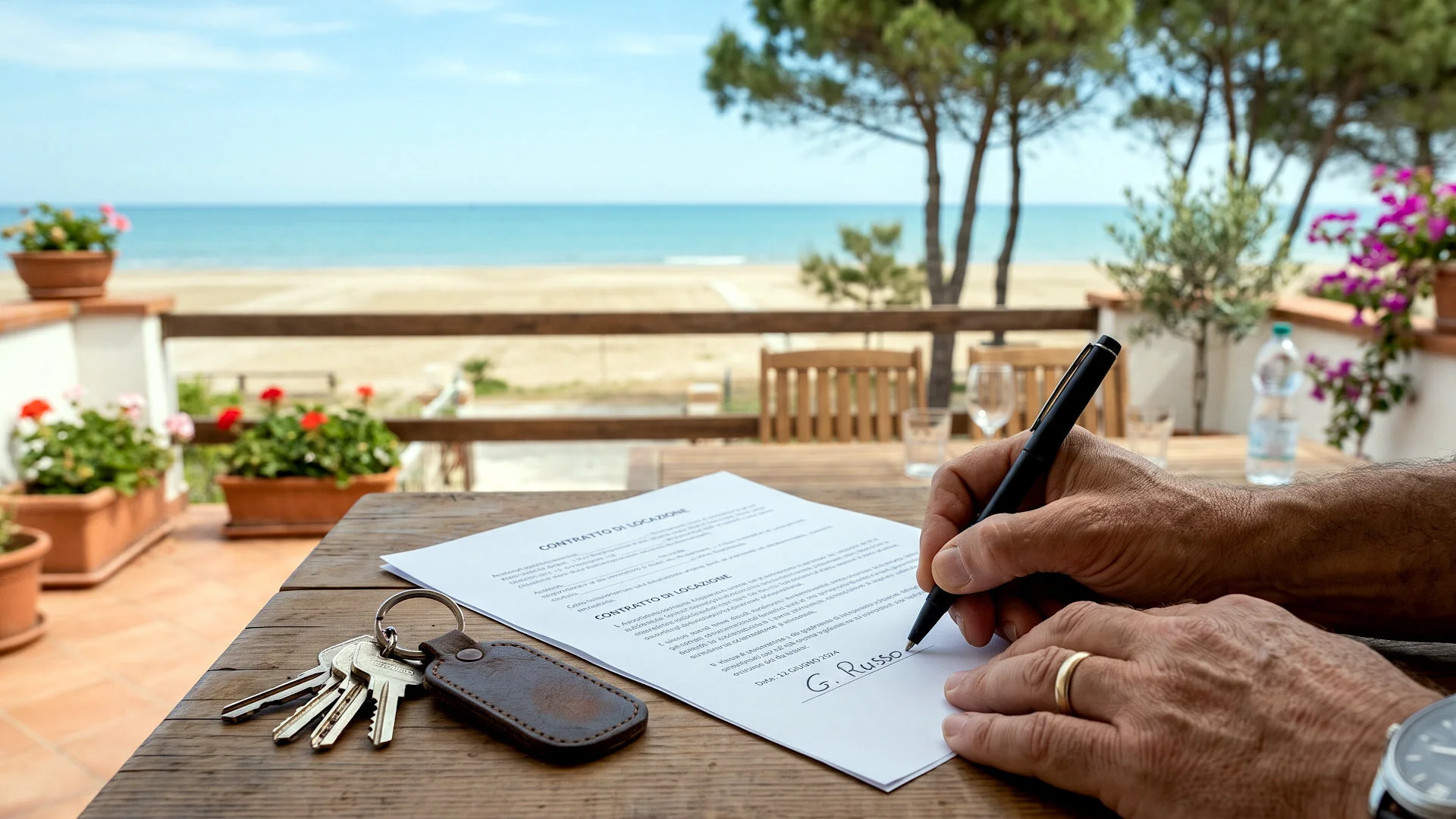
“Let's sign it tonight, so nobody takes it from us.” It is the sentence I hear most often at the end of a successful viewing, when the family is out on the terrace and the sea shows between the pines. I understand it: after months of searching, the right home makes you hurry. But the purchase offer, the proposta d'acquisto, is the sheet of paper that sets the rules for the whole sale, and it weighs more than it seems to the person signing it.
An accepted offer can already count as a preliminary contract. From that moment you are bound to buy, the deposit you have paid is at stake and a deadline starts running to register it with the Italian Revenue Agency (Agenzia delle Entrate). If you are buying with a mortgage, a badly written clause can leave you without the home, without the loan and without your deposit.
In this guide to the offer, a key step in buying property in Italy, you will find how to structure an offer for a second home, with the articles of the Italian Civil Code (codice civile) that govern it explained in plain words. You will find what changes between the two kinds of deposit, how to write the mortgage clause, what it costs to register the offer and what to check before signing. For your own specific case, the reference remains the notary or a lawyer you trust.
What a purchase offer is and when it becomes a contract
The purchase offer is the written offer in which you tell the seller on what terms you would buy their home. The contract is concluded when the seller accepts it and you learn of the acceptance. This is set out in article 1326 of the Civil Code: the contract is concluded when the person who made the offer has knowledge of the acceptance.
The same article contains two rules that matter a great deal in a negotiation. The acceptance must reach you within the deadline you set. And an acceptance that does not match the offer counts as a new offer: if the seller replies “I accept, but for 5,000 euros more”, there is no agreement yet, and the next move is yours.
What does it become once accepted? The Revenue Agency puts it in practical terms: the acceptance must be registered as a preliminary contract when the clauses of the offer are enough on their own to form a preliminary contract of sale. This usually happens with a complete offer, one that already contains the property, the price, the payments and the dates. The preliminary contract (contratto preliminare, often called the compromesso) must be made in writing and creates the obligation to sign the rogito, the final deed of sale, while ownership passes only with the notary's deed.
How long an irrevocable offer lasts
Almost all the offers I see are irrevocable for a certain period. This is article 1329 of the Civil Code: if you have committed to keep the offer open for a certain time, a withdrawal has no effect. In practice, for those days you cannot change your mind while the seller decides.
The law sets no minimum or maximum duration: you choose the deadline and write it in the offer. There is a widespread belief that an offer “is valid for thirty days by law”. That is written nowhere: thirty days is a clause, and it can be negotiated. For a second home, a deadline that gives the seller time to reply without keeping you tied up for weeks is the sensible choice.
The elements of a well-written offer
A solid offer answers in advance every question that could divide you and the seller at the time of the rogito. If an element is missing, sooner or later someone will read it their own way. Here is what it should contain, seen through the eyes of someone buying a home by the sea.
| Element | What to write | Why it matters for a second home |
|---|---|---|
| Parties | full details of the buyer and of all the owners | seaside homes are often held by several heirs or by spouses |
| Property | address, cadastral data, appurtenances (parking space, cellar) | in holiday complexes the parking space is not always included |
| Furnishings | a list of what stays in the home | many holiday homes are sold furnished |
| Price and payments | amount, deposit, balance at the rogito, means of payment | avoids arguments over how much has already been paid |
| Nature of the sum paid | caparra confirmatoria, caparra penitenziale or acconto | changes what happens if one party pulls out |
| Irrevocability deadline | date and time by which the seller replies | article 1329 of the Civil Code |
| Dates | preliminary contract (if planned) and rogito | a mortgage takes weeks between valuation and approval |
| Mortgage condition | amount, deadline, effects if the mortgage does not come through | article 1353 of the Civil Code |
| Seller's declarations | mortgages, compliance, service charges paid | these are the points that most often block the rogito |
The price remains a negotiation between you and the seller. As a reference for the area there are the Revenue Agency's quotations, which I explain in the guide on what a home in Eraclea Mare is really worth.
In a holiday home the furnishings have a value, and they must be written down. A signed list of furniture and appliances, photographed too, avoids the surprise of a dismantled kitchen on the day the keys are handed over. The same goes for the parking space: in some holiday complexes it is a separate property, with its own cadastral entry in the catasto, the Italian land registry.
Caparra confirmatoria or penitenziale: what changes
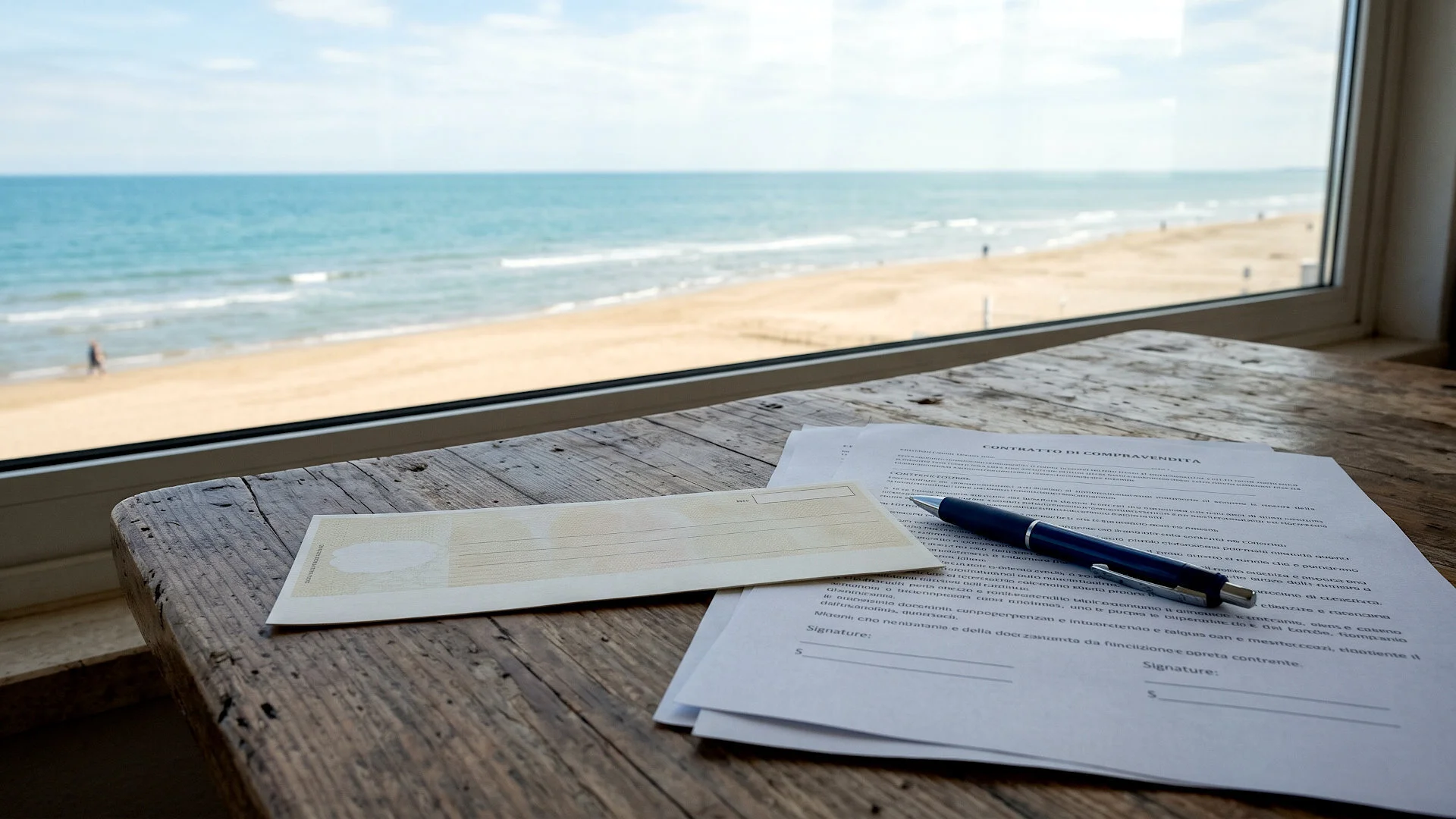
The caparra is the deposit you pay on signing, usually by cheque. The Civil Code provides for two kinds, with different effects when someone pulls out. Choosing one without knowing the difference is the most expensive mistake I see in offers written in a hurry.
Caparra confirmatoria
It strengthens the commitment to complete the deal. It is governed by article 1385 of the Civil Code.
What happens
- if all goes well, the deposit is returned or deducted from the price
- if you are the one who fails to keep the commitment, the seller can withdraw and keep it
- if the seller is the one who fails to keep it, you can withdraw and ask for double
- alternatively, the party not in default can ask for the contract to be enforced or terminated, and then compensation for damages follows the general rules
Caparra penitenziale
It is the agreed price for the right to withdraw. It is governed by article 1386 of the Civil Code.
What happens
- it applies only if the contract provides a right of withdrawal, for one or both parties
- whoever withdraws loses the deposit paid, or returns double the deposit received
- the deposit serves only as the price of withdrawal
In plain words: the caparra confirmatoria (confirmatory deposit) keeps you tied to the deal, while the caparra penitenziale (a deposit that buys the right to withdraw) leaves you a way out at a cost already written down. Which one suits you depends on how sure you are and on what the seller will accept, and it is a choice to make with someone who knows your case.
Then there is the acconto, which is something else again. The Revenue Agency defines it as an advance on the agreed price. The rules of article 1385 (keeping the deposit, asking for double) apply to sums paid “as a caparra”: if the offer says acconto, those rules do not apply.
On the tax side, however, since 2025 caparra and acconto pay the same on registration, as we will see further on. Up to 2024, the acconto paid 3% and the caparra 0.5%.
The mortgage clause: the condition that protects your deposit
If you are buying with a mortgage, the offer must depend on the mortgage being granted. The tool is the condition precedent (condizione sospensiva): article 1353 of the Civil Code allows the effect of a contract to be made subject to a future and uncertain event. The event, here, is the bank granting you the mortgage.
A mortgage clause that really protects you says at least four things:
- the amount of the mortgage you need, not a generic “subject to mortgage”;
- the deadline by which the bank must grant it, coordinated with the date of the rogito;
- what happens if the mortgage does not arrive by that deadline: the offer ceases to have effect and your deposit is returned to you;
- how you prove to the seller that the bank has said no.
The amount deserves one more line. As a general rule, the bank does not lend more than 80% of the value estimated by its surveyor, and the surveyor does not always arrive at the price you agreed. If you write the amount in the clause and the bank, after a low valuation, grants less, the condition is not met and the offer does not take effect. How the loan-to-value, the taxes and the monthly payment are calculated I explain in the guide on how to buy a seaside home with a mortgage.
There is one last point that concerns you and concerns me too. The estate agent (mediatore) is entitled to commission if the deal is concluded as a result of their work (article 1755 of the Civil Code). But if the contract is subject to a condition precedent, article 1757 states that the right to commission arises at the moment the condition is fulfilled. It is right that you know this before signing: ask for the offer, or your agreement with the agency, to say so clearly.
Registering the accepted offer: deadlines and costs
An accepted offer that counts as a preliminary contract must be registered with the Revenue Agency within 30 days of signing. The deadline was 20 days until Decree-Law 73/2022. If the sale goes through an agency, the obligation to request registration also applies to the agent. An offer that has not been accepted, on the other hand, is not registered.
There are three costs, all set out by the Revenue Agency:
- *a fixed registration tax (imposta di registro) of 200 euros*, whatever the price;
- *stamp duty (imposta di bollo)* of 16 euros every 4 pages and in any case every 100 lines (155 euros if the preliminary contract is a public deed or a private agreement authenticated by a notary);
- a proportional tax of 0.5% on sums paid as a caparra confirmatoria or as an acconto not subject to IVA (Italian VAT), for preliminary contracts signed from 1 January 2025.
The proportional tax is deducted from the tax due on the rogito, and cannot exceed it. The fixed 200 euros, on the other hand, are due in any case. An example gives you the idea, with a caparra confirmatoria of 20,000 euros.
| Sum paid on signing | Regime | Proportional tax |
|---|---|---|
| Caparra confirmatoria of €20,000 | preliminary contracts from 1 January 2025 | 0.5%, i.e. €100 |
| Acconto of €20,000 | preliminary contracts from 1 January 2025 | 0.5%, i.e. €100 |
| Acconto of €20,000 | preliminary contracts up to 31 December 2024 | 3%, i.e. €600 |
Source: Italian Revenue Agency, «Prima dell'acquisto è bene», guide «L'acquisto della casa», October 2025. The fixed €200 and the stamp duty are added to these sums.
If you are buying from a VAT-registered company, the rules change. The acconto is invoiced with VAT, and registration costs 200 euros for the acconto plus 200 for the preliminary contract. The caparra confirmatoria is not subject to VAT and pays 0.5%, again with the 200 euros for the preliminary contract.
When it pays to record the preliminary contract
The preliminary contract creates an obligation between you and the seller, but it does not make you the owner. If in the meantime the seller sold to someone else or registered a mortgage on the property, you could only claim damages. Recording the contract in the property registers (trascrizione) removes this risk: later sales and mortgages do not prejudice your rights, within the time limits the notary will explain to you.
To record it you need a notary, and the costs go up. On top of the registration tax and the 155 euros of stamp duty come the mortgage tax (imposta ipotecaria) of 200 euros and the mortgage registry fees (tasse ipotecarie) of 35 euros. It makes sense when a long time passes between the preliminary contract and the rogito, or when you pay substantial sums before the deed. The notary will tell you whether that is your case.
From offer to rogito: the steps in order
Each step has its own timing, and the mortgage is the one that takes longest. Here is the sequence I follow with families buying their seaside home with a loan.
The path of a purchase offer with a mortgage
Checks on the property
owner, mortgages, compliance, service charges, before writing a single line.
Offer signed with a deposit
price, irrevocability deadline, mortgage condition with amount and deadline.
The seller's acceptance Decisive step
when you learn of it the contract is concluded; the 30 days to register it start from the signing of the acceptance.
Registration with the Revenue Agency
a fixed €200, stamp duty and 0.5% on the deposit, which is then deducted at the rogito.
Mortgage application, valuation and the bank's approval
within the deadline written in the clause.
Notarial preliminary contract or rogito
with the balance of the price and the signing of the mortgage.
The highlighted step is the one there is no going back from. Before the acceptance only you are bound, and only for the irrevocability period; afterwards, both parties are committed.
What to check before signing
The checks are made before you sign the offer, because after the acceptance every problem turns into a negotiation. Some you can do on your own, others we do together. This is the list I use before taking a family to sign.
The checks before an offer on a second home
Mortgage search (ispezione ipotecaria)
the Revenue Agency's registers show the owner, the mortgages and any outstanding claims.
Owners and title
all the registered owners must sign the acceptance, including heirs and spouses who own jointly.
Floor plan and condition of the home
the cadastral floor plan (planimetria catastale) must match the home as it is today, enclosed verandas included.
Service charges
the accounts for the last two years and the minutes of the last owners' meeting, with any extraordinary works approved.
Appurtenances
parking space, cellar or garden, with their cadastral data.
Furnishings
the list of what stays in the home, signed by both parties.
Mortgage feasibility
before signing, know how much the bank can lend and how long it will take.
On the coast, the item that surprises people most is the building's service charges. Holiday complexes by the sea have pools, gardens and façades exposed to salt air, and extraordinary works already approved can be worth thousands of euros. If the offer does not say who pays for them, the question stays open until the rogito: read the minutes of the last owners' meeting and write into the offer who pays for them.
If you are still finding your bearings among areas, prices and purchase taxes, the starting point is the guide on how to buy a second home by the sea without mistakes.
An offer you can sign with peace of mind
The purchase offer is a short document with many consequences. Once accepted, the contract is concluded (article 1326 of the Civil Code) and, if the offer is complete, it counts as a preliminary contract to be registered within 30 days. The caparra confirmatoria ties you to the deal; the caparra penitenziale leaves you a way out at a known price. The mortgage clause protects your deposit only if it states the amount and the deadline, and only if you act in good faith.
Massimo Ongaro, estate agent at ma.re.blu“You can tell a well-written offer because at the rogito nobody has to reread it to work out what it meant. That is why we write it calmly, before anyone signs.”
Have you found the seaside home you were looking for? Come to our agency in Eraclea Mare and prepare the offer with us. We check the property's paperwork and prepare the draft with you, with the deposit, the deadlines and the mortgage clause, for the notary to review: that way you come to the signing knowing what you are signing.
An offer is written on a specific home: start with the homes for sale in Eraclea Mare and, to know what to look at in a building, with the page of Rossetto.
When does a purchase offer on a property in Italy become a contract?
When the seller accepts it and you learn of the acceptance: this is laid down by article 1326 of the Italian Civil Code. If the offer is irrevocable, however, whoever signs it is bound even before, for the period they wrote down (article 1329). If the seller accepts on different terms, the reply counts as a new offer and there is no agreement yet. A complete offer, once accepted, can count as a preliminary contract and must be registered.
How much does it cost to register an accepted offer in Italy?
According to the Italian Revenue Agency, you need 200 euros of fixed registration tax and stamp duty of 16 euros every 4 pages or 100 lines. For preliminary contracts signed from 1 January 2025, 0.5% of the caparra confirmatoria or of the acconto not subject to VAT is added. With a deposit of 20,000 euros the proportional tax comes to 100 euros, which is deducted at the rogito.
How long do you have to register an accepted offer?
Within 30 days of signing. Until Decree-Law 73/2022 the deadline was 20 days. If the deal goes through an estate agency, the obligation to request registration also applies to the agent. An offer the seller does not accept is not registered.
What is the difference between a caparra confirmatoria and a caparra penitenziale?
The caparra confirmatoria (article 1385 of the Civil Code) strengthens the commitment. If the party who paid it does not keep to the agreement, the other party can withdraw and keep it. If the party who received it does not keep to it, the other party can withdraw and ask for double. The caparra penitenziale (article 1386) is the price of withdrawing: it applies when the contract provides a right of withdrawal, and whoever withdraws loses the deposit or returns double.
What happens to the deposit if the bank does not grant the mortgage?
It depends on how the offer is written. If its effect depends on the mortgage being granted (a condition precedent, article 1353 of the Civil Code) and the clause provides for the deposit to be returned, you get it back. While you wait for the bank's answer, however, you must act in good faith (article 1358): really apply for the mortgage and hand over the documents.
How long does an irrevocable purchase offer last in Italy?
As long as you write. Article 1329 of the Civil Code makes a withdrawal ineffective for the period you set, but it lays down no minimum or maximum duration. The thirty days found in many forms are a clause, not a law, and they can be negotiated.