There is a sentence I hear almost every week at my desk in Eraclea Mare. It goes like this: “I do have the seaside home, but with all the taxes and paperwork these days, why would I bother?” I repeat it as it is, because there was a time when I thought the same. Then I spent years redoing the sums, figure by figure, with the owners who trust me.
Behind that sentence there is almost always an understandable fear and a calculation done halfway. A closed-up home costs just the same: IMU (the Italian municipal property tax), condominium fees and maintenance keep running even with the shutters down. On the other hand, a home let without precise numbers can leave you with less than you imagined at the end of the season.
Renting out a holiday home in Eraclea Mare in 2026 works, if you get the rules and costs right before you publish the listing. The advantage of our resort can be measured: according to the property values published by the Italian Revenue Agency (Agenzia delle Entrate), buying in here costs less than in the nearby Lido resorts. A higher return than Jesolo or Caorle, on the other hand, is something I will not promise you, because no official figure proves it.
In this guide we start from the market as the official data describe it and from the tax and administrative rules for 2026. Then we look at entry prices in Eraclea, Jesolo and Caorle, the items to put in your sums and the four steps to get started. Every official figure comes with its source, I state my assumptions, and where an official number is missing I tell you so.
Why in 2026 a short-term let earns more than an empty home
A second home that sits closed earns nothing and costs money in the meantime: IMU, condominium fees, minimum utility bills and maintenance run regardless. A short-term holiday let, with stays of up to 30 days, is paid in advance and gives you the home back at every changeover. It also greatly reduces the risk of tenants not paying, the fear that holds most owners back.
The national picture shows habits changing. According to Scenari Immobiliari, an Italian property research institute (report presented in March 2026), over 1.33 million new rental contracts were signed in Italy in 2025, 4.4% more than the year before. For many families renting has become a settled way of living and of travelling.
Short-term rentals in Italy: €6.5 billion and 8.5 million dormant homes
Short-term lets in Italy turn over around €6.5 billion a year (Scenari Immobiliari, March 2026). For 2026 the same institute expects rents to rise by more than 4%, but that figure covers residential letting in general, not just short-term lets. A large market does not tell you how much your home will earn: your own numbers do.
Meanwhile, in the same country, a mountain of property stands idle. The fourth Federproprietà-Censis Report (December 2025) counts 8.5 million “dormant homes”, 25.7% of the dwellings owned by private individuals. These are homes used neither as a residence nor let on a long-term basis; among them are 5.8 million second homes used for short stays or not let at all.
The reason is not technical. For 82.9% of Italians, Censis writes, the main obstacle is the fear of not getting the home back, between tenants who stop paying and long eviction times. A short-term holiday let works precisely on that fear:
- guests pay before they arrive, through the platform or by advance bank transfer, and the risk of non-payment drops to a minimum;
- the contract lasts a few days, 30 at most, and the home is yours again at every changeover;
- you remain free to use it whenever you like, keeping the periods that matter to you.
If you recognise yourself in that 82.9%, you are a careful owner who until now had the wrong tool in mind. Traditional long-term letting and short-term letting are two different games, with different risks.
The eastern Veneto coast holds steady: 22.7 million overnight stays a year
The eastern Veneto coast steadily records around 22.7 million tourist overnight stays a year: 22.74 million in 2024 and 22.69 million in 2025 (Veneto Region, Statistics Office). The total covers five municipalities: Cavallino-Treporti, Jesolo, Eraclea, Caorle and San Michele al Tagliamento with Bibione. Together they form one of Italy's main beach districts.
For anyone who owns a home here, this means steady demand across the coast as a whole, though not a growing one. I am not giving you an occupancy rate, because no official survey of short-term lets exists for this coast. In our experience the central weeks of July and August fill up first, while June and September take more work on prices and listings.
For the same reason you will not find a “coastal” rental yield percentage here. A yield is the ratio between what you take in and what you spent to buy. The second number comes from the Revenue Agency's OMI quotations (the official property values of its Osservatorio del Mercato Immobiliare); the first depends on your home, on the weeks you let and on your costs.
Before we get to prices, it is worth clearing away the obstacle that holds owners back most: bureaucracy.
Short-term rentals in Italy in 2026: the tax and paperwork rules to know
*In 2026 a private individual can let up to two flats short-term with the cedolare secca (a flat-rate tax on rental income), without a partita IVA (VAT number); from the third flat onwards the activity is presumed to be a business.* On top of this come the national identification code in every listing, notification to the Region and the safety requirements, which also apply to private landlords.
The rules have tightened: the CIN has been required since 2025, and in 2026 the threshold for private individuals fell to two flats. They are, however, clearly written, and a clear rule becomes an item on your to-do list. Let's go through them one by one.
Cedolare secca at 21% and 26%: how the two-tier flat tax works
The cedolare secca is a substitute tax: you pay a fixed rate on the rent you collect and are freed from IRPEF (Italian personal income tax), the regional and municipal surcharges, registration tax and stamp duty. It has worked on two tiers since 1 January 2024 (Law 213/2023), so it is not new in 2026.
- 21% on one unit of your choice in your tax return, usually the one that earns the most.
- 26% on the other units let short-term, that is, on the second flat.
The income is declared in section B of the 730 form or in *section RB of the Modello Redditi PF*** (the two Italian personal income tax returns), stating the CIN. If an intermediary collects the payments for you, it withholds 21%: this is always an advance payment, and the final reckoning is done in the tax return.
Let's take a hypothetical case: a flat in Eraclea Mare that brings in €12,000 in rent over a season. With the cedolare secca at 21% you pay €2,520 in tax, and the rest is yours, net of management costs. Without the cedolare secca, that same €12,000 would be added to your income and taxed at your marginal IRPEF rate.
In 2026 that rate is 33% on income between €28,000 and €50,000 and 43% above that, plus surcharges. Year after year the difference adds up. If you want to see the calculation applied to different cases, you will find worked examples of the cedolare secca calculation in the blog's tax guide.
When you need a VAT number for short-term rentals (the third-property threshold)
From 1 January 2026, short-term letting is presumed to be a business activity from the third flat let short-term in the same year. This is laid down by Law 199/2025 (article 1, paragraph 17). With up to two flats you remain a private individual: no VAT number and no registration with the Chamber of Commerce.
Until 2025 the limit was four flats. Lawmakers lowered it to draw a sharper line between people who top up their income with a second home and those who are, in practice, running a hospitality business. From the third flat upwards, a lot changes:
- *you lose the cedolare secca*** on all the flats, not just the extra ones;
- the income falls under ordinary IRPEF or, if you meet the requirements, the regime forfettario (a simplified flat-rate scheme for small businesses), with a 15% substitute tax (5% for the first years in the cases provided for);
- the obligations of a business arrive: Chamber of Commerce, electronic invoicing (mandatory since 2024 for flat-rate businesses too) and possibly an INPS (social security) position, to be checked with your commercialista (accountant).
For most of the owners I meet this boundary does not matter, because one or two homes stay within the private bracket. Knowing the threshold matters if one day you think of expanding, before you sign your third rogito (the notarial deed of purchase).
The CIN code: what it is, how to apply and what fines you risk
The CIN (Codice Identificativo Nazionale, national identification code) is a unique code introduced by Decree-Law 145/2023 (article 13-ter), mandatory since 1 January 2025 for tourist accommodation and short-term lets. You apply for it on the Ministry of Tourism portal, with SPID or CIE (Italy's digital identity and its electronic identity card). It does not replace the Veneto regional code, the CIR: the two exist side by side.
There are two obligations. The CIN must be displayed on the outside of the building, in compliance with planning and landscape restrictions, and it must be shown in every listing, on platforms such as Airbnb and Booking.com and on direct channels, whether yours or the agency's.
This is where I see owners take the biggest risks, almost always through oversight. The fines are far from symbolic.
Think about what removal in high season means: a listing taken down in August is a lost season, on top of the fine. The CIN gets sorted before you publish the first photo.
Mandatory safety: fire extinguishers and gas detectors in a holiday home
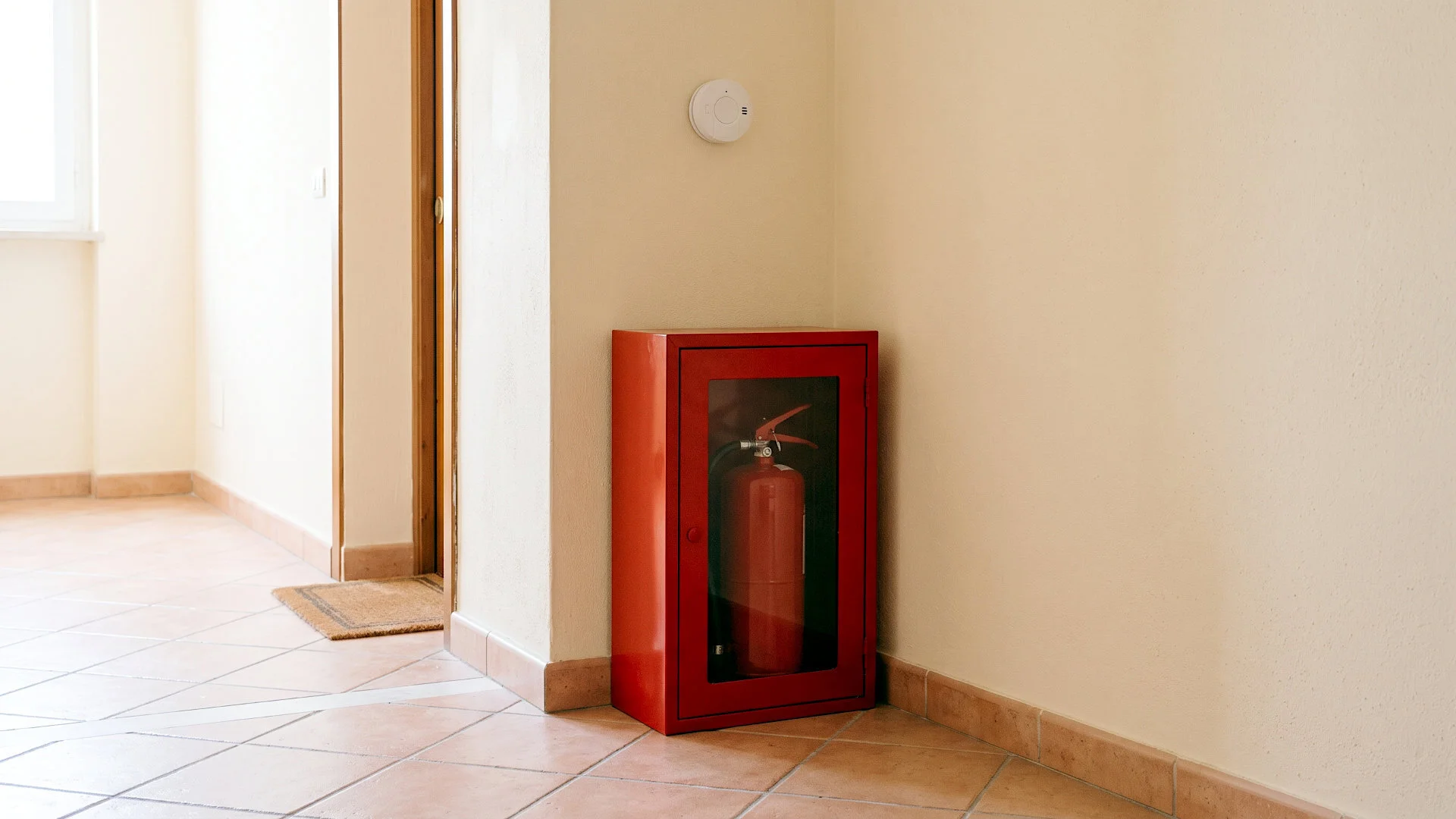
The safety rules for short-term lets also apply to private individuals, with no exceptions. Paragraph 7 of article 13-ter of Decree-Law 145/2023 requires every unit let to tourists to have working devices to detect combustible gas and carbon monoxide.
For fire safety the rule is precise: at least one fire extinguisher for every 200 square metres of floor space or part thereof and, in any case, no fewer than one extinguisher per floor, in visible and accessible places.
In our experience these are jobs costing a few hundred euros, which first-time owners tend to underestimate. The fine for anyone without them ranges from €600 to €6,000 for each breach: putting them in straight away costs far less than the fine.
The Veneto Region rules: tourist lets and the ROSS1000 portal
On top of the national rules sit the Veneto regulations, article 27-bis of Regional Law 11/2013. The key point concerns services: *a tourist let (locazione turistica) in Veneto does not allow services to guests during their stay.* If you are thinking of daily cleaning or breakfast, talk first to someone who knows the rules, because those fall outside the scope of a tourist let.
Before you start, you notify the Region that you are beginning a tourist let through the ROSS1000 portal. That is where the CIR comes from, which you need in order to apply for the CIN. Then, every month, you submit arrivals and overnight stays by the 10th of the following month, even in months without guests, entering zero movements.
The procedure is quick, but it has to be done regularly: anyone who skips it risks a fine of €1,000 to €2,000. With this you have the full map of the rules, and the question that weighs most on your wallet remains: how much it costs to buy in.
Where to buy to let: Eraclea Mare, Jesolo or Caorle?
Of the three resorts, Eraclea Mare is the one where buying in costs least, if you look at homes in normal condition. According to the Revenue Agency's OMI, a home in normal condition in Eraclea Mare is worth €1,700 to €2,000/m². In Jesolo Lido Est the range is €2,100 to €2,600/m², in the Caorle beach area €2,400 to €2,800/m².
How much the home then earns is something no official table tells you, because OMI does not publish rental values for these zones. Below are the quotations for the first half of 2026, zone by zone, next to the tourist tax paid by guests.
| Municipality and OMI zone | Normal condition (€/m²) | Excellent condition (€/m²) | Tourist tax 2026, tourist lets |
|---|---|---|---|
| Eraclea, E6 Eraclea Mare | 1,700-2,000 | 2,400-3,100 | €1.00 per person per night, all year |
| Jesolo, E6 Pineta | 2,000-2,500 | 2,350-3,400 | €1.80, April to October |
| Jesolo, E4 Lido Est | 2,100-2,600 | 3,300-4,400 | €1.80, April to October |
| Jesolo, E3 Lido Ovest | 2,400-3,000 | 3,500-4,400 | €1.80, April to October |
| Caorle, Levante and Ponente beach area | 2,400-2,800 | 3,100-4,300 | rates by type of accommodation |
| Caorle, historic centre | 2,400-3,500 | 3,000-4,500 | rates by type of accommodation |
Source: Italian Revenue Agency, property quotations database (OMI), first half of 2026, standard residential homes, €/m² of gross floor area. Tourist taxes: Municipalities of Eraclea (Executive Council resolution no. 44/2025), Jesolo and Caorle, 2026.
On a real home the comparison becomes concrete. For 70 m² gross in normal condition, the OMI range is €119,000 to €140,000 in Eraclea Mare. In Jesolo Lido Est it rises to €147,000 to €182,000, and in the Caorle beach area to €168,000 to €196,000.
Eraclea Mare: the lowest entry price among the nearby Lido resorts
Eraclea Mare is today the most accessible way in for anyone who wants a seaside home to let. In normal condition the OMI quotations are stable: from €1,750-1,950/m² in the first half of 2025 to €1,700-2,000/m² in the first half of 2026, with the midpoint unchanged. In excellent condition they went from €2,300-2,900 to €2,400-3,100/m².
A lower entry price means less capital tied up and, for the same floor area, a smaller mortgage; on its own, though, it does not mean a higher return. To say that Eraclea earns more than Jesolo or Caorle you would need official data on short-term rental income by zone, and today those data do not exist. You build the return yourself, with your home's numbers.
Areas such as Via Dancalia or Via Marinella offer trilocali (three-room flats) and terraced houses that, once done up, work well with family tourism. In our experience it is a loyal clientele, little swayed by passing fashions, that comes back year after year. It is our “green pearl”.
On running costs, the Eraclea Executive Council (resolution no. 44/2025) has set a tourist tax for tourist lets of €1.00 per person per night. It applies all year round, from 1 January to 31 December, and children up to the age of six are exempt. You pay it over to the municipality by the 15th of the following month and file the annual return by 30 June.
If you are wondering which areas and property types to look at, you can read more about areas and prices for buying a home in Eraclea Mare in the dedicated guide on the blog.
Jesolo: higher prices and a mature market
Jesolo plays a different game, built on international tourism, entertainment and a mature property market. The OMI quotations show it clearly. At Lido Ovest a home in normal condition is worth €2,400 to €3,000/m², at Lido Est €2,100 to €2,600/m², in the Pineta area €2,000 to €2,500/m². In excellent condition, at Lido Ovest and Lido Est, prices reach €4,400/m².
Beware of hasty comparisons. Jesolo Paese, at €1,300 to €1,700/m², is the inland town and not the Lido: anyone comparing a seaside home with that figure is putting two different things side by side.
Buying at the Lido therefore takes more capital: for 70 m² gross in normal condition at Lido Ovest you need €168,000 to €210,000. Guests pay a tourist tax of €1.80 for tourist lets, from April to October.
Caorle: solid tradition and high prices
Caorle sits at values close to those of Jesolo's Lido areas. The historic centre is worth €2,400 to €3,500/m² in normal condition and up to €4,500/m² in excellent condition. The Levante and Ponente beach area ranges from €2,400 to €2,800/m², up to €4,300/m² in excellent condition.
One detail surprises many clients: Porto Santa Margherita and Duna Verde are in the municipality of Caorle, not Eraclea, and have their own OMI zone. When you compare listings and quotations, always check the municipality and the zone.
The overall reading is simple. If you want to enter the market with less capital, Eraclea Mare is the most accessible location. Whether the home then earns more or less is decided by your numbers.
The right numbers: the items that decide whether the home pays
*A holiday home pays if the season's income comfortably exceeds the sum of fixed costs, management costs and the cedolare secca.* Put like that, it sounds obvious. Yet it is where I see the most mistakes: people look at the rate for Ferragosto, the mid-August holiday week, and forget everything else.
The price of the most expensive week sticks in the mind and ends up as the yardstick for the whole summer. One habit is enough to protect yourself: write down every item before you buy, or before you publish the listing, and not at the end of the season.
The items to put in your sums
Income
the weeks you actually let, each at its own rate; June, July, Ferragosto and September have very different prices, and an average leads you astray.
Management
if you delegate, the agency's commission on the rent, plus VAT.
Final cleaning
if it is included in the rate it is your cost; if you charge it separately as a flat fee, it becomes part of the cedolare secca tax base.
Fixed costs
condominium fees, utilities, insurance and a reserve for maintenance.
IMU
in Eraclea 0.97% for “other buildings”, on the rendita catastale (the cadastral income recorded at the catasto, the land registry) multiplied by 1.05 and by 160.
Cedolare secca
the 21% or 26% is calculated on your entire income, not on the margin.
An IMU example. With a cadastral income of €520 the base is 520 × 1.05 × 160 = €87,360, and at 0.97% that comes to about €847 a year. It is a cost you pay regardless, whether the home is let or closed.
The tourist tax stays out of your costs: you collect it from guests and pay it over to the municipality. It does need handling properly, though, because in Eraclea it applies all year and has its own deadlines.
I have done this calculation in full, week by week, for a three-room flat in a holiday residence: you will find it in the article on how much you earn from a seasonal let in Eraclea Mare. It is a declared example, with the assumptions written out one by one, and it shows you how much each item weighs.
4 steps to turn your second home into an income
Turning a second home into short-term rental income takes four steps in order: making the most of the property, getting compliant, setting prices and promotion, and managing hospitality and operations. Skipping one is the most common mistake. Taking them in sequence is what turns an idea into income.
1. Make the most of the home before putting it on the market
On the platforms, first impressions are made of photographs. A tidy, bright, well-kept flat lets at a higher price and fills up sooner. I am talking about making the most of the rooms, without costly renovations: fixing what looks dated, lightening the spaces, choosing furnishings that make guests feel on holiday from the cover photo onwards.
Every euro spent here goes into the sums like all the others. Spend where guests notice and where the nightly rate can really go up.
2. Get compliant: ROSS1000, CIN and cedolare secca
This is the step that frightens people, and by now you already know every piece of it. Lined up, they become a short sequence, the same one I take every owner through. *The SCIA (the certified notice of start of business activity) is only needed if you let as a business*: as a private individual you do not file it.
Compliant before the first booking
Notifying the Region
you start the tourist let on the ROSS1000 portal, which issues the CIR.
Applying for the CIN Key step
on the Ministry of Tourism portal, with SPID or CIE, before publishing any listing.
Safety
working gas and carbon monoxide detectors, one fire extinguisher per 200 square metres and at least one per floor.
Code on display
CIN displayed outside the building and written in every listing, on the platforms and on your own channels.
Tax
choose the cedolare secca and declare the rent in section B of the 730 form or section RB of the Modello Redditi PF.
Monthly deadlines
arrivals and overnight stays on ROSS1000 by the 10th, tourist tax to the municipality by the 15th.
3. Set dynamic prices and promote on the right platforms
A seaside home is worth a lot at Ferragosto and little in October, and the price has to follow it. Dynamic pricing adjusts the nightly rate to the season, weekends, events and real demand.
You also need to sync calendars across the platforms, so as not to run into double bookings. Every rate you set ends up in the season's sums, and that is where you see whether the home pays.
Then there are reviews: replying, looking after guests, building a reputation that brings in more bookings year after year. The difference between a half-empty calendar and a full one often lies entirely here.
4. Manage hospitality, cleaning and the tourist tax
The last step is the day-to-day life of the let: welcoming and registering guests, cleaning at every changeover, the tourist tax. In Eraclea you collect it and pay it over to the municipality, one euro per person per night.
Taken one at a time, these are simple tasks. Added together and multiplied by every booking in a full season they become a job, and this is where the most important decision comes in: do everything yourself or hand it over.
Managing it yourself or handing it to an agency: which really pays?
The choice between managing it yourself and handing it to an agency depends on what your time is worth and how much regulatory risk you want to carry. The answer depends on your situation: let's put the two scenarios side by side, without taking sides.
Managing it yourself
It leaves you full control and saves you the commission. It works well if you live near the home and have time to devote to it.
In return it asks for
- being there in person for changeovers and check-ins
- being reachable by guests
- full responsibility for CIN, ROSS1000, safety and tourist tax
Handing it to a local agency
It has a cost, which goes into the sums like any other item, and gives you your time back. It works if you live far away or do not want a second job.
What you get
- paperwork and deadlines handled by people who know them
- prices set season by season
- screened guests, cleaning and check-ins organised
I will tell you honestly, as an agent: if the home is your only unit and you live just round the corner, managing it yourself is feasible. If you live far away or do not want to turn the income into a second job, handing it over protects both your nerves and your numbers. Do the sums both ways and choose the one that leaves you more.
The next step for your home in Eraclea Mare
Let's recap. The eastern Veneto coast steadily records around 22.7 million overnight stays a year. The 2026 rules are clear: **cedolare secca at 21% and 26% since 2024, the two-flat threshold since 2026, CIN, ROSS1000 and a year-round tourist tax.** Among the locations on the coast, according to the OMI quotations, Eraclea Mare offers the lowest entry price.
A home kept closed out of fear of bureaucracy can become an orderly income, on one condition: the sums are done first, item by item, and not at the end of the season. The risk of non-payment drops to a minimum, time can be delegated, and the rules can be learned with a method and with someone local who knows them by heart.
If you want to know how much your property in Eraclea Mare could earn, request a rental return analysis for your property. We build it on your area, your floor area and your costs: we talk it over together, with no obligation, and turn your doubts into numbers.
To get a feel for the market, see what is on offer among the rentals in Eraclea Mare and, if you have yet to buy, among the homes for sale.
How much does a holiday home in Eraclea Mare earn in 2026?
No official figure exists for short-term rental returns by zone: the Revenue Agency's OMI publishes prices, not rents. Eraclea Mare's measurable advantage is the entry price: €1,700 to €2,000 per square metre in normal condition (first half of 2026), less than Jesolo's Lido areas and the Caorle beach area. How much your home earns depends on the weeks let, rates, costs and the cedolare secca, and has to be worked out case by case.
Do you need a VAT number to rent out a holiday home in Italy short-term?
No, if you let up to two flats short-term. From 1 January 2026 (Law 199/2025) the activity is presumed to be a business from the third flat let short-term in the same year; until 2025 the limit was four. Within two units you remain a private individual, with the cedolare secca and no registration with the Chamber of Commerce.
What is the CIN, and what do you risk without one?
The CIN is the national identification code (Codice Identificativo Nazionale), mandatory since 1 January 2025 for short-term lets (Decree-Law 145/2023). Letting without a CIN costs €800 to €8,000; not displaying it or not showing it in the listing costs €500 to €5,000, with removal of the listing. In Veneto you apply for it on the Ministry of Tourism portal after notifying the Region through ROSS1000, before you publish.
How does the cedolare secca at 21% and 26% work on short-term rentals in Italy?
It is a flat-rate tax that replaces IRPEF (Italian personal income tax), the surcharges, registration tax and stamp duty. Since 2024, 21% applies to one unit you choose in your tax return and 26% to the others, so to the second flat let short-term. The income is declared in section B of the 730 form or section RB of the Modello Redditi PF, stating the CIN.
What safety devices does a holiday home in Italy need?
Every unit let to tourists, including those of private individuals, must have working detectors for combustible gas and carbon monoxide. You need at least one fire extinguisher for every 200 square metres of floor space or part thereof, and in any case one per floor, in a visible and accessible place. Anyone without them risks €600 to €6,000 for each breach.
How much is the tourist tax in Eraclea Mare?
For tourist lets, Executive Council resolution no. 44/2025 sets €1.00 per person per night, all year round, from 1 January to 31 December. Children up to the age of six are exempt. You collect it from guests, pay it over to the municipality by the 15th of the following month and file the annual return by 30 June.
Should you manage a short-term rental yourself or use an agency?
It depends on your time and on how far you live from the home. Managing it yourself saves the commission, but it takes presence, availability and responsibility for every obligation. Handing it to a local agency has a cost, to be put in your sums, and covers paperwork, prices, guests and deadlines: it is useful above all if you live far away or have other commitments.