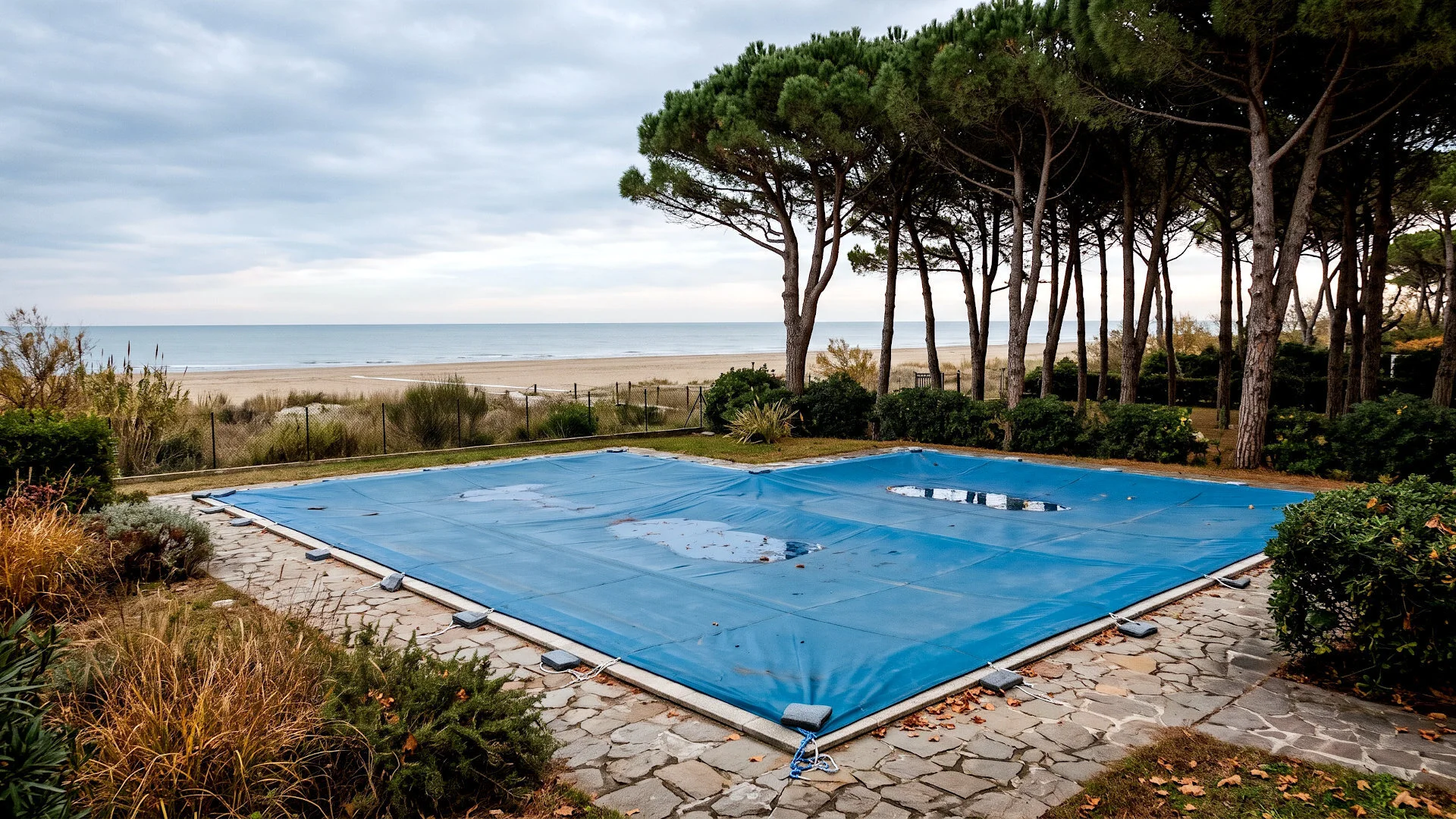
The pool in a residence, as holiday complexes with shared facilities are called in Italy, is judged in May, on the day the cover comes off. If the water can be brought back without surprises and the equipment starts up again, the season begins on time; if a contractor has to come and repair something, it begins late, and in summer everyone notices.
What you find in May depends largely on how the pool was closed in the autumn. The shared areas are closed by the contractor the owners' association has hired. But you pay for it too, through your share of the service charges, and in May you live with the consequences when you open the gate to the pool.
I have already written about closing up the apartment itself in the guide on how to protect your second home by the sea in winter. Here we talk about what you share with the other owners: the pool, the irrigation, the garden and the outdoor furniture. And about the autumn owners' meeting, where it is decided whether next season opens in good order or with a building site beside the pool.
Who decides and who pays for closing the complex’s shared areas
In a holiday complex, closing the shared areas for the winter is maintenance carried out by the condominio, the association of all the owners. The building manager (amministratore di condominio) organises it, the contractor carries it out and the owners pay for it through the service charges. The more expensive choices, such as replacing an installation or relaying paving, are instead up to the owners' meeting (assemblea di condominio).
The Italian Civil Code (Codice civile) divides the tasks fairly clearly. Article 1130 gives the building manager three jobs here: carrying out the meeting's resolutions, paying for the routine maintenance of the shared parts and taking “protective measures” (atti conservativi) for the shared parts of the building. Closing the pool, draining the irrigation and putting the furniture under cover usually fall within this year-in, year-out work.
Extraordinary maintenance work, on the other hand, is decided by the owners' meeting, under article 1135. That is why autumn counts twice: it is the season when things are closed up, and often also the one when the owners meet to decide what to do before reopening.
For an owner who lives far away, the practical point is one thing: knowing what to ask. The building manager works for all the owners, and a precise question asked in November carries more weight than a complaint made in June.
How to winterise a communal swimming pool
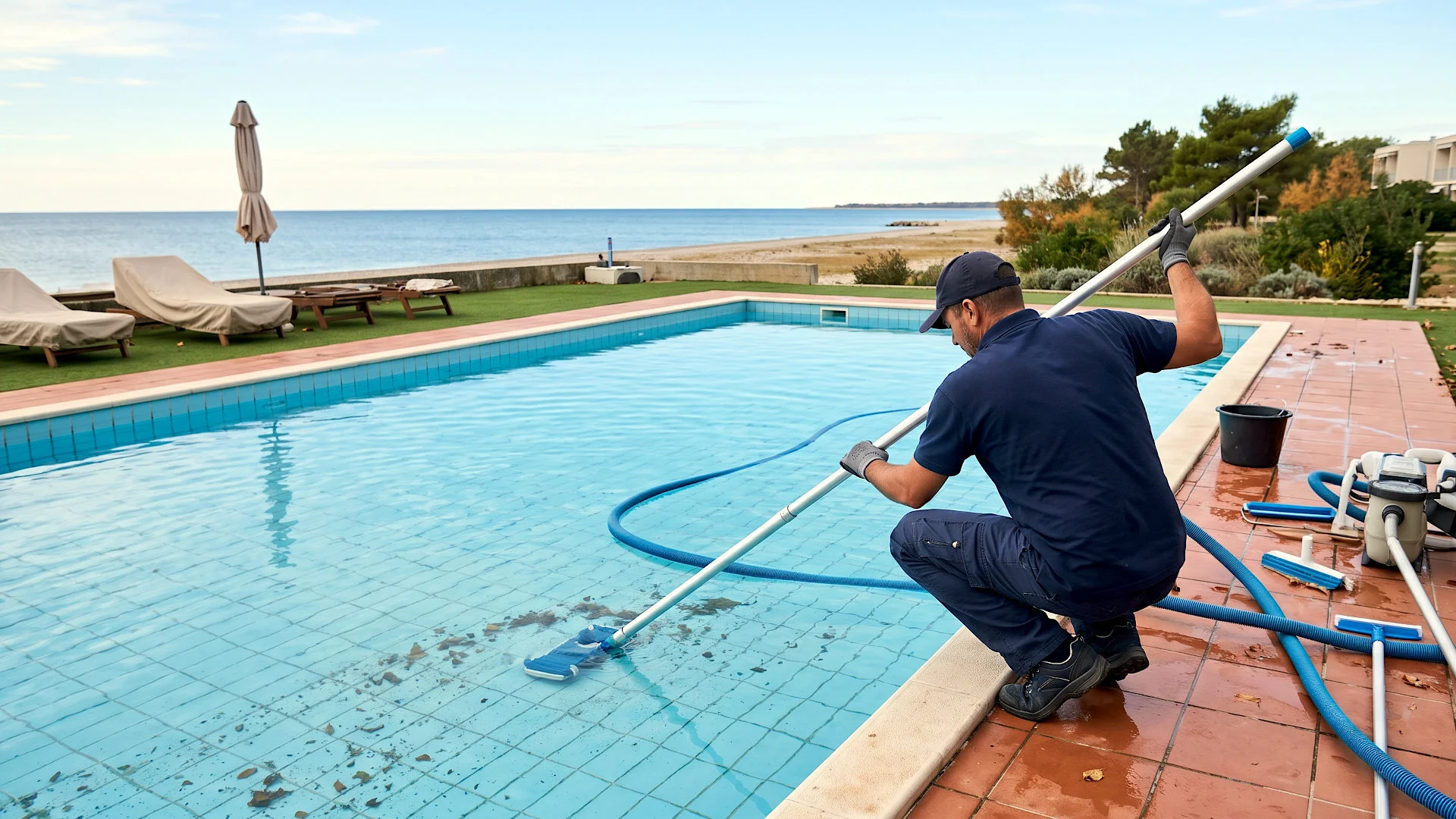
Winterising a communal swimming pool is the sequence of steps that puts it to rest for the cold months. It includes cleaning, winter treatment of the water, lowering the level below the skimmers, protecting the equipment from frost and fitting the cover. As a rule, the pool stays full: only the level is lowered.
The reason for each step is simple. Water left standing for months gets dirty, and the winter treatment keeps it in a condition that can be recovered in spring. Water expands when it freezes, so pipes and equipment exposed to the cold need protecting. Finally, the cover keeps out leaves and pine needles, which in a complex in the pine forest fall without pause.
Winterising the pool in seven steps
Cleaning the floor, walls and skimmers
leaves, pine needles and sand removed, skimmer baskets emptied.
Winter treatment of the water
with the products and doses the pool technician specifies.
Level below the skimmers, without emptying the pool Key step
this is the step everything else depends on, and the technician decides the height based on the installation.
Frost protection for the equipment
as the manual prescribes, following the technician's choices.
Accessories removed from the edge
ladders and anything that gets in the way of fitting the cover.
Winter cover fitted and secured
with the water tubes only partly filled, to leave room for water that may freeze.
Plant room closed and tidy
chemicals stored as their safety data sheets indicate.
There is one question worth asking the technician once the job is done: how they protected the plant room from frost, and what will need doing when the pool reopens. The written answer, passed on to the building manager, becomes the first page of the spring work.
Should you drain the pool for the winter?
It is the first question many owners ask, and the short answer is no, unless the technician says otherwise. Manufacturers of winter covers ask for the level to be lowered below the skimmers, and the cover's instructions require it to rest on the water in the central part.
There is also a reason that has to do with the ground. Where the water table is high, manufacturers of pool accessories provide for a hydrostatic valve on the main drain, precisely to deal with the water beneath the pool. A pool left empty for months is a case to be assessed by someone who knows the installation and the ground it is built on. If someone at the owners' meeting suggests emptying it “to save on chemicals”, ask first for the technician's opinion in writing.
The pool file: the documents to put in order in November
Closing the pool is also the right moment to check the pool's paperwork. The hygiene and health rules come from the agreement between the Italian State and the Regions of 16 January 2003 (Accordo Stato-Regioni), which the Veneto Region adopted with resolution no. 1173 of its Regional Executive (delibera di Giunta) of 18 April 2003. In this classification, *pools that belong to a condominio are category B*.
The agreement distinguishes two kinds of checks. Internal checks are the job of the person responsible for the pool, who among other things keeps a log of the checks on the pool water, with chlorine, temperature and pH. External checks are carried out by the local health authority, according to criteria and inspection plans set by each Region.
ULSS 4 Veneto Orientale is the local health authority for the eastern Veneto. In May 2026, at a meeting in Jesolo, technicians from its public health and hygiene service (Servizio igiene e sanità pubblica) listed the documents they may ask for during an inspection, depending on the installation. Among them are:
- the self-monitoring plan (piano di autocontrollo) and the log of checks on the pool water;
- the internal regulations, with the rules of behaviour for people using the pool;
- the safety data sheets of the products used to treat the water and for cleaning;
- the declarations of conformity of the installations under Ministerial Decree (D.M.) 37/2008, the Italian rules on building installations;
- the records of maintenance of the installations and of the measuring instruments.
Nobody swims in winter, so this is when the building manager can put the file in order without hurry. Ask whether it is complete and who holds a copy: in May, with the pool to reopen, a missing document turns into a delay.
The same meeting pointed out something that bears directly on closing up. Chlorine-based products are dangerous if handled or mixed incorrectly, and the plant room must ensure they are stored properly. Leaving open canisters or damp sacks in November in a room that stays shut for five months is not a good idea.
How to protect the irrigation system from frost
The irrigation system is the great forgotten item when a complex closes up. It lies under the lawn, nobody sees it and in summer it runs by itself, so in October nobody thinks about it. The water left in the lines, however, freezes like water in any other pipe, and the damage only comes to light when the system is first switched on in spring.
Manufacturers' instructions, like the ones Rain Bird publishes for home owners, follow a precise order. First the water supply to the system is shut off, then the main shut-off valve is protected from frost by wrapping it in insulating material. Pipes and backflow preventers above ground are insulated in the same way, without blocking vents and drains.
The lines are drained with manual or automatic drain valves, or with compressed air. For compressed air the same manufacturer recommends a specialist, because the procedure may involve safety risks. In a complex with many zones and many metres of pipe, it is a job for the gardening contractor.
That leaves the controller. Putting it in rain mode stops the cycles from starting but keeps the programmes and the clock; disconnecting it from the mains means reprogramming it in spring. If the system also controls a pump, protection against accidental starts should be agreed with the installer.
Pruning, pine needles and processionary caterpillars: the complex’s garden in autumn
Many holiday complexes in Eraclea Mare have their gardens in the pine forest, among the stone pines of the Special Area of Conservation “Laguna del Mort e Pinete di Eraclea”. If you would like to know it better, I have written about it in the guide to the Eraclea Mare pine forest. For whoever runs the shared areas, the pine forest means shade in summer and work in autumn.
Pine needles pile up on the paths, in the gutters, in the pool skimmers and in the irrigation valve boxes. A thorough clean before closing stops them from sitting and rotting all winter, clogging drains that have to work from the very first day in spring.
Pine processionary caterpillars: when the nests come down
The pine processionary moth deserves its own line in the gardening contract. With the decree of 6 December 2021, the compulsory national control programme was abolished, but any orders issued by individual municipalities still apply. The health problem, meanwhile, has not changed: the stinging hairs of the caterpillars can cause skin and allergic reactions, including serious ones, in people and animals.
The winter nests form in the sunniest parts of the crown. According to guidance from the Tuscany Region, mechanical removal is the most effective technique and the one with the least environmental impact. It has to be done in winter, before the caterpillars come out, and only by specialist staff wearing protective equipment. For a complex with children and dogs in the garden, it is worth the building manager putting it in the calendar now.
Pruning, cuttings and shared furniture
Autumn pruning leaves a lot of material, and who takes it away should be written into the contract with the gardening contractor. For green waste from individual owners, Veritas, the company that collects waste in Eraclea, allows in its 2026 calendar up to 100 litres a week in the roadside bins, always loose, without bags. Anything beyond that must be taken loose to the Eraclea recycling centre, or you can book a home collection.
Before felling a pine, even a diseased or dangerous one, the building manager would do well to consult the municipality's technical office (Ufficio tecnico del Comune). In a protected pine forest area, it pays to clarify first what is required.
That leaves the shared furniture: sun loungers, umbrellas, chairs from the pool area, barbecue tables. Everything that can be moved goes under cover, in a dry room, with a list of what has been stored and where.
Which works to decide at the autumn owners’ meeting
The autumn owners' meeting is when a holiday complex decides how it will open the following season. Works decided in November leave time for quotes, for collecting the funds and for carrying out the job in the months when nobody uses the pool. Works decided in March risk finishing after the season has started.
The Civil Code sets a few boundaries that are worth knowing before you walk into the room. For extraordinary maintenance work, article 1135 requires the meeting to set up a special fund equal to the cost of the works. An amendment in 2013 allows the fund, where the contract provides for staged payments linked to progress, to be built up in line with each individual payment.
The majorities also change with the weight of the decision. For major extraordinary repairs (riparazioni straordinarie di notevole entità), article 1136 always requires a majority of those attending that also represents at least half the value of the building. That means 500 millesimi, because in an Italian condominio each property's share of the building is expressed in thousandths. And the meeting cannot pass resolutions unless it is shown that everyone entitled to attend was properly notified.
One last deadline concerns the accounts. The building manager draws up the annual statement of accounts (rendiconto annuale della gestione) and calls the meeting to approve it within one hundred and eighty days, as article 1130 provides. Reading it before the meeting where the works are discussed tells you how much the pool cost in the last season.
Best for the complex
Works decided in autumn
The meeting votes in November and the work is done while the pool is closed.
What you get
- time to compare several quotes
- special fund collected before the work starts
- work done with the pool closed, with no guests around
- a season that opens without a building site
Works decided in spring
The meeting votes in March or April, when the winter damage can be seen. But time is then short for quotes and the fund, and there is a risk of work still under way after the season has started.
What you get
- a more precise picture of the winter damage
- decisions taken on problems already seen
I know what many owners who live far away think: “The building manager takes care of it, I pay my share and that's that.” It is an understandable position, and in a well-run complex it almost always works. But the building manager carries out what the meeting decides, and a meeting with few owners present decides with the ideas of whoever was there. A proxy with two written questions brings your voice into the room too.
The questions to ask the building manager before you leave
You don't need to become an expert in pools or installations to follow the closing of your holiday complex properly. It is enough to ask the right questions at the right moment, and to ask them in writing, so the answer stays on record. This is the list I suggest you keep to hand.
Closing the complex for the winter: what to ask
Who closes the pool and when
the contractor's name, the date and, if possible, a few photos once the job is done.
Lowered level or drained
what the technician decided, and why.
Cover and gate
cover fitted, pool area locked.
Pool file
self-monitoring plan, log of checks, internal regulations, safety data sheets, declarations of conformity.
Plant room
chemicals stored and room locked.
Irrigation
water shut off, lines drained, controller in rain mode.
Pine forest
processionary nests scheduled for removal in winter, needles cleared from paths and drains.
Garden and furniture
who takes away the prunings, sun loungers and umbrellas under cover.
Spring works
quotes on the agenda of the autumn owners' meeting.
During the winter
who comes by to check the shared areas, and who lets you know if something is wrong.
The last question is the one owners ask least. During the winter, what matters is who comes by to check the shared areas, and how quickly they let you know if the wind has shifted a cover.
Who keeps an eye on the complex when you are away
The complex has a building manager, and the shared areas are their business. Your home, on the other hand, is yours: the closed-up apartment, the storage room, the parking space, the guests if you let it in spring. The two often overlap, because a problem in the shared parts almost always reaches some apartment as well.
Someone who lives in Eraclea Mare all year round sees the complex in February too, and can come by to check when the other owners are away. If you let your home, the guide on the management mandate for holiday lets explains what you can hand over to an agency and what stays with you.
If you own an apartment in a holiday complex in Eraclea Mare and live far away, book a conversation with ma.re.blu about looking after your home. You tell me what the complex is like, how it is usually closed for the winter and what worries you, and together we work out what we can take care of while you are away.
To see what the residences here are like, look at the residences in Eraclea Mare and, if you would like to try one, the rentals.
Should you drain a communal swimming pool for the winter?
As a rule, no. Manufacturers of winter covers ask for the pool to be cleaned, the water treated and the level lowered below the skimmers. Emptying it completely is a choice to leave to the technician: where the water table is high, manufacturers provide for a hydrostatic valve on the main drain to deal with the water beneath the pool.
Does a winter pool cover make the pool safe?
No. Manufacturers' instructions say that a winter cover does not guarantee safety against people or animals falling into the water. In a holiday complex it makes sense to keep the gate to the pool area locked all winter, and rainwater that collects on the cover must be removed with a pump before it is taken off.
Which documents belong in the file of a communal pool in Italy?
Pools that belong to a condominio are category B under the agreement between the Italian State and the Regions of 16 January 2003, adopted by the Veneto Region with resolution (DGR) 1173/2003. The agreement provides for a person responsible for the pool and a log of checks on the pool water. In a presentation in Jesolo in May 2026, technicians from the local health authority ULSS 4 Veneto Orientale also listed the self-monitoring plan, internal regulations, safety data sheets for the products and declarations of conformity of the installations.
How do you protect an irrigation system from frost?
You shut off the water to the system, insulate the main shut-off valve and drain the lines with drain valves or compressed air. For compressed air Rain Bird recommends a specialist, because the procedure may involve safety risks. With the controller in rain mode, the programmes and the clock are kept until spring.
When should pine processionary nests be removed?
In winter, before the caterpillars leave the nests. Mechanical removal is indicated as the most effective technique and must only be carried out by specialist staff with protective equipment. The compulsory national control programme was abolished by the decree of 6 December 2021, but any orders issued by municipalities still apply.
What majority does an Italian owners' meeting need for major extraordinary repairs?
For major extraordinary repairs, article 1136 of the Italian Civil Code always requires a majority of those attending that also represents at least half the value of the building, that is, 500 millesimi (thousandths). For extraordinary maintenance, article 1135 also requires a special fund to be set up equal to the cost of the works.