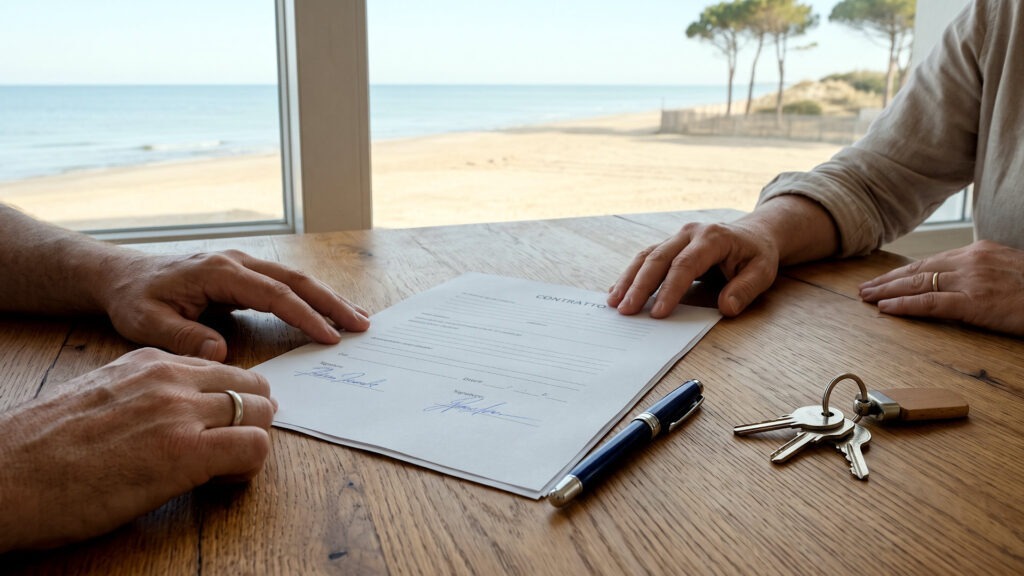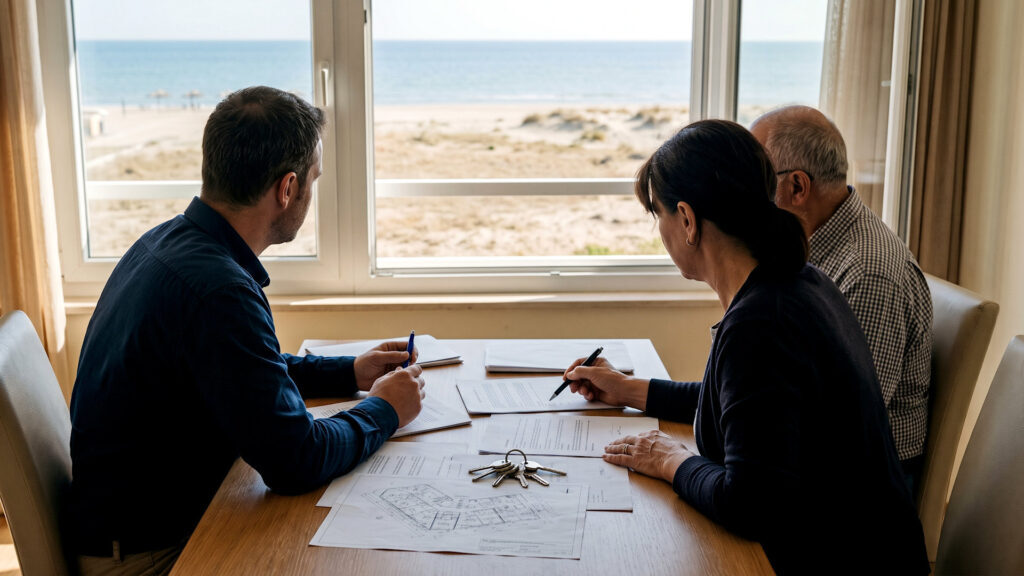
“I want to sign before Christmas,” many owners tell me at the end of the summer. They walk into the agency with the key to their seaside home in their pocket, convinced that the hard part is finding a buyer. Often the buyer turns up sooner than expected. What decides the date of the rogito, the deed of sale signed in front of a notary, is almost always the document that takes longest to obtain.
To sell a second home in the Veneto you need three families of paperwork. First come the ones the law requires on pain of nullity of the deed: cadastral compliance and the references of the building permits. Then there is the APE, the energy performance certificate: it is compulsory, and if it is missing the sale is not void, but it costs a fine. Finally there are the documents of established practice, which no law makes a condition of the deed but which the notary and the buyer will ask you for anyway.
In this guide you will find them divided this way, with the rule that requires each one, the office that issues it and the time to allow for it. Almost all the rules are national: the Veneto comes into play through its municipalities, and I will use Eraclea as a concrete example. At the end there is a checklist to print.
Which documents you need to sell a house: the short answer
Before the details, the whole picture. The distinction that matters is between legal obligation and practice, because the consequences are different: a void deed does not transfer the house, a fine gets paid, a request based on practice can be negotiated.
| Document | What it is in law | Rule | Who issues it |
|---|---|---|---|
| Cadastral extract and floor plan matching the property as it actually is | Obligation on pain of nullity | Law 52/1985, art. 29 para. 1-bis | Agenzia delle Entrate (the catasto, the property register); statement by a qualified technician |
| References of the building permit (permit, licence, retrospective permit) | Obligation on pain of nullity | Presidential Decree 380/2001, art. 46; Law 47/1985, art. 40 | Municipality, private building office (access to records) |
| Energy performance certificate (APE) | Obligation with a fine, without nullity | Legislative Decree 192/2005, arts. 6 and 15 | Certified energy assessor |
| Deed of provenance (purchase deed, gift, succession) | Basis of the notary's checks | Civil Code, art. 2650 | The notary who drew it up; the property registry (Conservatoria) |
| Registered acceptance of the inheritance (if the house was inherited) | Needed for the continuity of registrations | Civil Code, arts. 476, 2648, 2650 | Notary |
| Status of condominium payments | Practice, but the law binds the buyer to the debts | Implementing provisions of the Civil Code, art. 63 | Building manager (amministratore di condominio) |
| Agibilità, fitness for occupancy (today a certified notice) | Practice at the deed: not among the grounds for nullity | Presidential Decree 380/2001, art. 24 | Municipality (building file) |
| Declarations of conformity for the technical systems (impianti) | Practice: the obligation to hand them over has been repealed | Ministerial Decree 37/2008, art. 13, repealed | Installer |
| Zoning certificate (CDU, certificato di destinazione urbanistica) | Only for land, and for grounds of 5,000 m² or more | Presidential Decree 380/2001, art. 30 | Municipality |
Now let us look at what lies behind each row, starting with the ones that can stop the deed.
Cadastral compliance: the floor plan must look like the house
Since 1 July 2010, the deed that transfers a building must contain, on pain of nullity, the cadastral identification and a reference to the floor plans on file. It must also contain a declaration by the registered owners that the data and floor plans match the property as it actually is. This is laid down by article 29, paragraph 1-bis, of Law 52/1985, introduced by Decree-Law 78/2010.
You, the seller, sign that declaration. The law allows it to be replaced by a statement from a technician qualified to update the catasto, and that is the route I recommend almost every time: a technician's signature protects both you and the buyer. Before the signing, the notary checks that the owners recorded in the catasto match those in the property registers.
You can view the planimetria catastale, the cadastral floor plan, online through the Agenzia delle Entrate service for your own properties, logging in with SPID, CIE or CNS (the Italian digital identity, the electronic identity card or the national services card). Viewing is reserved for holders of rights in the property and their delegates. Print it and walk round the house with it: it is the simplest check, and it uncovers the problem that delays more deeds than any other.
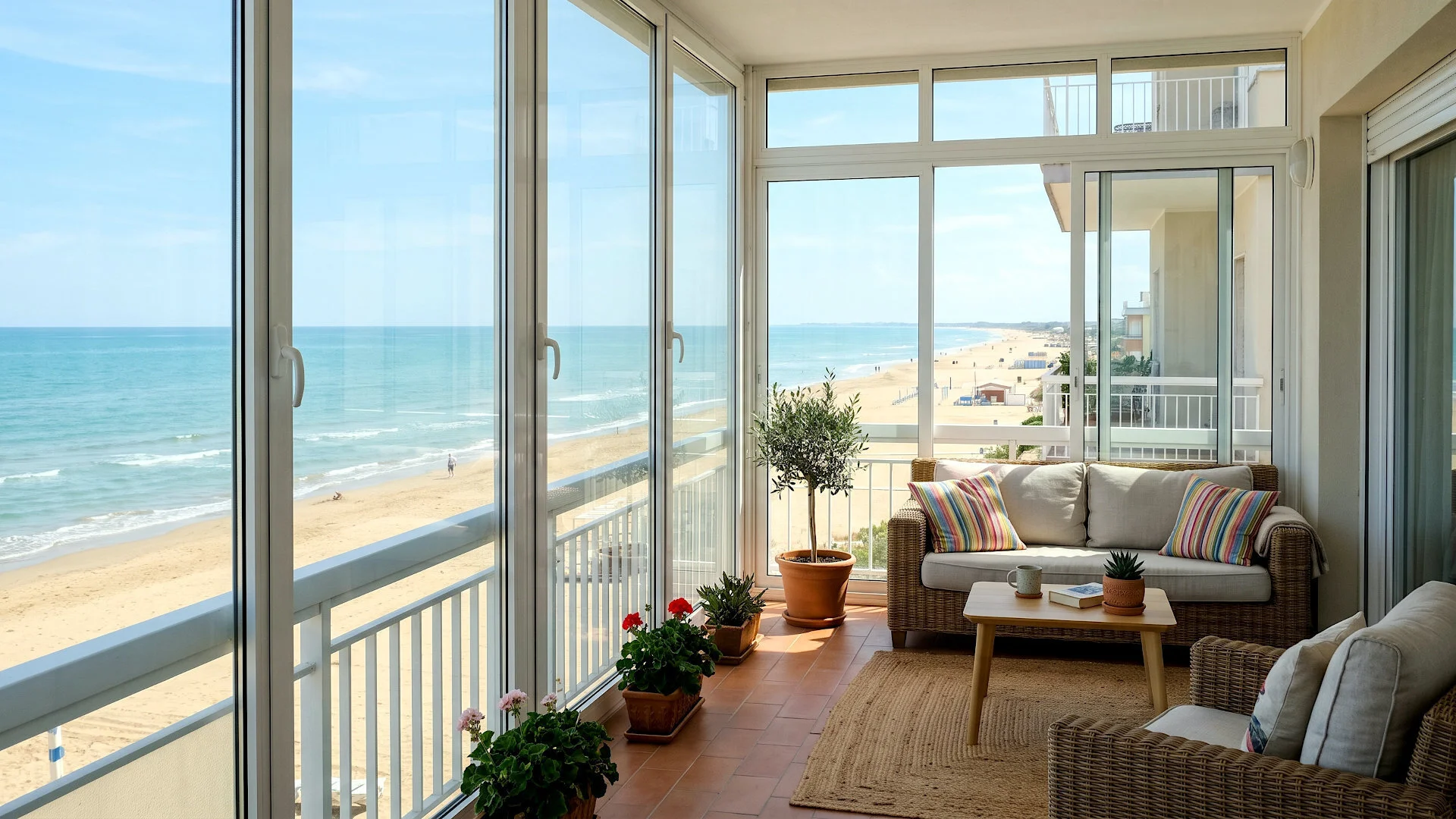
On the coast, the discrepancies I see most often are always the same: the enclosed veranda that on the floor plan is still a terrace, the kitchen moved, a wall added to make a small bedroom. If the paper does not match, the technician files the cadastral update before the deed. It is a matter of days if you find out in time; it becomes a problem if you find out at the notary's office.
Building permits: the references the notary must write into the deed
The second condition of nullity concerns building compliance. For buildings whose construction began after 17 March 1985, article 46 of the Consolidated Building Act (Presidential Decree 380/2001) states that the deed is void if it does not state, as declared by the seller, the references of the building permit or of the retrospective permit (permesso in sanatoria). The rule also applies to work carried out with a certified notice filed as an alternative to the permit.
For older houses, article 40 of Law 47/1985 applies, with the references of the licence or the concession. For work begun before 1 September 1967, a sworn declaration (dichiarazione sostitutiva di atto notorio) stating the start date can be provided. On the coast I often sell houses built before 1985, so I come across this distinction frequently.
The references are in the municipality's building file. If the deed is drawn up without them but the permit existed, the law allows it to be confirmed with a later deed. Better not to get that far: a deed that has to be redone costs everyone time and money.
Lawful status: what changed with the 2024 decree
Decree-Law 69/2024, known as Salva Casa and converted by Law 105/2024, rewrote the definition of lawful status (stato legittimo) in article 9-bis of the Consolidated Building Act. Today the lawful status is the one set by the permit that provided for the construction, or by the permit for the last work that affected the whole property, combined with the permits for partial work.
There is, however, a condition to read carefully. The latest permit counts towards lawful status only if the authority, when issuing it, checked the legitimacy of the earlier permits. A permit to redo the bathroom concerns only part of the house, so it is not enough. And even a permit covering the whole property counts only if the municipality checked the earlier ones: that is why the building history has to be reconstructed in any case.
The decree also brought in a simplification that helps in a condominium: for the lawful status of an individual unit, discrepancies in the common parts of the building do not count, and vice versa. If your holiday complex has a problem with the shared façade, that alone does not block the check on your flat.
Access to records in Eraclea: time and costs to put in the calendar
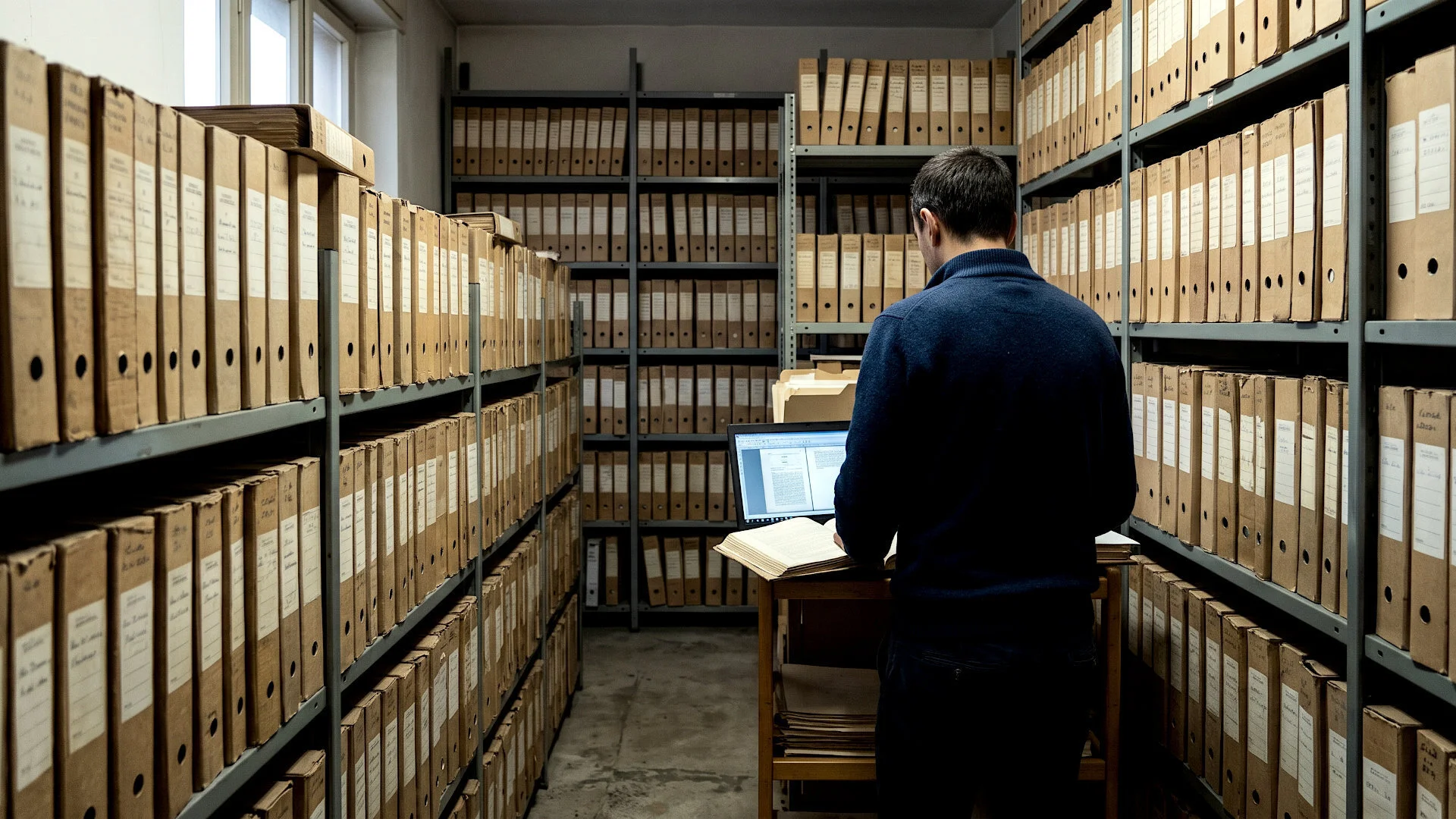
To get copies of the building permits, you file a request for access to records (accesso agli atti) with the municipality where the house is located. Each municipality in the Veneto has its own rules; Eraclea's are published and I use them as an example, because most of the houses I handle are here.
According to the service's information sheet, access to records at the Comune di Eraclea is intended precisely for those who need to verify lawful status and for those starting a sale. You fill in the form and send it by PEC (Italian certified email) or to the municipal registry office, with an identity document. The stated times are 30 days with the ordinary procedure and 15 days with the urgent one.
Determination no. 289 of 15 May 2025 changed the procedure. Since that date the municipality sends a standard set of scanned documents and charges flat-rate administrative fees:
- €50 for requests covering up to 5 building files;
- €100 for 6 to 10 files;
- €150 for more than 10 files.
Visiting the archives in person is still possible on a reasoned request, after the standard documents have been sent. My practical advice comes down to one thing: request access to records as soon as you decide to sell, not when you already have a buyer. A month's wait weighs little in September and a great deal in December.
APE: always compulsory, but the fine does not void the sale
The energy performance certificate is governed by article 6 of Legislative Decree 192/2005. The owner must make it available when negotiations begin and hand it over at the end. The deed of sale must include a clause in which the buyer declares they have received information and documentation on the APE, and a copy must be attached.
There are two fines, and it is worth not confusing them. If the deed lacks the clause or the attachment, the parties pay jointly and in equal shares between €3,000 and €18,000. If the owner sells without having obtained an APE for the house, article 15 sets a fine of €3,000 to €18,000 for the owner. In neither case does the law provide for nullity: the sale remains valid, but the fines are paid.
You need the APE well before the deed. Sale listings must show the energy performance indicators and the energy class: if they are missing, the person responsible for the listing risks a fine of €500 to €3,000. That is why we do not publish a house without an APE.
In seaside second homes this is a real risk. The boiler works a few weeks a year, the technician does not always come round, and the owner keeps an APE with a distant date in a drawer. The date written on the certificate is not enough: what counts is the history of the checks.
Inherited house: the succession is not enough, you need the acceptance
Many seaside second homes are inherited. Here the most common misunderstanding is believing that once the declaration of succession (dichiarazione di successione) has been filed and the catasto record transferred to the heirs, the house is ready to be sold. The Civil Code looks at something else: the acceptance of the inheritance, and its registration.
Article 2648 of the Civil Code provides that the acceptance of an inheritance is registered. Article 2650 sets out the principle of continuity of registrations: if the previous acquisition has not been registered, later registrations against the person who acquired it have no effect. In practice, the chain of owners in the property registers must have no gaps.
Selling an inherited property is in itself an act that presupposes the intention to accept: this is the tacit acceptance described in article 476. So you do not have to sign a separate acceptance in order to sell, but the acceptance must be registered, and the Code allows this to be done on the basis of the deed itself. If the house was inherited, tell the notary from the very first contact: the notary will check the provenance, tell you how to put the registration in order and how much it costs.
Condominium: the debts that pass to the buyer
When the house is in a holiday complex or an apartment building (a condominio, with shared parts run by a building manager), the law gives the buyer a precise reason to ask questions. Article 63 of the implementing provisions of the Civil Code states that whoever takes over is liable jointly with the seller for the contributions of the current year and the previous one.
The same rule keeps you bound too. The seller remains jointly liable for contributions that fall due until the building manager receives a certified copy of the deed of transfer. Sending it right after the deed is a five-minute job that spares you requests months later.
That is why, even though no rule calls it this, the notary and the buyer ask the building manager for a statement on the status of payments. It captures the situation on the date it is issued. The advice I always give is to ask at the same time for the list of resolutions already approved and not yet paid, so that the compromesso, the preliminary sale contract, can settle who bears those costs.
The documents of established practice: fitness for occupancy, systems and zoning certificate
Then there are documents that the law does not make conditions of the deed, but which carry weight in the negotiation. It helps to know what they are, so you are not alarmed when someone asks for them and you do not promise them if you do not have them.
Fitness for occupancy. Today the agibilità is attested by a certified notice filed with the municipality (article 24 of Presidential Decree 380/2001), covering safety, hygiene, healthiness and energy saving. The nullity rules you read about above do not mention it. The buyer will ask for it, though, and if it is missing this must be said before the offer. It is in the building file, together with the permits.
The declarations of conformity for the systems. Article 13 of Ministerial Decree 37/2008, which governed the handover of documentation on the technical systems in property transfers, was repealed in 2008. The installer's declarations are still useful, and buyers appreciate them. If you do not have them, in practice the deed can state that the buyer takes the systems in the condition they are in: this must be written clearly.
The zoning certificate. It is needed to sell land. For a flat or a small house it is not needed, unless the grounds belonging to the building reach 5,000 m² or more. In Eraclea it is issued by the municipality and is valid for one year, provided the planning instruments do not change in the meantime.
How to get organised to sell within the year
The simplest way not to miss the sales window is to work backwards: start from the date of the deed and line up the waiting times of the various offices. This is the order I follow with owners who want to close by December.
The seller's countdown calendar
Retrieve the deed of provenance and the cadastral extract
they are in the file from your purchase or the succession; the visura catastale, the cadastral extract, can be downloaded online.
Request access to records from the municipality Key step
in Eraclea it takes up to 30 days with the ordinary procedure, 15 with the urgent one.
Have a technician compare floor plan, permits and the actual state of the house
if there is a discrepancy, you now have time to fix it.
Check the APE and the boiler logbook
without an APE the house cannot be advertised in compliance with the rules.
Ask the building manager for the status of payments and the approved resolutions
you will need them for the compromesso.
If the house was inherited, talk to the notary straight away
the provenance must be checked before setting the date.
The highlighted step is the one that delays the most deeds, because it depends on an office and not on you. Starting your access-to-records request in September leaves you the margin to correct whatever emerges and still sign within the year.
The checklist of documents for selling your second home
Print it, tick off the items and bring the folder to the agency or the notary. If an item does not apply to you (for example, the house was not inherited), note anyway that you have checked it.
Documents for selling a second home
Identity document and codice fiscale (Italian tax code) of the owners
for every registered owner, including part-owners.
Deed of provenance
purchase deed, gift deed or succession documents.
Up-to-date cadastral extract
from the Agenzia delle Entrate online service.
Cadastral floor plan matching the actual state of the house
preferably with a technician's statement.
References of the building permits
permit, licence, concession or retrospective permit, from the municipality's access to records.
Valid APE with the system logbook
with the boiler checks up to date.
Acceptance of the inheritance
if the house was inherited, to be checked with the notary.
Building manager's statement on payments
with the resolutions approved and still to be paid.
Fitness for occupancy (agibilità)
if it is in the building file; if it is missing, say so beforehand.
Declarations of conformity for the systems
if you have them, attach them.
CDU (zoning certificate)
only for land or grounds of 5,000 m² or more.
Before you put it on the market, put the paperwork in order
A second home with its documents in order sells with fewer surprises. The buyer trusts it more, the notary works without postponements, and the negotiation stays on the price. Work on the paperwork done before the listing is also a selling point: you can tell anyone who views it that the house is ready for the deed.
If you are also thinking about how to present it and at what price, you will find the rest of the process in the guide on how to sell a seaside home without underselling it. For its value, read the one on what a house in Eraclea Mare is really worth. And before signing with an agency, it is worth understanding how to choose between an exclusive mandate and several agencies.
Checking the documents is the first job we do when an owner entrusts us with a sale. Ask ma.re.blu to check your home's documents before you put it on the market. We go through the cadastral extract, floor plan, permits and APE with you, tell you what is missing and whom to ask for it. Then we set a realistic date for the deed together.
To see what you are up against while you gather the papers, look at the homes for sale in Eraclea Mare and the residences in the area.
Which documents are compulsory when selling a house in Italy?
Two things are required on pain of nullity. The first is the cadastral data with the reference to the floor plans and the declaration that they match the property as it actually is (Law 52/1985, article 29). The second, for buildings begun after 17 March 1985, is the references of the building permit or of the retrospective permit (Presidential Decree 380/2001, article 46). The APE, the energy performance certificate, is compulsory, but if it is missing a fine applies, not nullity.
Can you sell a house in Italy without an APE?
The deed remains valid, but the law provides for fines. An owner who sells without an APE risks €3,000 to €18,000. The same range, jointly between the parties, applies if the deed lacks the APE clause or the attached copy. Listings without the energy class are also fined, €500 to €3,000, payable by the person responsible for the listing.
When selling inherited property in Italy, is the declaration of succession enough?
No. The Civil Code provides that the acceptance of an inheritance is registered (article 2648) and that the chain of registrations in the property registers has no gaps (article 2650). Selling an inherited property counts as tacit acceptance (article 476), which must be registered. Tell the notary from the first contact: the notary checks the provenance and tells you how to register it.
How long does it take to get the building documents from the Comune di Eraclea?
The Comune di Eraclea states 30 days with the ordinary procedure and 15 with the urgent one for access to records. Since 15 May 2025 the administrative fees have been flat-rate: €50 for up to 5 building files, €100 for 6 to 10, €150 for more than 10. If you want to sign within the year, file the request as soon as you decide to sell.
Who pays outstanding condominium fees when you sell a house in Italy?
Between the parties, the compromesso (preliminary contract) decides, but the law gives the condominium a guarantee. The buyer is jointly liable for the contributions of the current year and the previous one (article 63 of the implementing provisions of the Civil Code). The seller remains jointly liable until the building manager receives a certified copy of the deed. That is why you ask the building manager for the status of payments before the compromesso.
Do you need a zoning certificate to sell a flat in Italy?
No. The zoning certificate (CDU, certificato di destinazione urbanistica) is needed to sell land. For a flat or a small house registered in the urban catasto it is not needed, unless the grounds belonging to it reach 5,000 m² or more (Presidential Decree 380/2001, article 30). When it is needed, the municipality issues it and it is valid for one year if the planning instruments do not change.