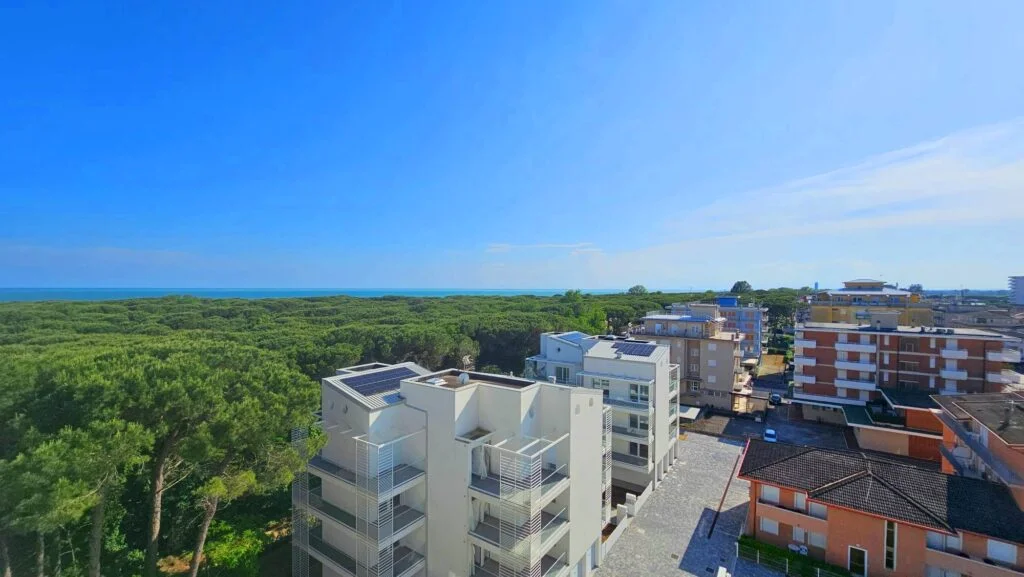
A flat by the sea with a starting price that looks like a typo. You can find one among Italy's court-ordered property sales, and the urge to bid at once is strong. The starting price, though, is only the first line of the bill. The rest is written in the expert's valuation report, in the court's sale order and in the Italian Code of Civil Procedure.
This guide explains how an Italian property auction works step by step and which costs come on top of the price. It also covers when you actually get the keys and which risks stay with you. By the end you can decide calmly whether an auction suits you, or whether a sale on the open market is the better route.
If you are weighing up a second home in Italy in general, start with the guide to buying a second home by the sea. Here we look at one particular case, with rules of its own.
What you are really buying at auction
At an auction you are not buying from a person who sells: you are buying from an enforcement procedure. The owner has debts, a creditor has seized the home and the court puts it up for sale to pay those who are owed money.
That changes everything. There is no seller to tell you about the home, no negotiation and no notary of your choice. Ownership passes by a court order, the decreto di trasferimento (transfer decree), not by a notarial deed of sale.
As a rule the judge hands the sale over to a professional: article 591-bis of the Code of Civil Procedure names a notary, a lawyer or a chartered accountant listed with the court. This delegate sets the auctions, opens the bids, receives the balance and then handles registration, transcription and cadastral update of the decree.
Next to the delegate there is the custodian, who manages the property while the procedure is open. This is the person you arrange the viewing with, and the one who will have the home vacated if someone still lives there.
Where to find seaside auctions and what to read first

Every court-ordered sale must appear on the Portale delle Vendite Pubbliche, the public sales portal of the Italian Ministry of Justice: article 490 of the Code of Civil Procedure requires it. For property, the notice, the judge's order and the valuation report must also go on dedicated websites at least forty-five days before the bidding deadline.
Forty-five days sounds like plenty. In practice it is the time to read three documents, view the home, talk to the bank and decide. The most important document is the perizia, the report of the expert appointed by the court. It describes the property, its condition, its compliance with planning and land registry rules, and its estimated value.
The second is the sale order, which sets the rules for that specific auction. Every sale order is different, and the figures that really matter (deadlines, deposit, who pays what) are found there.
What to check before you bid
Full valuation report
condition of the property, planning and land registry compliance, any irregularities flagged by the expert.
Sale order
starting price, minimum bid, deadline for the balance, how to pay the deposit.
Costs for the winning bidder
what the order puts on you and what stays with the procedure.
Occupancy
whether the home is empty, lived in by the debtor or occupied by others.
Building service charges
unpaid contributions for the current year and the previous one.
Viewing with the custodian
date, time and arrangements set by the order.
Mortgage
the bank's answer before the auction date, if you are not paying entirely from your own funds.
A viewing is not optional if you want to sleep at night. Article 560 obliges the debtor to allow viewings by potential buyers, together with the custodian and in the way the judge decides. Ask early, because the days before an auction go quickly.
Starting price, minimum bid and price cuts: how the price is set
The starting price is set by the sale order, taking the valuation report into account. You do not have to bid that figure, though. A bid is valid even below the starting price, down to a quarter less: this is the minimum bid allowed by article 571.
An example in round numbers. If the starting price is 120,000 euros, the minimum bid is 90,000 euros. Below that threshold the bid has no effect and is set aside.
If nobody bids, the judge or the delegate sets a new attempt. Article 591 allows the starting price to be cut by up to a quarter of the previous one, and after the fourth attempt with no bids by up to half. That is why some homes reach very low prices: nobody wanted them at the earlier prices.
A price that has dropped three times deserves one more question, not fewer. Why did nobody bid? The answer is often in the valuation report: an irregularity, an occupant, a difficult state of repair.
To judge whether a price is really low, compare it with an official reference. For Eraclea Mare, the OMI figures apply: these are the property values published by the Italian Revenue Agency, zone E6, first half of 2026. Homes in normal condition range from 1,700 to 2,000 euros per square metre, those in excellent condition from 2,400 to 3,100. How to read these figures is explained in what a home in Eraclea Mare is really worth.
Finally, remember that the final price is decided by the bidding. If others bid, the price goes up, and the saving you had in mind can shrink or disappear.
How to take part: bid, deposit and bidding
Taking part does not require you to be a professional. Anyone may bid except the debtor, also through a representative. As a rule the sale order says that bids, deposit, bidding and payment take place online.
Two rules in article 571 deserve a careful read before you sign. A bid cannot be withdrawn: once submitted, you cannot take it back except in a few cases set by law. And the deposit cannot be less than one tenth of the price you offer.
How to take part in an Italian property auction
Choose the property on the portal
read the notice, the order and the valuation report in full.
View it with the custodian
look at the home, the common areas and who lives there.
Work out the real cost
price, the winning bidder's share of fees, unpaid service charges, works.
Prepare bid and deposit Decisive step
at least 10% of the price offered, as the order requires, before the deadline.
Take part in the bidding
with several bids the price goes up; if you do not win, the delegate returns your deposit.
Pay the balance on time
from your own funds or with a mortgage, together with the anti-money-laundering declaration.
Receive the transfer decree
from that moment the home is yours.
If you do not win the home, the deposit comes back. Article 591-bis gives the delegate the task of returning deposits to unsuccessful bidders, to the same account they came from.
After the auction: balance, mortgage and transfer decree
Winning the auction does not make the home yours yet. You must pay the balance within the deadline in the sale order, which under article 569 cannot exceed one hundred and twenty days from the award. For justified reasons the judge may allow payment in instalments, within twelve months.
Within the same deadline you must hand in a written declaration with the information required by Italian anti-money-laundering law. Article 585 provides for it, and it carries as much weight as the bank transfer.
A mortgage can be used. Article 585 provides that the bank pays the sum directly to the procedure, with a first-ranking mortgage on the same home. The delicate point is timing: the bank has to assess you and the property before the one hundred and twenty days run out, so the application must start before the auction. For terms, guarantees and costs of the loan, see the guide to a mortgage for a second home by the sea.
Once the balance is paid, the judge issues the transfer decree. Article 586 says that the same decree orders the cancellation of the seizures and of the mortgages registered against the property. The home reaches you clear of the creditors' mortgages, and this is one of the real advantages of an auction.
There is also a brake. The same article allows the judge to suspend the sale if the price offered is considered well below the fair price. A very low bid therefore remains uncertain until the decree.
The real cost of an auction home, beyond the price
At auction you pay no estate agent's commission. You do pay other items, though, and some arrive when you have already paid almost everything.
The first is the delegate's fee. Ministerial Decree 227 of 2015 puts on the winning bidder half of the fee for the transfer of ownership stage, plus overheads and the costs of registration, transcription and cadastral update.
The second is the taxes on the transfer. How much and when you pay them is set by law and by the sale order. In a 2026 order of the Court of Lucca, for example, the taxes are due within thirty days of the delegate's request. Ask the delegate for the figure before you bid, and add it to your sums.
The third is the building's service charges. Article 63 of the implementing provisions of the Italian Civil Code states that whoever takes over a flat is jointly liable for the contributions of the current year and the previous one. In a seaside residence with a shared pool and garden, two years of unpaid charges can weigh.
The fourth concerns cancelling the seizures and mortgages. Who pays is decided by the sale order: in the Lucca order mentioned above it is the procedure, elsewhere it may not be. Read the line, do not take it for granted.
Then there are the works. The valuation report describes the condition of the home, but a home left closed for a long time by the sea may need work on windows, systems and damp walls. To compare an auction honestly with the open market, add everything up. The taxes on an ordinary purchase are in the guide to the taxes on buying a second home.
Occupied home: when you really move in
This is the question that worries buyers most, and the answer is in article 560. The debtor and the family members living with them keep possession of the home until the transfer decree. Before then you cannot move in, even if you have won the auction.
With the decree the judge also orders the home to be vacated. The custodian carries this out, without the formalities of an eviction, with the police if needed, and at no cost to you, unless you release the custodian from the task.
Vacating comes earlier if the home is not lived in by the debtor, or if whoever occupies it has no right that can be enforced against the procedure. In those cases the judge orders it at the latest with the order that authorises the sale. For furniture left inside, the custodian sets a period of at least thirty days to remove it.
If, on the other hand, the occupant has a valid lease that binds the procedure, the situation changes and the valuation report must say so. It is one of the lines to read twice.
Planning irregularities and the valuation report: the risk that stays with you
In Italy, a private sale of a home with certain planning irregularities is void. Court-ordered sales are different: article 46 of the consolidated building law excludes this nullity for deeds arising from enforcement procedures.
It looks like an advantage, and it is also a risk. You can buy a home with an irregularity, and from that moment the irregularity is yours. The same article lets you apply for a retrospective building permit within one hundred and twenty days of notification of the decree, but only if the property meets the conditions to obtain it.
The valuation report is the document that warns you. If the expert flags an irregularity, before bidding have a surveyor explain whether it can be regularised, how and at what cost. An enclosed veranda or a loft turned into living space must be weighed in euros, next to the discount.
Auction or assisted purchase: how to choose
There is no right answer for everyone. It depends on how much time you have, how much cash you can tie up and how much risk you are willing to handle alone.
Home at auction
Often a lower starting price, but the final price is decided by the bidding.
What you need to allow for
- a bid you cannot withdraw and a deposit of at least 10%
- the balance within the order's deadline, at most 120 days
- the debtor in the home until the transfer decree
- two years of unpaid service charges and irregularities at your expense
Purchase on the open market
A price negotiated with the seller, checks before signing.
What you get
- viewings when you need them and direct questions to the seller
- a written purchase offer with conditions
- a deed signed before the notary you choose
- keys handed over on the agreed date
If you choose the open market, the key steps are in the guide to the purchase offer for a second home. To see what is available in Eraclea Mare today, I suggest a look at the homes for sale in Eraclea Mare. They also work as a yardstick for judging an auction price.
If a particular residence appeals to you, start from the list of residences in Eraclea Mare. Knowing how a complex is laid out, with its shared spaces, also helps you weigh the service charges.
Before you bid, run the numbers with someone who knows Eraclea Mare
An auction can be a good deal. It is one when you know what you are buying, what it will cost in total and when you can move in. It becomes far less of one when the starting price is the only figure you have looked at.
My advice is simple: before paying a deposit, compare the auction home with what the Eraclea Mare market offers for the same money, costs included. Knowing the residences, the areas and the service charges along this coast helps you read a valuation report with different eyes.
If you would like to do this with me, contact us for sound advice on your investment. We compare the auction price with what the Eraclea Mare market offers today, and choose the route together.
Can you bid less than the starting price at an Italian property auction?
Yes, down to a quarter less. Article 571 of the Italian Code of Civil Procedure only treats as ineffective a bid more than a quarter below the price set in the sale order. With a starting price of 120,000 euros, the minimum bid is 90,000 euros. The final price is then decided by the bidding, if there are other bidders.
How much deposit do you pay to take part in an auction?
At least one tenth of the price you offer, in the way set by the sale order. If you do not win the home, the delegated professional returns your deposit. If you win and do not pay the balance on time, you lose it as a penalty.
How long do you have to pay the balance for an auction home?
The deadline set by the sale order, which under article 569 of the Code of Civil Procedure cannot exceed one hundred and twenty days from the award. For justified reasons the judge may allow payment in instalments within twelve months. The anti-money-laundering declaration is due within the same deadline.
Can you buy an auction home in Italy with a mortgage?
Yes. Article 585 of the Code of Civil Procedure provides that the bank pays the sum directly to the procedure, with a first-ranking mortgage on the same home. The application should start before the auction, because the balance must be paid within the order's deadline.
Who pays the unpaid service charges of an auction home?
The buyer is jointly liable with the former owner for the contributions of the current year and the previous one, under article 63 of the implementing provisions of the Italian Civil Code. It is worth knowing the amount before you bid.
When can you move into an auction home occupied by the debtor?
The debtor and the family members living with them stay in the home until the transfer decree. With the decree the judge orders the home to be vacated, which the custodian carries out without the formalities of an eviction and at no cost to the buyer, unless the buyer releases the custodian.
Does an auction clear planning irregularities?
No. Article 46 of the Italian consolidated building law excludes nullity for irregularities in deeds arising from enforcement procedures, so the home can be bought even with an irregularity. A retrospective permit can be requested within one hundred and twenty days of notification of the decree, but only if the property meets the conditions to obtain it.